 Vietnamnet.vn

 Podcast



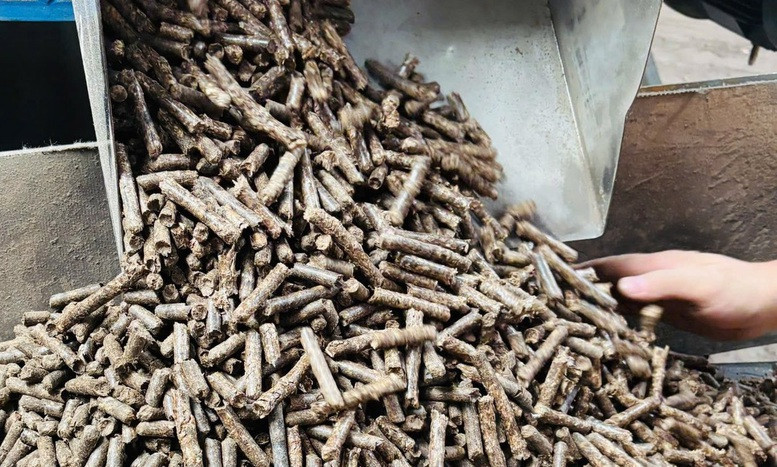
Most acacia timber still goes into woodchips and pellets
Vietnam's forestry sector has made remarkable progress over the past three decades, Deputy Minister of Agriculture and Environment Nguyen Quoc Tri said at a forum on sustainable acacia plantations and the development of a high-value timber industry on October 8.
The forum was held as part of the IUFRO Acacia 2026 international conference.
By the end of 2025, Vietnam's total forest area had reached nearly 15 million hectares, with forest cover standing at 42.03%.
Acacia plantations account for approximately 2.5 million hectares, representing 60% of the country's production plantation forests.
Tri said these plantations provide a vital source of raw materials for Vietnam's wood-processing industry, helping drive exports of timber and forest products to more than $18 billion in 2025, with the figure projected to approach $20 billion in 2026.
Acacia forests also support the livelihoods of around 1.5 million households nationwide.
"Improving the efficiency of acacia plantations is therefore not just a matter for the forestry sector. It directly affects household incomes, business competitiveness and the added value generated by the entire wood industry," he said.
Despite these achievements, considerable potential remains untapped.
According to Tri, 80% of harvested acacia timber is still used to produce woodchips and wood pellets, both relatively low-value products.
Meanwhile, the proportion of large-diameter timber used for furniture manufacturing, advanced wood processing and other higher-value market segments remains modest.
Nguyen Quoc Khanh, chairman of the Vietnam Timber and Forest Products Association (VIFOREST), said Vietnam has the world's largest area of acacia plantations, with approximately 80% managed by individual households.
"Yet we face a paradox. We possess an enormous resource, but the value we generate from it remains far below its potential. A very large share of harvested plantation timber still ends up as woodchips and small-diameter wood," Khanh said.
He argued that the central question should no longer be simply how to plant more acacia trees.
Instead, Vietnam needs to find ways to generate greater and more sustainable value from every hectare of plantation forest and every cubic meter of acacia timber.
Turning acacia into furniture and higher-value products
According to Khanh, encouraging forest growers to extend harvesting cycles and produce larger-diameter timber requires more than simply persuading them to wait a few extra years before cutting their trees.
The key is to establish an economic model that enables forest owners to maintain longer growing cycles while still securing adequate financial returns.
This would require financing solutions suited to long-term forestry investments, forest protection and insurance mechanisms, lasting partnerships between wood-processing companies and forest owners, forest certification, carbon-related mechanisms and, most importantly, a market willing to pay fair prices for larger timber.
Khanh stressed that the greatest economic value of acacia does not come from the forest itself but is created further along the value chain.
Vietnam's acacia development strategy must therefore cover every stage, from seedling selection and plantation management to wood processing, materials development, product design, manufacturing, branding and international marketing.
The timber industry also needs to accelerate its shift away from exporting woodchips toward higher-value products, including veneer, plywood, medium-density fiberboard (MDF), particleboard, engineered wood, laminated timber, structural components, furniture and products with greater design content.
Three areas deserve particular attention: design, marketing and sustainability.
The VIFOREST chairman said that advances in materials science, technology, design and manufacturing could transform Vietnamese acacia into finished products such as tables, chairs and other furniture.
These could eventually become branded products found in hotels, apartments and households around the world.
But as international markets place increasingly strict requirements on product origin and sustainability, environmental, social and governance (ESG) standards are becoming more than a matter of corporate social responsibility.
They are increasingly a condition for market access and an important factor in building brand value.
Khanh believes this shift also presents an opportunity to establish a new identity for Vietnamese Acacia.
The ambition should extend beyond simply selling furniture made from acacia wood.
Instead, Vietnam should gradually establish Vietnamese Acacia as a recognizable material in international markets, valued for its traceable origins, renewability, responsible forest management, standardized production and quality design.
Tri said Vietnam would continue prioritizing resources for research, breeding and the introduction of tree varieties offering higher productivity, better timber quality and stronger resistance to adverse conditions.
The country will also improve technical procedures for planting, tending and converting production forests toward the cultivation of large-diameter timber.
At the same time, the Ministry of Agriculture and Environment will accelerate the transfer of technological advances into forestry production, with particular attention to small-scale forest owners.
Further efforts will focus on strengthening forest management capabilities, improving timber traceability, ensuring compliance with legal timber requirements and expanding sustainable forest management certification.
The ministry will also encourage closer links between timber-growing regions and processing facilities to improve efficiency throughout the value chain.
Tam An
.svg)
