 Vietnamnet.vn

 Podcast


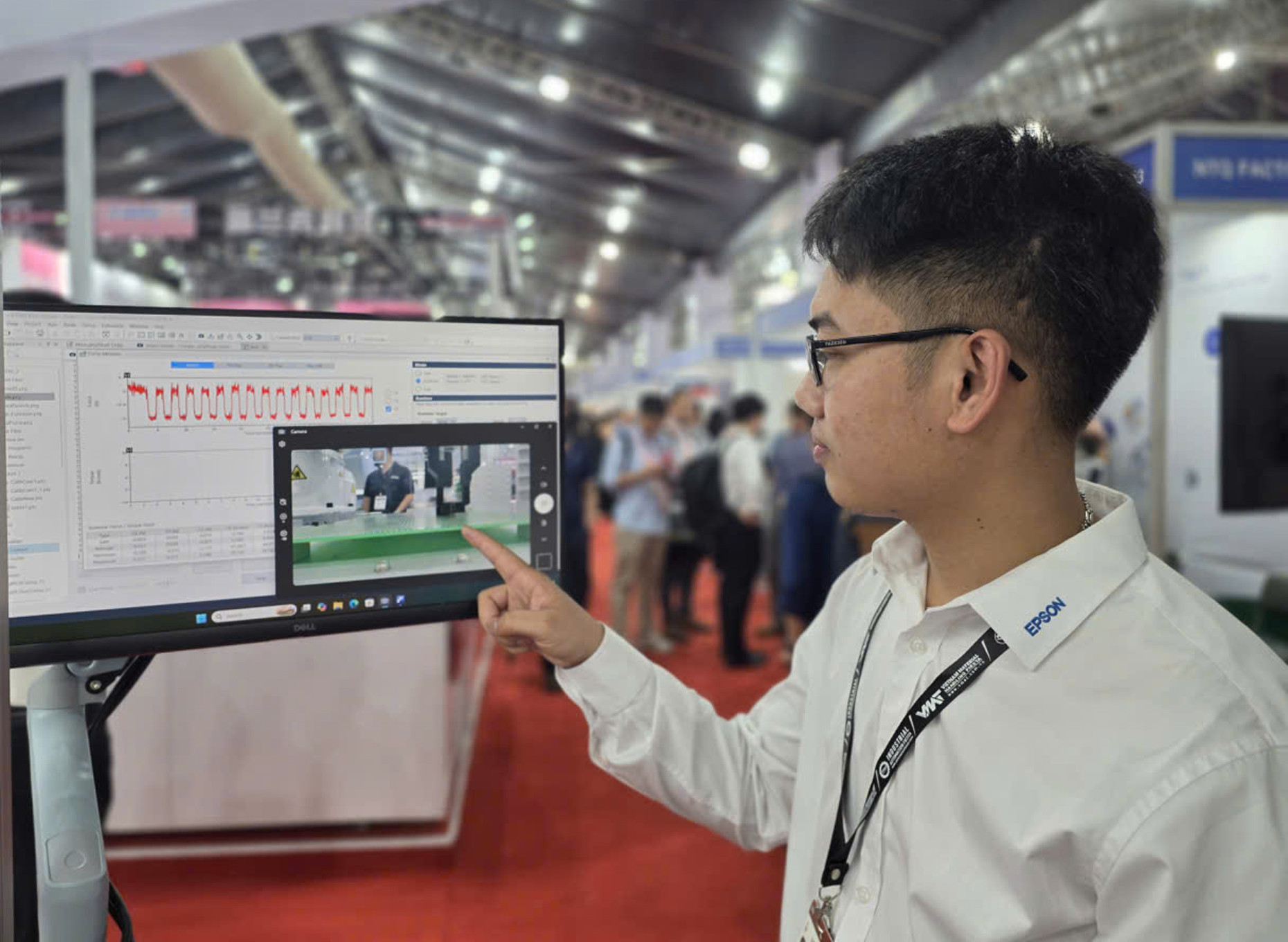
The World Robotics 2026 report, published by the International Federation of Robotics (IFR) on 24 September 2026, said the number of industrial robots in operation worldwide reached a record high of 5 million units, an increase of 9 percent in 2025.
This figure has doubled compared to seven years ago, reflecting the rapid pace of automation in the industrial manufacturing sector.
Jane Heffner, President of the International Federation of Robotics (IFR), noted that industrial automation is expanding rapidly worldwide, with Asia leading global growth ahead of the Americas and Europe.
Within this regional surge, the Vietnam industrial robot market has emerged as Southeast Asia's fastest-growing destination, propelled by manufacturing facilities relocating from China.
At the VIAF Bac Ninh 2026 Automation Exhibition, Epson demonstrated force-sensing technology that enables robots to perform delicate operations with human-like precision when handling fragile components or carrying out tasks that require a high degree of accuracy.
The company also showcased its proprietary Gyroplus technology, allowing robots to start and stop smoothly even at high operating speeds.
In terms of products, Epson is stepping up the introduction of its SCARA and six-axis robot generations, featuring improvements in payload capacity and design.
Some of the new robot models can handle payloads of up to 50kg, while their compact designs make them easier to integrate into different production environments.
Ken Nyi Lau, Epson's Southeast Asia regional product manager, said Vietnam is currently the region's fastest-growing market for robot sales.
The main growth driver is the trend of manufacturing facilities relocating from China to Vietnam and other Southeast Asian countries.
“Vietnam, alongside several regional neighbors, is absorbing a wave of manufacturing relocations from China, representing the core customer segment Epson targets right now,” Lau explained.
Relocating manufacturers account for the majority of Epson's robotics revenue in Vietnam today. Most clients operate in electrical and electronic component assembly, followed by automotive manufacturing, food processing, and packaging sectors requiring automation to boost productivity, ensure quality control, and optimize operating costs.
Epson representatives noted that ongoing supply chain diversification leaves substantial room for expansion in the Vietnam industrial robot market over coming years.
Lau highlighted Epson's competitive strengths in durability, precision, compact design, and operational reliability, supported by specialized engineering services tailored to both domestic enterprises and foreign-invested (FDI) manufacturers.
These businesses require high automation and specialized technical support to meet the specific demands of their manufacturing operations.
Automotive, medical and pharmaceutical sectors
Although the electrical and electronics industries currently account for the largest share of Epson's robot applications in Vietnam, the company aims to expand into other manufacturing sectors.
According to Lau, along with electrical and electronics manufacturing, Epson wants to develop its customer base in the automotive, medical, pharmaceutical, healthcare, and food and beverage (F&B) sectors.
SCARA robots are expected to find broader applications in the medical and pharmaceutical industries because of their ability to perform repetitive tasks with a high degree of precision.
Six-axis robots are designed for automotive applications and manufacturing processes that require greater flexibility.
While FDI companies often invest in automation from the outset, Epson has observed that an increasing number of domestic businesses are also beginning to consider using robots into their factories.
However, these companies face the challenge that many of their production facilities have been operating for years with older production lines.
Replacing all existing equipment to move toward automation can require substantial investment and disrupt operations.
However, companies do not necessarily need to replace their entire production lines. Instead, they can opt for partial automation, starting with processes that are suitable for it.
Integrating robots into existing production lines is not particularly complicated if companies identify which tasks need to be automated and select suitable equipment.
Nevertheless, the biggest barriers remain companies' awareness, financial resources and workforce capacity.
"I believe the biggest challenge for Vietnamese businesses is helping them recognize the importance of automation. This also requires efforts from various stakeholders, including financial support, so that companies can feel confident about making the transition to automation," Lau said.
The Epson representative cited developments in Thailand and Indonesia, where many factories are stepping up automation to reduce labor costs and maintain product quality.
Thai Khang

