 Vietnamnet.vn

 Podcast



Vietnam's National Center for Hydro-Meteorological Forecasting (NCHMF) is closely monitoring Super Typhoon Bavi, warning that although the storm is currently not expected to enter the East Sea, its extensive circulation could generate strong winds, high waves and rough seas across much of the region later this week.
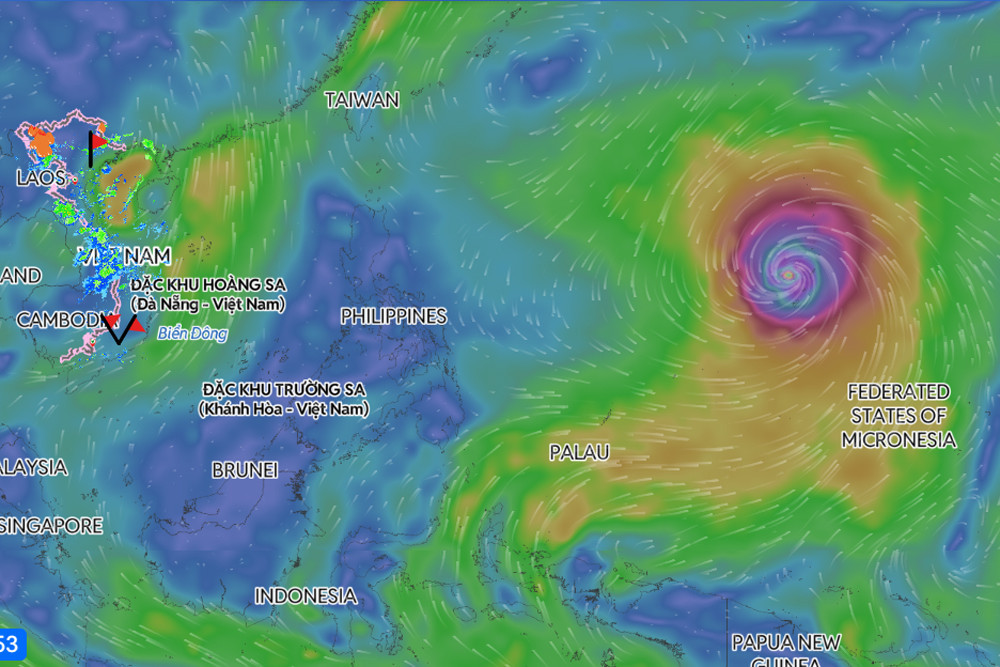
As of the morning of July 6, the center of Super Typhoon Bavi was located more than 2,000 kilometers east of the central Philippines. The storm had maintained Category 17 intensity, the highest level on Vietnam's Beaufort wind scale, with gusts exceeding Category 17.
Forecast models and assessments from international meteorological agencies indicate that over the next 24 hours the storm will continue moving west-northwest at an average speed of about 20 kilometers per hour.
Between July 6 and July 9, Bavi is forecast to retain super typhoon strength while maintaining its west-northwest track. Around July 10, the storm is expected to gradually turn northwest toward the area north of Taiwan (China).
Based on current forecasts, meteorologists say there are no indications that Bavi will move into the East Sea. Current forecast scenarios estimate the probability of such a track at below 10 percent.
Despite the low likelihood of direct entry, the storm's enormous circulation is expected to influence weather over the East Sea. Forecasters warn that the storm's circulation and its wind-enhancing effect could strengthen the southwest monsoon beginning around July 9.
From July 9 to July 11, strong southwesterly winds of Force 6-7 are forecast across the northern, central and southern parts of the East Sea, including waters surrounding the Hoang Sa (Paracel) and Truong Sa (Spratly) archipelagos.
Wave heights are expected to reach 3-5 meters, creating very rough sea conditions that could pose risks to vessels operating across the region.
Bavi is the third super typhoon to develop over the northwestern Pacific this year, following Sinlaku and Mekkhala.
Satellite imagery shows a well-defined circular eye surrounded by highly symmetrical and dense cloud bands, indicating an exceptionally powerful tropical cyclone.
According to climate and disaster risk expert Dr. Nguyen Ngoc Huy, forecast models including GFS and ICON currently indicate that Bavi is more likely to approach Taiwan (China) around July 10-11 before moving into mainland China between July 12 and July 14.
However, experts caution that the storm's track remains subject to change. Should the subtropical high over the Sea of Japan shift farther south, Bavi's trajectory could alter, potentially bringing it closer to the East Sea.
The National Center for Hydro-Meteorological Forecasting said it will continue closely monitoring the development of Super Typhoon Bavi and provide updated forecasts and warnings as the situation evolves.
Maysak weakens after affecting northern Vietnam
While attention has shifted to Bavi, Tropical Storm Maysak, designated as Storm No. 1 in Vietnam's 2026 typhoon season, weakened into a tropical depression after moving inland over southern Guangxi Province, China.
Before weakening, Maysak lingered for several hours near Mong Cai in Quang Ninh Province, bringing sustained winds of Force 9 with gusts reaching Force 12.
The system is forecast to continue weakening into a low-pressure area and is no longer expected to directly affect Vietnam.
Nevertheless, strong winds and high waves continued over the northern Gulf of Tonkin immediately after the storm, prompting authorities to advise fishermen and maritime operators to closely monitor official weather warnings.
Heavy rain and flooding continue across northern Vietnam
Although Maysak has weakened, its residual circulation has continued to bring heavy rainfall across parts of northern Vietnam.
Rainfall exceeding 70 millimeters was recorded in several locations, with some mountainous areas forecast to receive more than 130 millimeters within a short period, raising the risk of flash floods and landslides.
From the evening of July 5 through July 6, moderate to heavy rain was forecast for Lai Chau, Dien Bien, Son La, Lao Cai and Tuyen Quang provinces. Elsewhere across northern Vietnam, Thanh Hoa, Nghe An, the Central Highlands and southern Vietnam, scattered thunderstorms with locally heavy rain were expected.
Authorities warned of possible tornadoes, lightning, hail and strong wind gusts during thunderstorms.
River levels across northern Vietnam are also expected to rise sharply. Water levels on smaller rivers and the upper reaches of major river systems could increase by 2-4 meters, with flood warnings reaching Alert Levels 1 and 2 in some locations.
Vietnam's National Civil Defense Steering Committee instructed authorities in Tuyen Quang, Phu Tho, Cao Bang, Lang Son, Quang Ninh, Thai Nguyen, Hanoi and Bac Ninh to prepare flood response measures, monitor river levels, relocate residents if necessary and strengthen embankment protection.
Quang Ninh accelerates recovery after Maysak
In Quang Ninh Province, local authorities continued recovery operations after Maysak caused widespread damage in Mong Cai.
Numerous trees were uprooted, roofing sheets were blown onto roads and floodwaters from the Ka Long River inundated riverside walkways.
Provincial Party Secretary Quan Minh Cuong ordered authorities to verify reports that three fishermen remained missing after the storm and instructed military forces to mobilize boats and equipment to search affected waters.
He also directed emergency crews to recover drifting fishing vessels, restore electricity, clear roads blocked by fallen trees and help residents resume normal activities as quickly as possible.
Local police are also working to identify the body of a man found drifting near Mong Cai's coastline on July 5.
Provincial officials stressed that protecting lives remains the highest priority while emergency response teams continue monitoring weather conditions and carrying out recovery work.
Bao Anh - Pham Cong
.svg)
