 Vietnamnet.vn

 Podcast



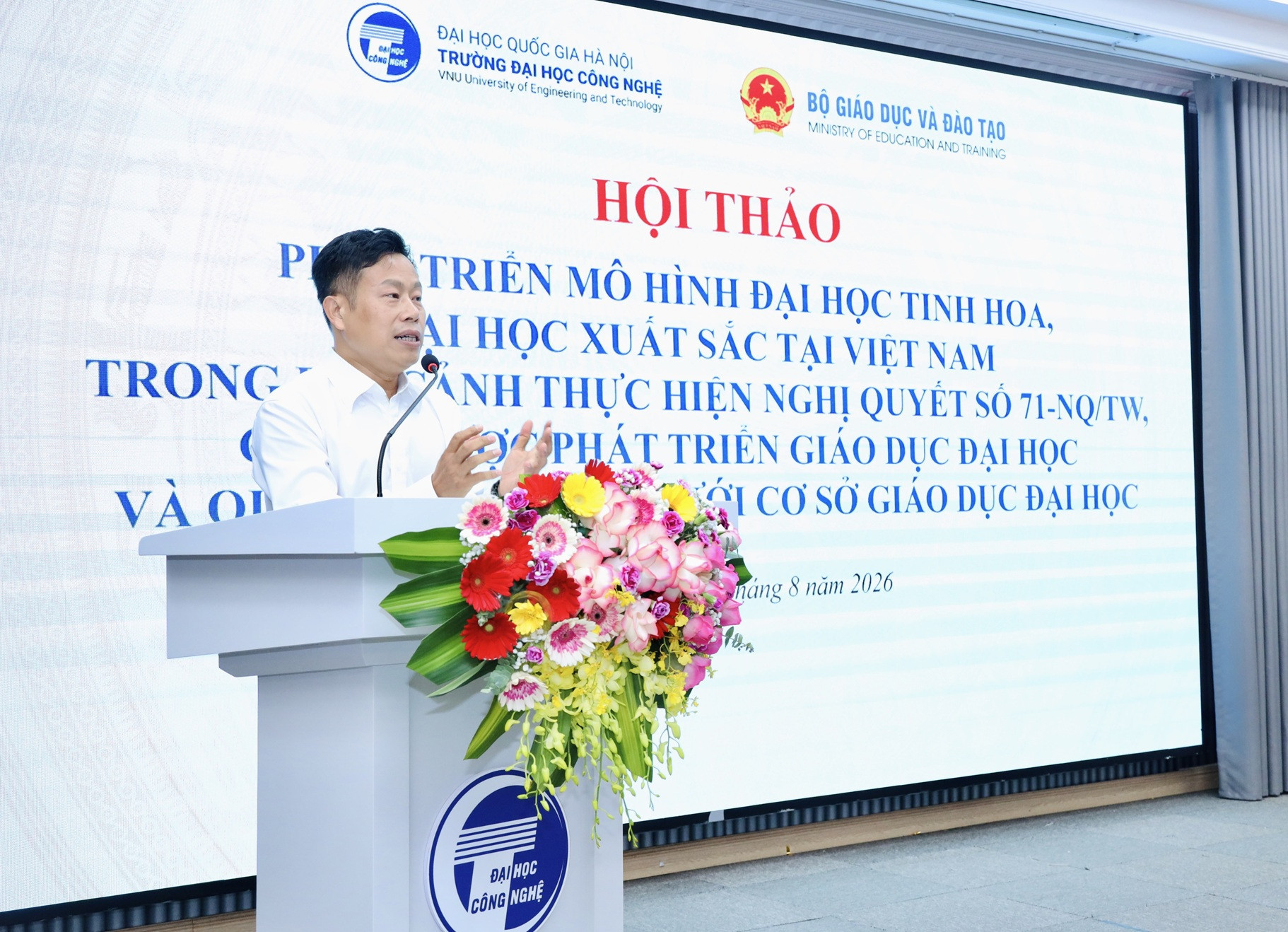
Quan emphasized the need to improve quality and establish clearer tiers within higher education, with the goal of developing elite and excellent institutions that reflect each university’s mission and capabilities.
The Ministry of Education and Training also said Vietnam plans to develop three to five elite universities to help advance national strategy, with some expected to play a leading role across the higher education system.
Professor Chu Duc Trinh, Rector of the University of Engineering and Technology under Vietnam National University, Hanoi, said building an elite university requires not only a commitment to quality but also a sense of responsibility to the nation.
“If there is no responsibility to the country, and only responsibility to one’s own university or oneself, it simply will not work,” Trinh said.
He argued that few universities currently take full responsibility for the outcomes of their education.
“When students graduate and cannot find jobs, or work for a few years and then leave their jobs, we do not see much commitment from universities. We need to stay engaged with those outcomes because they reflect the reputation of each institution,” Trinh said.
He added that an elite university must not only educate talented people but also create new knowledge -something he believes Vietnamese universities have yet to achieve.
According to Trinh, Vietnamese universities have also failed to make a significant mark in the development of strategic technologies. No institution has truly taken the lead in setting standards or building new ecosystems. Most, he said, still focus primarily on recruiting students, providing four years of education and awarding degrees.
Universities, he argued, need to “dream big.” “Our universities have not dreamed big enough. They need great ambitions and a national mission. We certainly need elite universities, but the question is how to build them,” Trinh said.
In his view, elite universities cannot emerge without investment and greater autonomy. Changes will therefore be necessary in the period ahead.
“A university recognized as elite and given greater authority must also ask itself what it can contribute to the country. That is not an easy question,” he said.
Universities still heavily focused on attracting students
According to Trinh, most universities remain heavily focused on enrollment, with some going to considerable lengths to attract students.
He said institutions that continue expanding across multiple disciplines and fields could aim to become key universities. But to become truly elite, they would need to identify areas in which they have the potential to lead and even be prepared to discontinue fields that offer no clear competitive advantage.
Presenting an overview of Vietnam’s higher education development strategy, Professor Nguyen Tien Thao, Director General of the Higher Education Department under the Ministry of Education and Training, said the list of universities designated as elite is not expected to be permanent. Instead, it could be reviewed and adjusted annually based on the development of each institution.
For faculty at elite universities, the proposed approach would not require institutions to follow common ratios for lecturers holding doctoral or master’s degrees. Instead, the focus would be on bringing together talent from across Vietnam and potentially turning these universities into destinations for scientists from around the world.
According to Thao, the guiding principle for elite universities is to “shift from administrative governance to mission-driven governance.”
Deputy Minister Le Quan said that following the workshop, the ministry would need to draft a set of criteria for screening and selecting higher education institutions for key and elite groups.
“On that basis, higher education institutions will apply. The foundation of excellence is having universities that can lead. And leadership does not mean leading in every single field,” Quan said.
He added that becoming an “elite” university should not be understood as requiring an institution to meet every criterion without exception.
“Elite higher education is not the responsibility of one or two institutions while the rest of the sector stands by and watches. Our strategy this time calls for three to five elite universities, but the country needs more than that,” Quan said.
Thanh Hung
.svg)
