 Vietnamnet.vn

 Podcast



The Ministry of Finance has submitted a revised proposal to the government offering substantial reductions in administrative penalties for household businesses and other taxpayers seeking to resolve outstanding tax registration issues.
The proposal forms part of a draft government resolution introducing special measures to address difficulties faced by taxpayers that have ceased operations but have not completed procedures to deactivate their tax identification numbers.
The measures also cover taxpayers classified as no longer operating at their registered business addresses.
Proposed penalty reduction raised from 50% to 85%
Following consultations on the draft resolution, the Ministry of Finance revised several provisions, including a more generous penalty reduction for household businesses using the tax declaration method.
Under the revised proposal, eligible household businesses and individual entrepreneurs would pay just 15% of the normally applicable administrative fines, equivalent to an 85% reduction.
The initial draft had proposed a 50% reduction.
To qualify, taxpayers must submit all outstanding tax returns and required invoice-related notices and reports.
The reduced penalties would apply to violations involving late submission of tax declarations and breaches of regulations governing the preparation and submission of invoice-related documents.
The relevant penalties are prescribed under Articles 13 and 29 of Decree No. 125/2020/ND-CP and its subsequent amendments.
The proposed policy would take effect on November 21, 2026, and remain in force until June 30, 2028.
The resolution primarily targets taxpayers whose tax identification numbers are classified under status 03, indicating that business operations have ceased but tax registration termination procedures remain incomplete, or status 06, indicating that the taxpayer is no longer operating at the registered address.
For household businesses and individuals previously subject to the presumptive tax method, the draft proposes waiving penalties for tax procedural violations.
Businesses offered phased penalty reductions
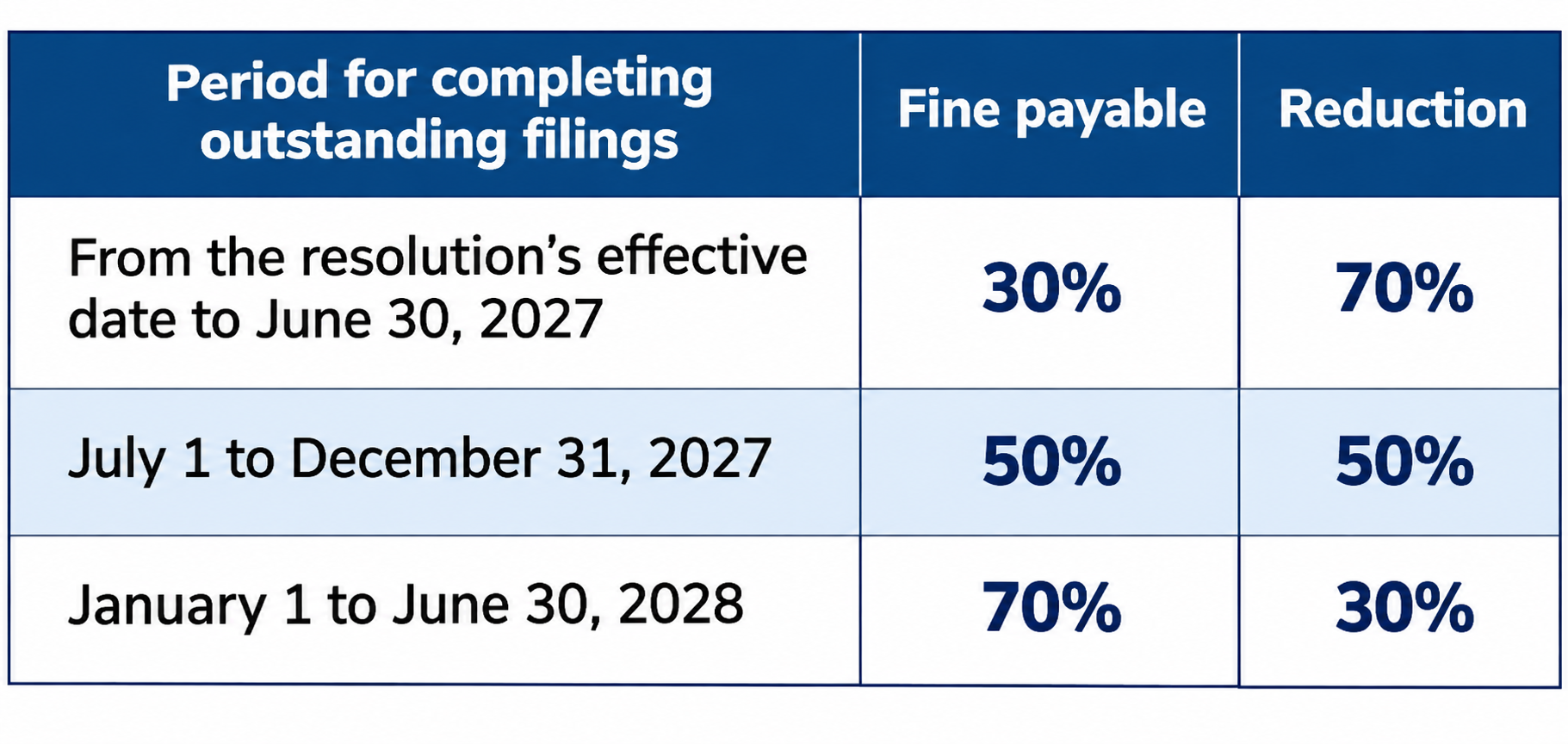
The draft resolution also introduces penalty reductions for enterprises and organisations that submit all outstanding tax declarations.
Unlike the proposed flat 85% reduction for household businesses using the declaration method, the reductions for enterprises and organisations would depend on when they complete their documentation.
The phased approach is intended to encourage businesses to resolve outstanding tax obligations promptly, with greater reductions available to those completing the required procedures earlier.
Ministry of Justice questions basis for special treatment
During consultations, the Ministry of Justice requested clarification of the legal grounds for exempting all household businesses and individual entrepreneurs using the presumptive tax method from penalties for tax procedural violations.
It noted that Clause 4, Article 9 of Decree No. 125/2020/ND-CP provides an exemption only for household businesses and individuals subject to tax assessments under Article 51 of the Law on Tax Administration.
The ministry also raised concerns about the separate penalty treatment proposed for household businesses using the declaration method.
Under the earlier draft, these taxpayers would have paid 50% of the penalty specified in the relevant provision, potentially resulting in lower fines than those imposed on other taxpayer groups.
However, the draft did not clearly explain the legal and practical justification for the difference or how the reduction would apply across subsequent implementation periods.
The Ministry of Justice therefore requested a clearer explanation of the proposed preferential treatment.
Finance Ministry explains rationale for reduced fines
In response, the Ministry of Finance said the proposed exemption for taxpayers previously using the presumptive tax method was designed to resolve outstanding procedural issues arising under the former tax administration system.
Under that system, tax authorities determined taxpayers' obligations rather than relying entirely on the self-declaration and self-assessment mechanisms used under the declaration method.
The ministry argued that this distinction justified special treatment for procedural violations associated with the former system.
The proposed exemption would encourage affected taxpayers to contact tax authorities, update their registration information, complete outstanding documentation and either restore or terminate their tax identification numbers.
However, the ministry stressed that exemption from procedural penalties would not mean exemption from outstanding tax liabilities.
Taxpayers would remain responsible for paying taxes owed and could still face penalties for fraud, concealing revenue, tax evasion and other violations subject to enforcement under the law.
The drafting agency also noted that Law on Tax Administration No. 38/2019/QH14 ceased to be effective on July 1, 2026.
As a result, provisions in Decree No. 125/2020/ND-CP referring to Article 51 of that law must be considered in relation to taxpayers previously subject to the presumptive tax system.
These provisions mainly concern tax obligations arising before 2026 and cannot automatically be extended to tax periods beginning in 2026.
Simplified penalty framework aims to encourage compliance
Regarding household businesses using the declaration method, the Ministry of Finance explained that these taxpayers differ from larger enterprises in operational scale, resources and their ability to comply with accounting and invoicing requirements.
The ministry initially proposed reducing their penalties to 50% of the standard amount.
However, after reviewing the Ministry of Justice's comments, it increased the proposed reduction to 85%, meaning eligible taxpayers would pay only 15% of the normal fine.
The revised approach also replaces the earlier arrangement with a single penalty rate for eligible household businesses.
According to the drafting agency, applying a uniform rate would make the policy simpler, clearer and easier to implement.
The ministry expects the measure to encourage household businesses and individual entrepreneurs to complete missing tax filings and resolve outstanding registration procedures.
If approved, the resolution would provide temporary relief for eligible taxpayers while helping tax authorities address unresolved tax identification numbers and improve compliance with registration requirements.
Nguyen Le

