 Vietnamnet.vn

 Podcast



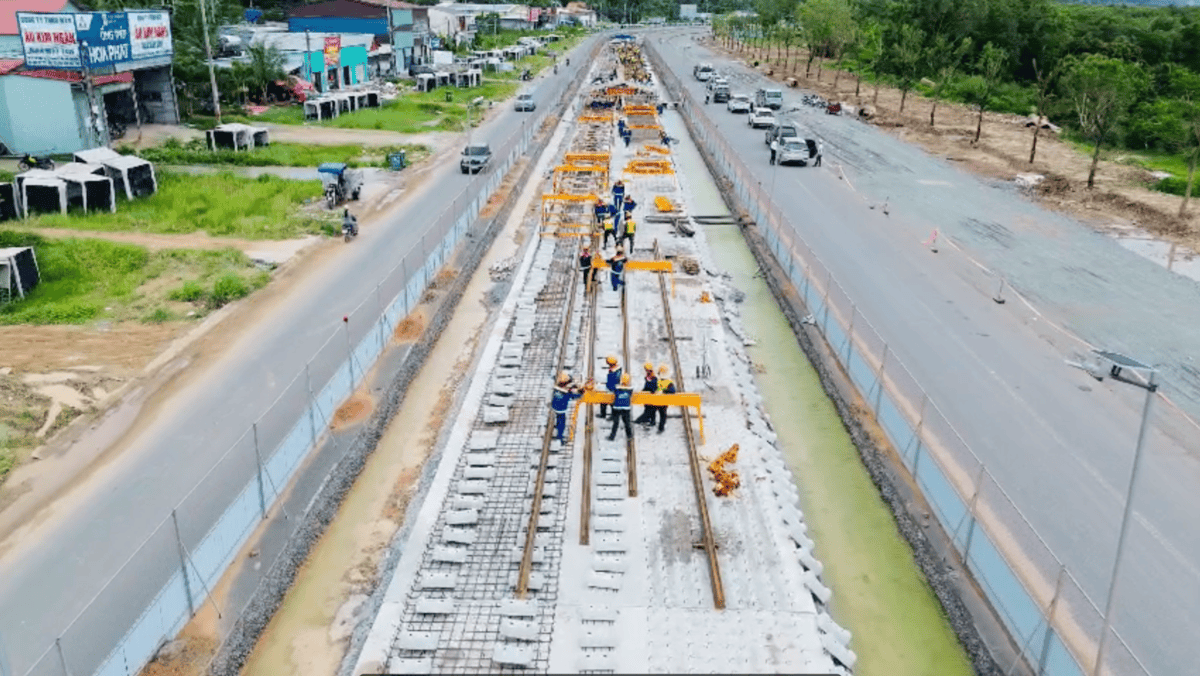
The bigger challenges lie in site clearance, weather conditions and the requirement to complete key components in time to serve APEC 2027.
The 17.59km Phu Quoc LRT, which has a total investment of nearly VND9 trillion, will connect Phu Quoc International Airport with the APEC Conference Center. The line will use electric trains on the standard 1,435mm gauge, including 14.81km at ground level, 0.78km on elevated sections and 2km underground through the APEC core area.
The rail system uses 60R2 grooved rails, 180mm high, with each rail measuring 25m in length. VRC and China CRCC16 are implementing the package covering the supply, installation, construction and calibration of the rail system.
According to the chair of the Vietnam Railways Corporation (VRC), Dang Sy Manh, this is the first time the railway sector has directly undertaken the construction of an LRT line under current conditions. However, the project's main works are not particularly new to the railway sector.
"Reinforced concrete, structural launching, rail laying, and rail welding are all tasks in which the railway industry has execution experience," Manh said.
Vietnam Railways has previously participated in urban rail projects such as Cat Linh - Ha Dong and Ben Thanh - Suoi Tien, while sending officials, engineers, and workers to study and research technologies domestically and abroad.
According to the Vietnam Railways Chair, the Phu Quoc LRT presents no technological hurdles. It remains track-bound railway technology. Despite stringent technical demands, construction items undergo step-by-step execution, inspection, and acceptance. Based on actual site observations, consultancy units commended the construction organization and quality control.
Beyond construction and installation, Vietnam Railways has operational and management experience. Therefore, partnering with the investor to bring the project into early operation offers distinct advantages.
Under design specifications, the Phu Quoc LRT line can operate up to 14 train sets. In Phase 1, local authorities and investors plan to operate 6 to 10 train sets, each consisting of 3 carriages using clean energy.
The entire line holds transport capacity for 4,500 passengers per hour. Upon completion, travel time from Phu Quoc Airport to the APEC Convention and Exhibition Center and resorts in the southern part of the island would fall to roughly 20 minutes.
Race against time
For the Phu Quoc LRT, the primary challenge lies not in technology, but in a race against time. A massive volume of work requires completion before February 2027, while remaining time frames are narrow.
Dang Sy Manh said site clearance and weather factors directly impact the progress. "The challenge here is handing over clean site areas to contractors, coupled with erratic weather and climate conditions at times," he noted.
Under these conditions, Vietnam Railways must adhere closely to critical paths, organizing construction fronts and coordinating resources to avoid passivity against unexpected site developments.
Dinh Ba Long, chief commander of the Phu Quoc LRT track installation front, noted that track installation items alone require completion before March 2027 for handover to the investor for trial runs.
Consequently, construction teams maintain three to four shifts daily, capitalizing on favorable weather windows to accelerate track laying. During rainfall, engineers and workers erect mobile rain shelters to sustain work.
"This imposes significant pressure, but also carries honor. As a project serving APEC, everyone recognizes the need to make utmost efforts to finish their assigned tasks," Long shared.
Test bed for urban rail
Dang Sy Manh said the Phu Quoc LRT functions not only as a project serving APEC 2027, but also as an opportunity for Vietnam Railways to accumulate experience executing future urban rail projects.
Experience lies not merely in rail laying or welding techniques, but in organizing high-urgency construction sites, mobilizing multiple units, and coordinating manpower and equipment across key tasks.
"This serves as a step to affirm that Vietnam Railways can deliver projects of this scale and potentially higher-tech developments, such as urban rail projects in major cities, including light rail systems," Manh said.
Vu Diep
.svg)
