 Vietnamnet.vn

 Podcast



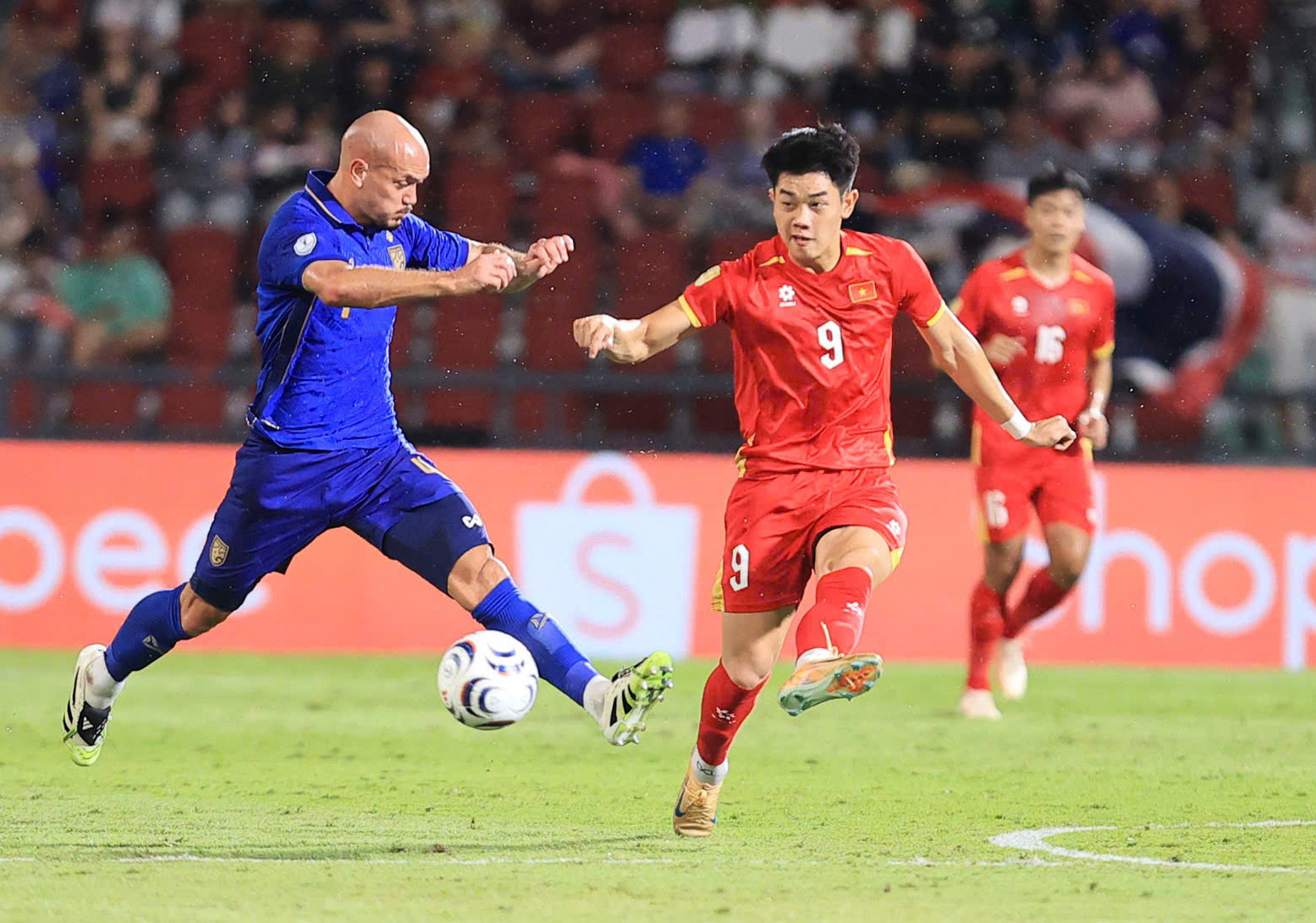
"We remain fully focused on winning the trophy when we play in Vietnam," the Thailand coach said. "The biggest challenge for us is our current physical condition. The players have to recover quickly."
Thailand's fatigue was increasingly visible as the first leg developed.
Vietnam survived a difficult opening half before growing into the contest and eventually striking twice after the break.
The contrast between the two squads could become even more significant in Hanoi.
Kim has used Vietnam's depth throughout the tournament, repeatedly changing his starting XI and preserving key players for different stages of matches.
Apart from the group-stage match against Singapore, when he retained the lineup from the opening victory over Timor-Leste, Kim has regularly rotated his team, at times changing as much as half of his starting XI.
That approach has given Vietnam fresh legs for decisive periods.
Nguyen Xuan Son's role in Bangkok was a good example.
Although the striker did not score, he continually battled Thailand's defenders, forcing them into physical contests and draining their energy.
Once Thailand began to tire, Kim introduced Quang Hai and Hai Long.
The impact was immediate.
For the opening goal, Dinh Bac accelerated into the danger area before producing a clever backheel that removed Thailand's defenders from the move and gave Hai Long the opportunity to finish.
The second came from another rapid transition. A long ball moved the attack toward the flank before Do Hoang Hen supplied Quang Hai, whose superb volley doubled Vietnam's advantage.
Both goals combined individual quality with attacking patterns that had clearly been prepared.
They also exposed the same problem for Thailand: defenders struggling to keep pace once fatigue had accumulated.
The running figures underline the physical demands of the first leg.
Chaiyaphon Otton covered the most ground for Thailand at 10.4 kilometres, followed by Kakana Khamyok with 10.1km. Manuel Bihr and Sarach Yooyen each recorded 9.2km, while Waris Choolthong covered 9.1km.
Vietnam will now face an opponent required to chase the game from the opening whistle.
That could play directly into Kim's hands.
With a 2-0 advantage, Vietnam do not need to attack recklessly. Thailand, by contrast, need goals and will have to commit players forward, potentially increasing both their physical workload and the spaces available for counterattacks.
Xuan Son could again be used to occupy and wear down Thailand's defence before Kim turns to his bench.
Dinh Bac, Doan Van Hau, Truong Tien Anh and Nguyen Van Vi offer further energy, while Hai Long and Quang Hai have already demonstrated how dangerous Vietnam's substitutes can become against tired opponents.
Vietnam must still guard against complacency. Thailand created enough opportunities in Bangkok to show they remain dangerous, particularly if the hosts concede early.
But the deeper the game goes, the greater Vietnam's physical advantage could become.
At Rajamangala, patience and fresh legs helped turn an even contest into a 2-0 victory.
At My Dinh, the same formula could deliver something far more valuable: the ASEAN Cup trophy.
Dai Nam
.svg)
