 Vietnamnet.vn

 Podcast



Landmark infrastructure shaping a new development axis
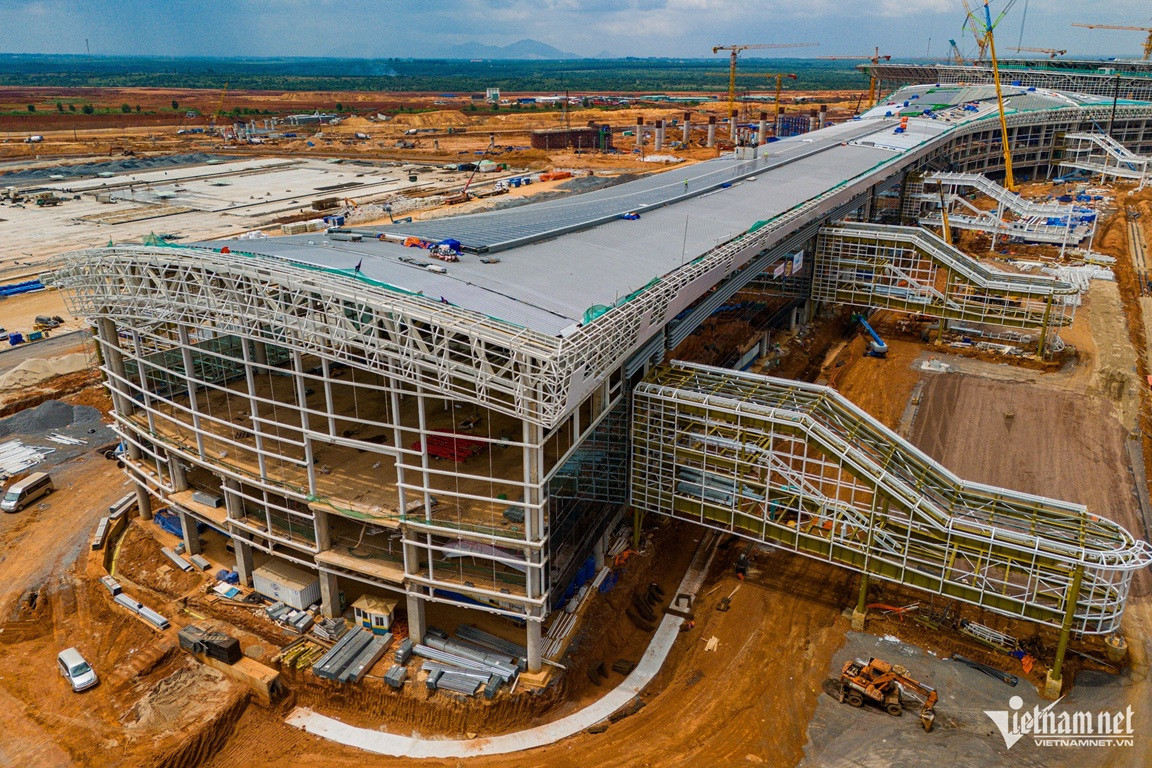
One of the most defining achievements of this period was the acceleration of airport infrastructure investment, with Long Thanh International Airport in Dong Nai emerging as a flagship project - arguably the most important aviation infrastructure development in Vietnam in decades.
Designed to ICAO 4F standards, Long Thanh is set to handle over 100 million passengers annually. It is envisioned as a future regional aviation hub for Southeast Asia. On December 19, 2025, the project’s main components were technically inaugurated, welcoming its first flights - laying a critical foundation for commercial operations from 2026 onward.
Meanwhile, Gia Binh International Airport in Bac Ninh represents a novel dual-use planning model that integrates economic development with national defense and security.
Located in the heart of northern Vietnam’s electronics manufacturing belt, Gia Binh is designed to serve as an air logistics hub for high-value cargo such as chips and electronic components, relieving pressure on Noi Bai International Airport. With ICAO 4F specifications, a planned capacity of 50 million passengers annually, and four runways, Gia Binh is considered a strategic link in the restructuring of the Hanoi Capital Region’s airport network.
According to Minister of Construction Tran Hong Minh, the investment in Gia Binh is a strategic move, laying the groundwork for an airport cluster model that enhances operational capacity and regional connectivity.
In tandem with new projects, existing airports also underwent major upgrades. Tan Son Nhat’s Terminal T3 began operations in April 2025, raising the airport’s total capacity to around 50 million passengers annually.
In the north, Noi Bai International Airport continued expanding its Terminal T2. After upgrades, the terminal’s floor area surpassed 200,000 square meters, increasing its capacity from 10 to 15 million passengers annually, with a peak service capacity of about 18 million.
Several regional airports - including Phu Quoc, Phu Bai, Vinh, Phan Thiet, Tuy Hoa, Pleiku, and Buon Ma Thuot - also advanced under the 2030 development plan, expanding Vietnam’s flight network and stimulating regional socio-economic growth.
Fleet expansion and robust market recovery
Alongside infrastructure breakthroughs, Vietnam’s commercial aircraft fleet expanded rapidly. By mid-2025, the total number of operational aircraft reached approximately 254, a significant increase since the beginning of the term.
The 2021–2025 period also witnessed a strong recovery and impressive growth in air travel. In 2025 alone, the industry carried 83.5 million passengers, up 10.7% from the previous year - an all-time high.
International passenger volume reached 46.6 million, up 12%, while cargo throughput rose to approximately 1.3 million tonnes, a 22% increase. Domestic passenger traffic reached 36.9 million, an 8.4% rise, with around 55 routes connecting Hanoi and Ho Chi Minh City to 20 airports nationwide.
Notably, Vietnamese airlines operated 113 international routes in 2025, linking directly to major aviation hubs across Northeast Asia, Southeast Asia, South Asia, Europe, and Oceania.
These results were supported by proactive policy and regulatory coordination. The Civil Aviation Authority of Vietnam streamlined flight permits and resource allocation, helping airlines secure and lease aircraft - especially during peak periods - thus maintaining transport capacity and market stability.
Toward double-digit growth in 2026
According to Ho Minh Tan, Deputy Director General of the Civil Aviation Authority, 2026 is expected to be a pivotal year, bringing fresh growth drivers for Vietnam’s aviation industry.
The National Assembly’s approval of a 10%+ GDP growth target is forecast to boost demand for travel, tourism, and freight. In parallel, amendments to the Civil Aviation Law and new regulatory policies are set to create a more enabling legal framework for market development.
Forecasts suggest that in 2026, Vietnam’s aviation sector could handle about 95 million passengers and over 1.6 million tonnes of cargo - up 13.6% and 9.3%, respectively, compared to 2025.
The Civil Aviation Authority emphasized that, beyond continuing infrastructure investment and speeding up capacity-enhancement projects, airlines will be supported in expanding their fleets and increasing load capacity on both domestic and international routes. Leasing and aircraft purchase models will be diversified, while domestic maintenance capabilities will be strengthened to reduce reliance on external providers.
At the same time, the Authority plans to accelerate international air service negotiations, including new and revised bilateral agreements, to broaden market access and enable efficient utilization of Long Thanh International Airport.
Vu Diep
.svg)
