 Vietnamnet.vn

 Podcast


Vingroup shares defy market downturn as Vuong's fortune soars
Vietnam's stock market declined in the final trading sessions of October, but shares of companies within the Vingroup ecosystem continued to show resilience.
On October 30, Vingroup shares (VIC) closed unchanged at VND 241,000 ($9.13), while the benchmark VN-Index fell 13.99 points, or 0.8%, to 1,741.62.
VIC had previously recorded seven consecutive sessions of gains, including one session when the stock reached its daily trading limit. Since the beginning of the year, the shares have risen more than 42%.
Other Vingroup-related stocks also performed positively. Vinhomes shares (VHM) gained 1.45% to VND 63,000 ($2.39) in the final trading session of the week, bucking the broader market decline. Vinpearl shares (VPL) remained unchanged at VND 90,100 ($3.41).
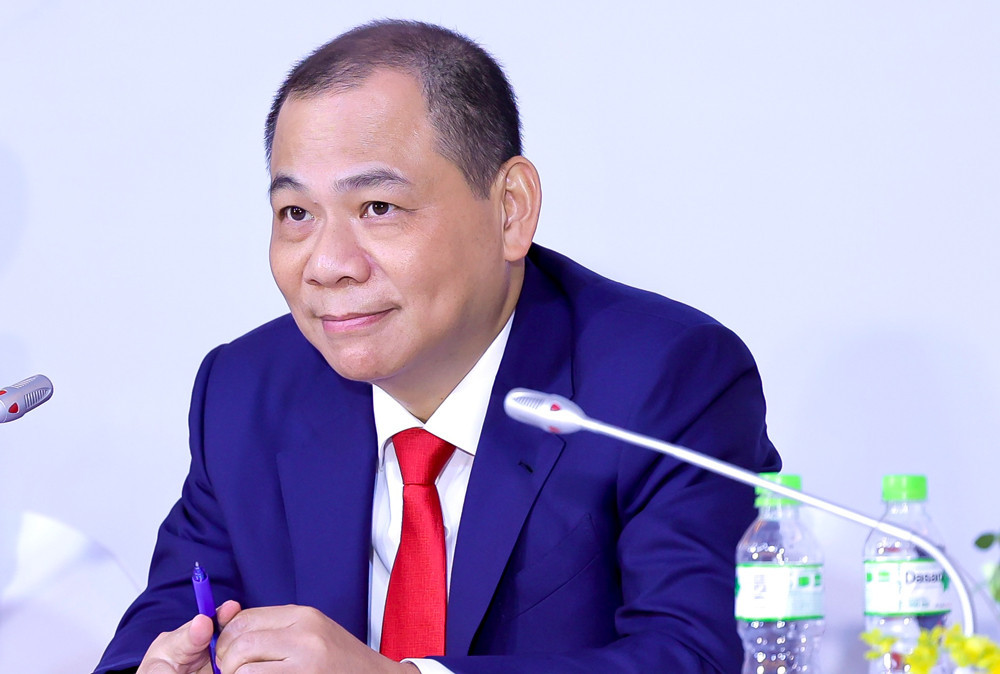
According to Forbes, the net worth of Vietnamese billionaire Pham Nhat Vuong reached an estimated $37.8 billion as of October 31, supported by gains in Vingroup-related stocks.
The founder of Vingroup ranked 59th among the world's richest individuals and remained Southeast Asia's wealthiest person, well ahead of the region's third-richest billionaire, whose fortune stood at nearly $23 billion.
Over the past 18 months, Vuong's wealth has increased nearly tenfold, coinciding with a sharp improvement in the financial performance of companies across his business empire.
Vingroup reported after-tax profit of VND 43.7 trillion ($1.65 billion) in the first nine months of 2026, nearly six times the level recorded a year earlier and equivalent to 125% of its full-year target.
The strong performance was driven primarily by its electric vehicle and real estate businesses.
VinFast delivered 211,242 electric vehicles worldwide during the first nine months of 2026, up 91% year on year.
In Vietnam alone, the automaker delivered 177,697 vehicles, an increase of 71%, maintaining its position as the country's leading automaker by sales volume.
In real estate, Vinhomes posted after-tax profit of VND 75.1 trillion ($2.84 billion), nearly five times the previous year's figure and 25% above its annual target.
Revenue from consolidated operations and business cooperation arrangements reached VND 232.6 trillion ($8.81 billion), representing a 234% increase.
Meanwhile, Vinpearl recorded consolidated net revenue of nearly VND 10.7 trillion ($405 million), up 19% year on year.
Its after-tax profit reached VND 2.829 trillion ($107 million), 6.6 times the previous year's level and equivalent to 94% of its annual target, supported by improved accommodation operations and a recovery in international visitor numbers.
Infrastructure investment opens new growth opportunities
Vingroup and other major Vietnamese conglomerates are expected to benefit from government efforts to accelerate public investment and introduce policies supporting businesses.
Effective November 1, the average retail electricity tariff was reduced by 2% to VND 2,159.9 ($0.082) per kilowatt-hour, excluding value-added tax.
Earlier, the State Bank of Vietnam had instructed credit institutions to reduce lending rates by 1.5-2 percentage points for production, business activities and priority sectors.
Notably, Vietnam's public investment plan for 2026 exceeds VND 1.07 quadrillion ($40.5 billion).
Development investment spending for 2027 is projected to reach VND 1.756 quadrillion ($66.5 billion), an increase of around 57% compared with the 2026 plan.
This substantial flow of public capital is expected to create additional business opportunities for companies operating in construction, building materials and mechanical engineering.
Vingroup is already expanding its presence in infrastructure development.
Its railway subsidiary VinSpeed has partnered with Siemens Mobility to supply 10 trainsets and signaling systems for two railway projects: the Hanoi - Quang Ninh line in northern Vietnam and the Ben Thanh - Can Gio line in Ho Chi Minh City.
A general contracting consortium comprising Vinhomes and SGC has also signed contracts to develop five urban railway lines, numbered 1, 2, 8, 10 and 14, with a combined investment of nearly VND 900 trillion ($34.1 billion), excluding land clearance costs.
In the industrial sector, VinMetal is working with Italy's Danieli to develop production lines for railway steel and structural steel in Ha Tinh province, with planned annual capacity exceeding 700,000 tonnes.
The strategy could strengthen connections between Vingroup's real estate, construction, materials and infrastructure businesses, enabling the group to exercise greater control over supply chains and participate more extensively in the value chains of major projects.
Vinhomes also has substantial potential revenue from properties that have already been sold but not yet handed over to buyers.
As of the end of September 2026, the value of these contracts reached VND 185.6 trillion ($7.03 billion), about 1.7 times the average level recorded during 2021-2025.
By September 30, 2026, Vingroup's total assets had reached approximately VND 1.6 quadrillion ($60.6 billion), up 44.8% from the beginning of the year.
Cash, cash equivalents and short-term financial investments totaled VND 106.8 trillion ($4.05 billion).
Over the preceding 12 months, Vingroup said it had raised more than $2.3 billion through various financing channels, including international bond issuances, preferred shares and syndicated loans.
Diversifying its funding sources has provided the conglomerate with additional resources for business operations and investment.
However, the strategy also requires careful management of financial obligations, financing costs and cash flows.
Despite the growth opportunities, railway projects, urban developments and steel manufacturing complexes all require substantial capital commitments and involve lengthy investment recovery periods.
More broadly, increased public investment and greater private-sector participation in infrastructure development could create new opportunities for businesses and provide fresh momentum for Vietnam's economic growth.
For Vingroup, diversification into infrastructure and industry could become an important driver of long-term expansion.
Its success, however, will depend on the group's ability to mobilize and allocate capital efficiently, manage financial and operational risks, complete projects on schedule and ultimately turn large-scale investments into sustainable cash flows and actual profits.
Manh Ha

