 Vietnamnet.vn

 Podcast



Vietnam’s gaming industry is projected to generate US$1.66 billion in domestic revenue in 2025, placing the country among the world’s top 10 markets, with more than 54 percent of the population - over 50 million users - actively playing games.
No longer merely a form of entertainment, gaming has evolved into a significant economic sector. However, this rapid growth is being overshadowed by increasingly complex intellectual property violations.
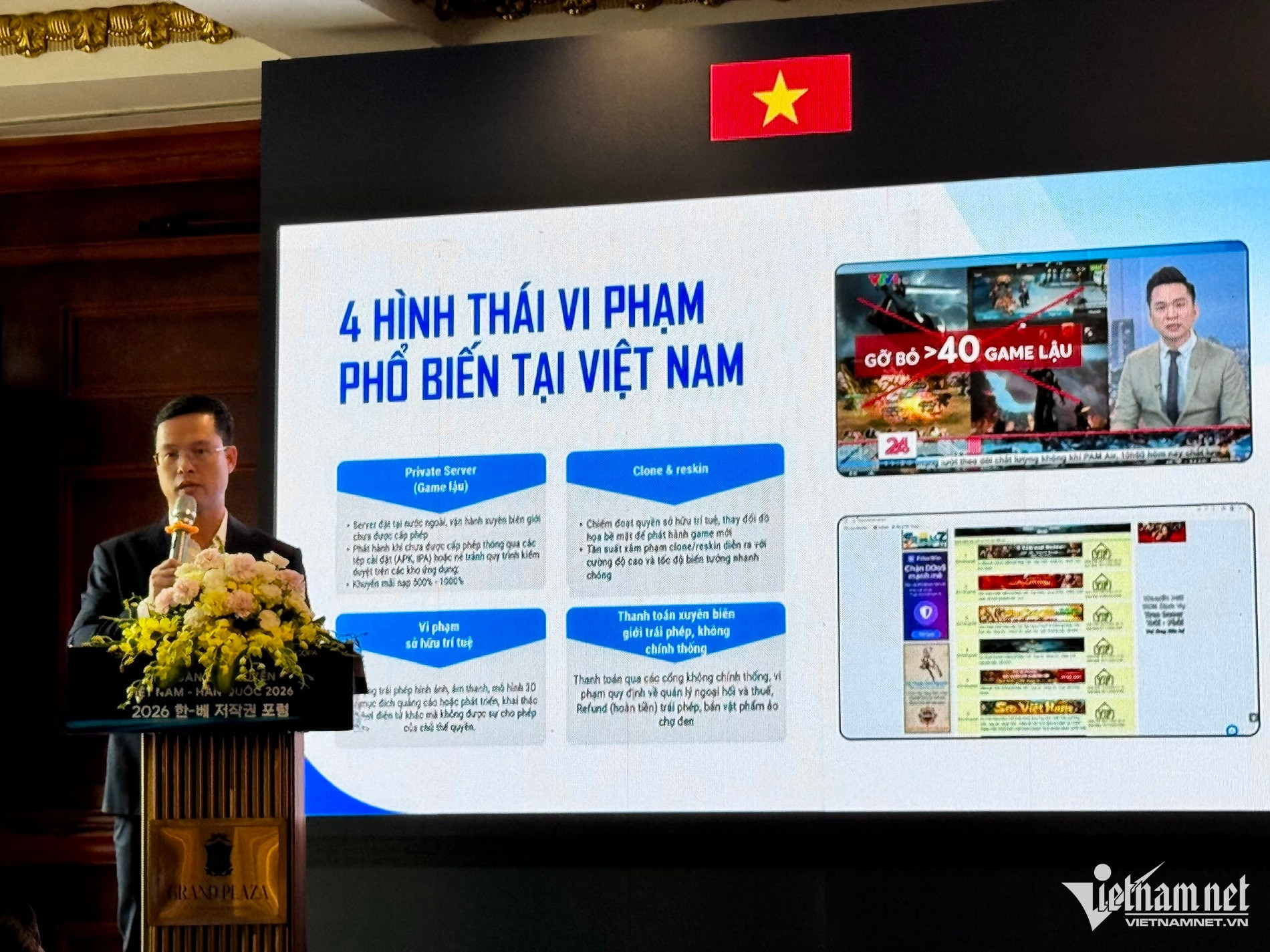
Speaking at the Vietnam - Korea Copyright Forum 2026 on May 7, Nguyen Hung Cuong, Deputy Director of VTC Intecom, outlined four common forms of infringement that are severely affecting domestic publishers.
The most serious issue is the proliferation of “private servers” - unauthorized versions of games. These servers are often hosted overseas and provide cross-border services into Vietnam, directly competing with licensed products.
Another widespread practice is “clone and reskin,” where developers steal source code, alter visual elements, and release the product as a new game.
Additionally, intellectual property violations include using official game images and audio to lure users into illegal platforms, employing unauthorized payment channels, and enabling hacking or modding activities that disrupt game balance.
For businesses, these violations create a dual impact: significant revenue losses and damage to brand reputation when users encounter risks on unlicensed platforms.
At the macro level, funds spent on illegal games flow out of the country, leading to tax losses and undermining the confidence of foreign investors entering the Vietnamese market.
Cuong acknowledged that the biggest challenges lie in technical barriers and weak enforcement. Illegal games can be created quickly and with relative ease.
“In 2023, it took us six months of coordination with authorities to shut down a cloned version of Silkroad Online,” he said.
However, the maximum administrative penalty for distributing illegal games currently stands at VND170 million (US$6,900), which industry representatives say lacks sufficient deterrent effect.
“Operators of illegal games do not seem to be afraid. When one game is shut down, they can launch another the very next day,” he noted.
User behavior also contributes to the problem. A portion of consumers continues to favor free content, inadvertently supporting piracy. Cuong cited a case in 2024 involving webtoon content from a Korean partner, where pirated versions appeared on free websites in Vietnam just 45 minutes after official release.
Despite these challenges, there are signs of progress. According to a report released in April 2026, since October 2025, authorities have blocked and removed 327 unlicensed games from app stores and taken down more than 300 illegal web-based games.
Notably, regulators are shifting their focus from merely blocking content to controlling and cutting off payment flows to unauthorized platforms.
On May 5, the Prime Minister issued Directive No. 38, calling for stronger and more decisive measures to combat intellectual property violations. Cuong said the directive brings renewed hope to digital businesses such as VTC Intecom.
To effectively address the issue, he proposed raising administrative penalties to more deterrent levels or even criminalizing large-scale piracy operations.
Such measures, he argued, are essential to safeguarding intellectual property in Vietnam and ensuring the sustainable growth of a billion-dollar industry.
Du Lam
.svg)
