 Vietnamnet.vn

 Podcast



Make in Vietnam enters a new phase
In his opening remarks, Deputy Minister Bui Hoang Phuong noted that over six years, the forum has ignited a strong aspiration for technological self-reliance among digital firms. The number of tech enterprises grew from 46,000 to nearly 80,000, with total industry revenue increasing by 66% to $198 billion. More than 2,000 companies have expanded into international markets.
Amid shifting models of governance and administration in the country, this is a prime opportunity for Vietnamese technology enterprises to break through.
The Deputy Minister emphasized: “Without mastering core and strategic technologies, Vietnamese enterprises cannot solve national challenges, and the country cannot break through in this new era. This is the path for Vietnamese businesses to reach the global market.”
A new direction: Lead where Vietnam has strength
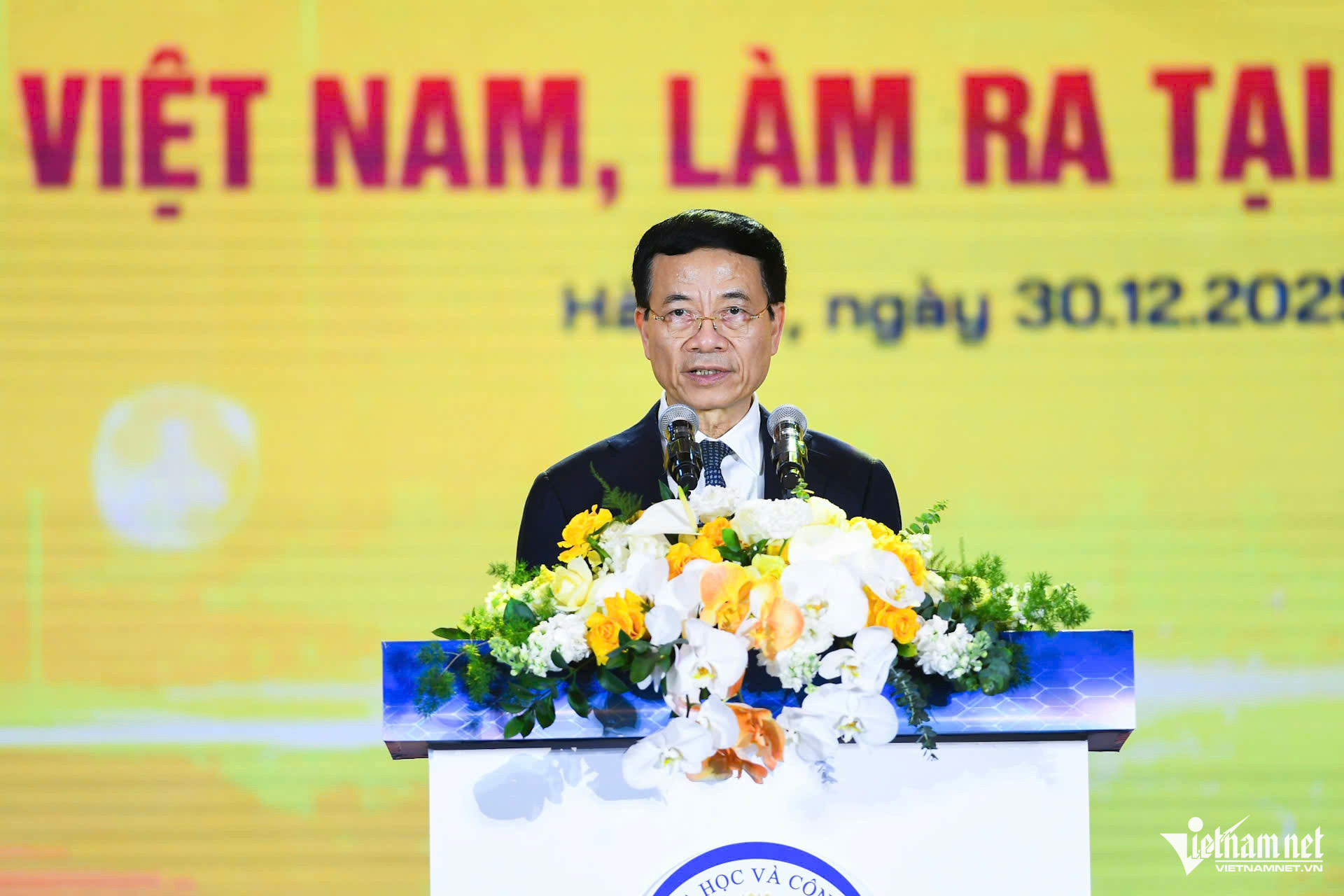
Minister of Science and Technology Nguyen Manh Hung affirmed that Make in Vietnam has evolved into both a national movement and a real capability, giving rise to a generation of companies, engineers, and scientists who are determined to own technology.
Reflecting on six years of impact, he declared that Vietnam must now take a higher, more difficult but necessary step: launching a new phase - "Make in Vietnam to Lead."
“Leadership does not mean leading at all costs,” said the Minister. “It means leading in areas where Vietnam holds advantages, urgent needs, and the potential to make a difference and create sustainable value. ‘Make in Vietnam to Lead’ represents a shift from ownership to sovereignty and leadership; from building core tech products to setting standards; from standalone solutions to platforms; and from domestic to regional and global markets.”
He stressed the need for new thinking, new methods, and a supportive policy framework. Leadership requires visionary thinking, guiding products, enterprise-centric innovation, and institutions that stay one step ahead. The Make in Vietnam to Lead journey moves from owning products to mastering the underlying technologies.
The Minister asserted that “create in Vietnam, build in Vietnam to lead” is not the task of one ministry, one industry, or a few enterprises - it’s a national strategy requiring collaboration between the government, businesses, the market, and society. It is the convergence of national ambition and technological capacity.
This new phase will not just mark a period - it will define a turning point in Vietnam’s development journey.
Tech firms back the strategy with bold action
At the forum, leaders of major Vietnamese firms agreed that Make in Vietnam is a new economic development mindset - shifting from outsourcing to mastering design, technology, and value chains.
Nguyen Thanh Lam, Director General of Vietnam Television (VTV), said Make in Vietnam is not about isolationism, but about owning core components to enable deeper integration. VTV aims to transform VTVGo into a national digital platform, helping safeguard cultural sovereignty online.
Viettel Chairman Tao Duc Thang affirmed the company’s mission to master core technologies to ensure national security. Viettel is investing heavily in strategic sectors such as 5G, semiconductors, and AI.
VNPT Chairman To Dung Thai outlined the group’s transition from a telecom operator to a tech enterprise. VNPT has built a foundational digital infrastructure and open data ecosystem, serving as a connector across platforms.
CMC Chairman Nguyen Trung Chinh emphasized that mastering core technologies is vital for digital sovereignty. CMC is investing in AI infrastructure and has successfully developed tech solutions to address national-scale challenges.
FPT CEO Nguyen Van Khoa said Make in Vietnam serves as a guiding principle for the company. FPT has significantly reduced its outsourcing share, focusing instead on pillars like AI, data, cybersecurity, and semiconductors - with serious R&D investment.
Toward a pioneering digital nation
Deputy Prime Minister Ho Quoc Dung praised the Ministry of Science and Technology for successfully organizing the high-impact forum.
He acknowledged the achievements of Vietnam’s tech companies while also highlighting existing challenges. He laid out four key tasks and solutions for sustainable growth.
The top priority, he stressed, is improving the legal and policy framework. He urged swift completion of guidelines for new laws including the Digital Technology Industry Law, the High Technology Law, the Artificial Intelligence Law, and the Intellectual Property Law.
The Deputy PM assigned the Ministry of Science and Technology to draft a government decree on AI regulatory sandboxes. He asked the Ministry of Finance to explore creating a National Technology Investment Fund, and the State Bank to consider recognizing “intellectual property” and “data” as assets that can be used for collateral in commercial lending.

Overview of the 2025 National Forum on the Development of Vietnamese Tech Enterprises. Photo: Ministry of Science and Technology
To boost the domestic tech market and prioritize the use of Vietnamese digital products, the Deputy PM instructed the development of government procurement policies for local technology. The Ministry of Finance is tasked with researching policies to promote the use of Vietnamese goods.
He encouraged state agencies to shift from public investment to subscribing to full-package digital services. He called for a nationwide campaign: “Vietnamese people prioritize using Vietnamese digital technology,” highlighting that local platforms understand local needs better, cost less, and offer superior service and support.
Another priority is nurturing tech enterprises capable of mastering core technologies - building major firms that can lead both the domestic market and reach international scale.
Finally, he stressed the importance of policies to attract and retain high-quality talent, as well as training a skilled workforce through strong partnerships between the government, academia, and business.
Deputy Prime Minister Ho Quoc Dung declared that 2026 will mark the beginning of a new era - an era of national rise.
“In that era, the digital space will be the new development frontier - and the stage where Vietnamese intelligence shines,” he said. “Vietnamese technology enterprises hold a historic mission: to transform Vietnam from a latecomer into a pioneer in the digital era.”
He expressed confidence that, with the momentum built over 40 years of Đổi Mới (Renovation), Vietnam will steadily build a sustainable, inclusive digital economy and society - and that the tech business community will write the next chapter of Vietnam’s remarkable rise.
Du Lam
.svg)
