 Vietnamnet.vn

 Podcast


The first Vietnam-Korea AI and Semiconductor Summit (VKAISS 2026) took place in Hanoi on November 12 under the theme "Shared Vision, New Horizons," opening new opportunities for technological development, workforce training and semiconductor supply chain cooperation.
The event was jointly organized by the Department of Digital Technology and Artificial Intelligence under the Ministry of Science and Technology, FPT Corporation, the Korea AI Semiconductor Fabless Association (KAISA) and the VINASA Semiconductor Industry Development Committee, under the ministry's auspices.
Eight agreements expand technology and semiconductor cooperation
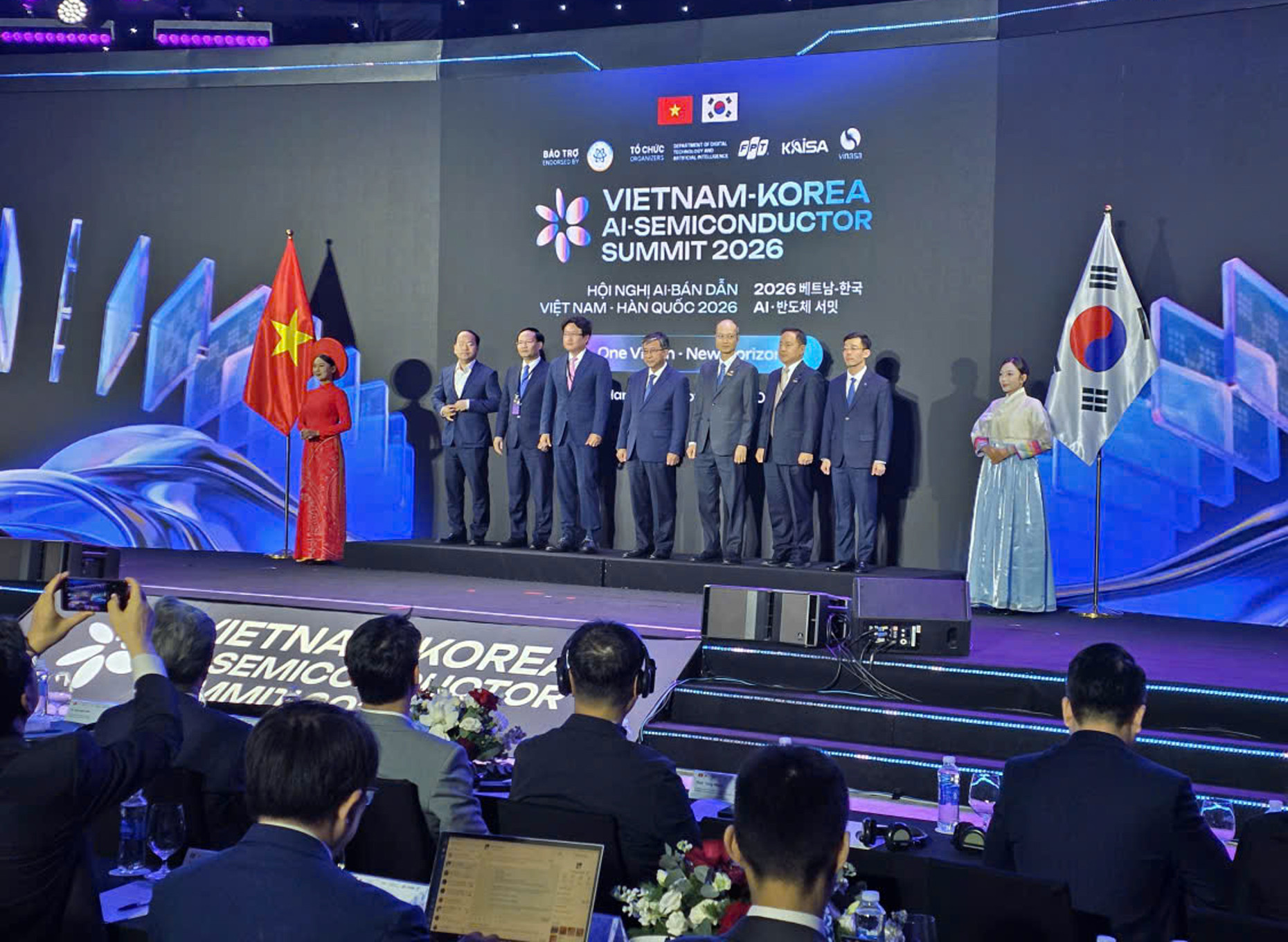
Eight agreements expand technology and semiconductor cooperation
One of the summit's highlights was the signing of eight memoranda of understanding (MoUs) between Vietnamese and South Korean businesses, industry associations and educational institutions.
The agreements focus on three main areas: business connectivity and semiconductor supply chains, technology development and workforce training.
In business cooperation, KAISA and the Bac Ninh Semiconductor Association established a partnership to connect South Korean semiconductor companies with electronics, semiconductor and supporting-industry enterprises in Bac Ninh Province.
The two organizations aim to promote trade, expert exchanges and cooperation in chip design, manufacturing, packaging and testing.
In semiconductor packaging and testing, FPT established partnerships with HANA Micron, Supergate and EdgeAI, expanding its network of partners across the semiconductor supply chain.
Notably, FPT and SKAIChips agreed to establish a cooperation framework for AI and semiconductor projects.
The two companies plan to explore integrating SKAIChips' chips, circuit boards and low-power technologies with FPT's AI models to develop solutions for food monitoring, electronic shelf labels, asset tracking and healthcare.
Their agreement also covers identifying potential customers and expanding commercial opportunities in Vietnam, South Korea, Japan and Malaysia.
In education, FPT Polytechnic College signed cooperation agreements with Soongsil University and EdgeAI, while the Posts and Telecommunications Institute of Technology partnered with the Institute of Semiconductor Engineers of Korea (ISE).
These partnerships will focus on exchanges of lecturers, specialists and students, as well as the joint development of specialized training programs, applied research and professional seminars.
Vietnam aims to master strategic technologiesSpeaki
g at the summit, Deputy Minister of Science and Technology Tran Trung Tinh emphasized that AI and semiconductors are complementary technologies that play crucial roles in Vietnam's strategy for technological self-reliance.
Under Resolution 57, Vietnam has identified AI and semiconductors as strategic technologies.
The country has also introduced comprehensive AI legislation and a semiconductor development strategy focused on specialized chips and deeper participation in global semiconductor supply chains.
Vietnam aims to develop both sectors comprehensively, treating them as two pillars of its efforts to master critical technologies.
According to the Deputy Minister, Vietnam's ambitions extend beyond attracting foreign investment to gradually mastering technology and securing a stronger position in global value chains.
He proposed three priorities for cooperation with South Korea.
The first is to move beyond investment and manufacturing cooperation toward joint research, design and product development.
The second is to make high-quality workforce training a long-term pillar of bilateral cooperation.
The third is to jointly develop an open, secure and trusted AI-semiconductor ecosystem.
Tinh also urged government agencies, research institutes, universities and businesses from both countries to translate these priorities into concrete programs and projects with clearly defined objectives and implementation schedules.
He called for stronger coordination in monitoring the implementation of signed agreements.
Nguyen Anh Tuan, Director of the National Center for Semiconductor Chip Pilot Production Support under the Department of Digital Technology and Artificial Intelligence, proposed strengthening a tripartite cooperation model involving the government, educational institutions and businesses.
Under this approach, the government would create favorable conditions, educational institutions would serve as the central training partners, and enterprises would participate in workforce development, research and the commercialization of specialized chips.
From a business perspective, FPT Deputy CEO Nguyen The Phuong stressed that signing agreements was only the beginning.
He said the success of cooperation would depend on identifying priority areas, assigning responsible parties and maintaining implementation progress.
Results should be demonstrated through joint research programs, practical training activities aligned with industry demand and products capable of being deployed commercially.
Phuong noted that South Korea is a global leader in semiconductor manufacturing, making bilateral cooperation an opportunity for the two countries to capitalize on their complementary strengths.
A representative of the South Korean Embassy in Vietnam also highlighted Vietnam's rapid progress in establishing its position in the regional AI and semiconductor industries.
The representative noted that Vietnam had begun construction of a semiconductor facility in Hoa Lac and was implementing policies to accelerate the development of both sectors.
With these efforts, Vietnam and South Korea could significantly strengthen their positions in AI and semiconductors, the representative said.
KAISA Chairman Kim Kyung Ho praised the growing partnership between the two countries, describing it as an important foundation for sustainable cooperation.
He expressed confidence that combining South Korea's semiconductor technologies and industrial capabilities with Vietnam's skilled workforce and expanding market would generate significant synergies.
Kim also voiced hope that VKAISS would bec
ening Industry-Academia Collaboration in AI and Semiconductor Workforce Development" examined the gap between academic training programs and actual recruitment requirements.
Experts discussed Vietnam's AI and semiconductor development policies, opportunities for domestic infrastructure cooperation, the integration of AI and semiconductor technologies in developing "Make in Vietnam" chips, emerging AI infrastructure trends and South Korea's experience in semiconductor research, training and commercialization.
Vietnam targets $25 billion semiconductor revenue by 2030
VKAISS 2026 took place as Vietnam accelerates implementation of its semiconductor industry development strategy and high-tech workforce training programs.
Under Decision 1018/QD-TTg and Decision 1017/QD-TTg, Vietnam aims to establish at least 100 chip design companies, one small-scale semiconductor fabrication plant and 10 chip packaging and testing facilities by 2030.
The country also targets annual semiconductor industry revenue exceeding $25 billion and the training of 50,000 semiconductor professionals with university-level qualifications or higher.
Achieving these ambitions will require Vietnam to strengthen its domestic technological capabilities while expanding international partnerships to gain access to advanced technologies, manufacturing expertise and global supply chains.
South Korea is regarded as a key partner in this process because of its technological strengths, manufacturing capabilities and extensive international semiconductor business networks.
Through eight MoUs, nearly 100 business matchmaking sessions, technical exchanges, training activities and exhibitions, VKAISS 2026 created additional opportunities for companies from both countries to identify partners, enter new markets and develop specific cooperation projects.
More importantly, the summit emphasized moving beyond networking and agreement signing toward substantive implementation.
The focus will be on establishing joint research programs, developing commercially viable products and training professionals whose skills meet industry requirements.
These initiatives are expected to help Vietnam and South Korea gradually build a more interconnected AI and semiconductor ecosystem, strengthen Vietnam's domestic technological capabilities and expand Vietnamese enterprises' participation in the global semiconductor value chain.
Thai Khang

