 Vietnamnet.vn

 Podcast



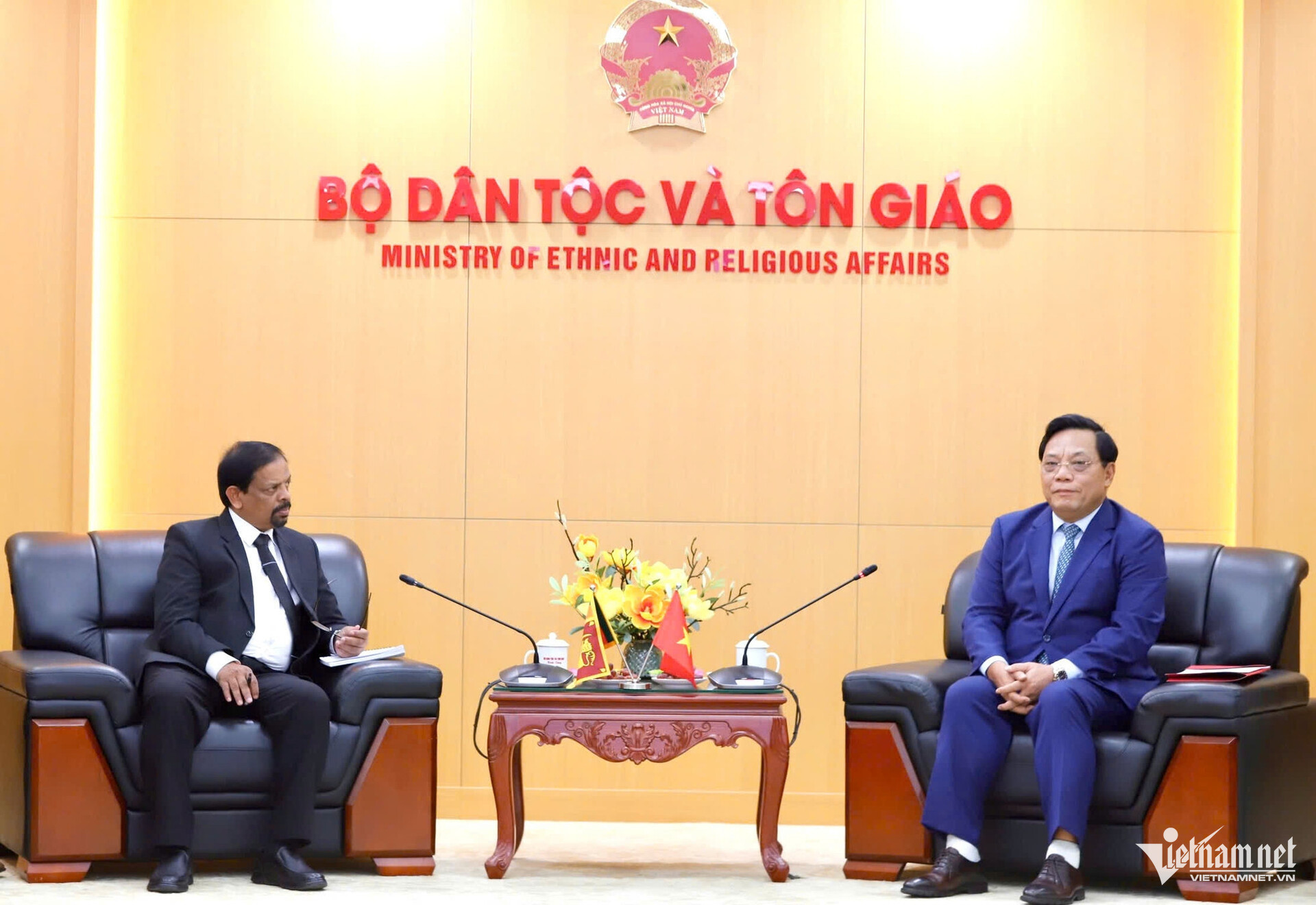
Deputy Minister of Ethnic and Religious Affairs Nguyen Hai Trung receives Gamagedara Dissanayake, Sri Lanka’s Deputy Minister of Buddhasasana, Religious and Cultural Affairs.
On the afternoon of August 29 in Hanoi, Deputy Minister of Ethnic and Religious Affairs Nguyen Hai Trung received Gamagedara Dissanayake, Sri Lanka’s Deputy Minister of Buddhasasana, Religious and Cultural Affairs.
The meeting was attended by Sri Lankan Ambassador to Vietnam Poshitha Perera, representatives of several units under Vietnam’s Ministry of Ethnic and Religious Affairs, and members of the Sri Lankan delegation.
Welcoming Dissanayake and his delegation to Vietnam, Trung said Vietnam and Sri Lanka share a long-standing traditional friendship. Since establishing diplomatic relations in 1970, ties between the two countries have continued to strengthen and expand across a wide range of fields.
In particular, the state visit to Sri Lanka by Party General Secretary and State President To Lam in May 2026 marked a new milestone as the two countries officially upgraded their relationship to a Comprehensive Partnership. During the visit, Vietnam’s Ministry of Ethnic and Religious Affairs and Sri Lanka’s Ministry of Buddhasasana, Religious and Cultural Affairs signed a memorandum of understanding on cooperation.
Turning commitments into concrete cooperation
According to Trung, the memorandum provides a framework for the two ministries to strengthen information sharing and exchange experience in state management of beliefs and religions, while promoting delegation exchanges, Buddhist engagement, training cooperation and the preservation of the two countries’ cultural and religious values.
Trung described the Sri Lankan delegation’s visit to Vietnam as one of the practical steps toward implementing the memorandum, while also helping reinforce the friendship between the two ministries and the two countries.
Highlighting the foundations of people-to-people ties, Trung said relations between Vietnam and Sri Lanka cannot be discussed without mentioning the close bonds between their Buddhist communities. While Buddhism in each country has its own distinctive characteristics, Vietnamese and Sri Lankan Buddhism share many similarities and have maintained close and deep-rooted traditional ties through exchanges among monks and nuns, academic engagement and Buddhist cultural activities.
During the visit, the Sri Lankan delegation brought sacred Bodhi trees to be planted at several Buddhist institutions in Vietnam. Trung said the trees carry not only religious significance but also serve as vivid symbols of friendship between the two countries and their peoples.
On behalf of the leadership of the Ministry of Ethnic and Religious Affairs, Trung thanked Dissanayake and members of the delegation for carrying out a range of meaningful activities that have helped deepen Vietnam-Sri Lanka relations.
Strengthening the preservation of cultural and religious values
Thanking Vietnam’s Ministry of Ethnic and Religious Affairs for its warm reception, Dissanayake said the agreements signed between the two sides had created favorable conditions for expanding cooperation. Similarities in history, culture and Buddhism, he said, provide a foundation for increasingly strong ties between the two countries.
Speaking about the sacred Bodhi trees brought from Sri Lanka to Vietnam, Dissanayake thanked Vietnamese agencies and organizations for facilitating their reception, planting and care. He expressed hope that the trees would be preserved and nurtured for generations as symbols of friendship between the two countries.
The Sri Lankan side also affirmed its readiness to share experience, send experts and provide advice and support to Vietnam in preserving and promoting cultural, religious and heritage values when requested.
On this occasion, Dissanayake said Sri Lanka would like to explore the construction of a Buddhist temple in Vietnam featuring distinctive Sri Lankan architecture and Buddhist culture, creating a space for cultural and spiritual exchanges among monks, nuns, Buddhist followers and people from both countries.
The Sri Lankan side asked Vietnam’s Ministry of Ethnic and Religious Affairs to provide guidance and support so that the initiative could be studied and implemented in accordance with Vietnamese law.
At the conclusion of the meeting, the two deputy ministers agreed that their designated agencies would continue discussions and develop specific plans, prioritizing highly feasible initiatives to help make religious and cultural cooperation one of the enduring pillars of the Vietnam-Sri Lanka Comprehensive Partnership.
Hoang Quy
.svg)
