 Vietnamnet.vn

 Podcast



Vietnam is entering a new phase of tapping into what many call a digital asset “goldmine” – a resource capable of reshaping national growth as the International Financial Center begins operations and unlocks capital flows and economic models built on digital assets.
From free trading to supervised models
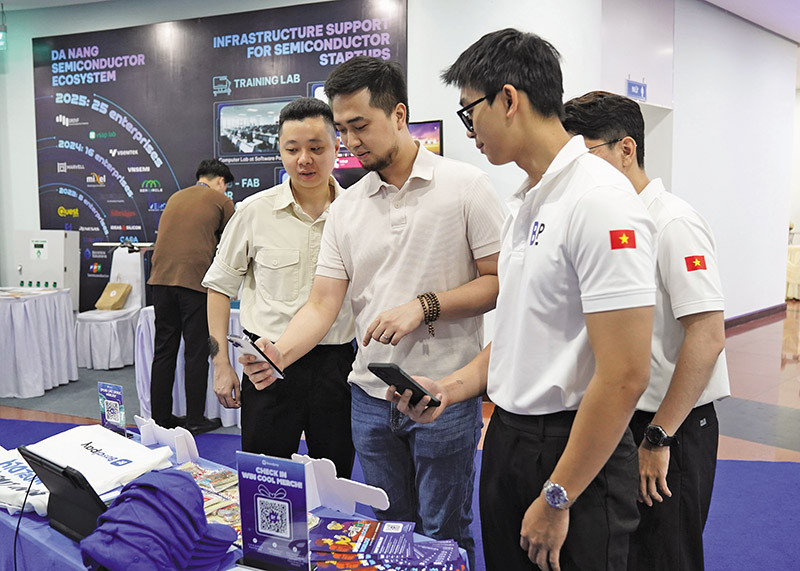
The first building blocks of Vietnam’s digital asset market are gradually taking shape as controlled sandbox mechanisms are officially activated.
Da Nang has emerged as a pioneer, leading pilot programs for intermediary solutions and digital asset trading infrastructure.
One notable solution is MIMO, a platform developed by Dragon Lab JSC that enables the conversion of digital assets into VND and vice versa.
According to Nguyen Duc Tan, Director of Dragon Lab, Vietnam’s digital asset market is expanding rapidly and ranks among the largest in the region.
Major exchanges such as Binance, OKX and Bybit consistently record Vietnam among the world’s top five countries in peer-to-peer trading volume, reaching billions of US dollars each month.
This reflects strong demand for digital asset storage and conversion among Vietnamese users, particularly young people and retail investors.
However, the absence of a comprehensive legal framework and formal supervisory mechanisms has created significant risks related to fraud, money laundering and financial insecurity.
Most digital asset transactions today, especially involving USDT or Bitcoin, are conducted through P2P or OTC channels, where users transfer funds directly without identity verification, protection mechanisms or regulatory oversight.
There have been numerous cases of fraud and asset misappropriation in direct or P2P group transactions on international platforms.
Users have faced risks of financial loss or wallet freezes due to links with non-transparent wallets.
Financial experts warn that unrestricted P2P trading may be exploited for money laundering or tax evasion, particularly when funds move through unidentified wallets.
“In the context of Vietnam finalizing its legal framework for digital assets, the need for a transparent, compliant and supervised trading model is urgent,” Tan said.
Dragon Lab has therefore developed MIMO as a sandbox-based intermediary conversion solution.
The platform allows users to convert USDT into VND under a non-custodial model within a transparent and supervised environment.
Unlike conventional platforms, MIMO does not trace users’ prior USDT transaction history.
Instead, it records and assumes responsibility only for transactions conducted within its own system.
This approach seeks to balance user privacy with verifiable transaction transparency, enabling regulators to monitor, assess and refine policies for the digital asset sector.
“We aim to expand MIMO and complete its pilot model in Da Nang under the sandbox mechanism,” Tan said.
“Dragon Lab will coordinate with regulators, research institutes and universities to standardize lawful digital asset transaction processes, contributing to the goal of building Da Nang into a digital finance and innovation hub.”
Alongside MIMO, Basal Pay, developed by Alphatrue Solutions JSC, is also being piloted in Da Nang.
Basal Pay integrates blockchain technology with traditional finance to facilitate transparent and automated exchanges between crypto assets and fiat currency, fully compliant with international anti-money laundering and counter-terrorism financing standards.
The emergence of solutions such as MIMO and Basal Pay signals that Vietnam is gradually building a next-generation digital financial infrastructure where digital assets can be traded legally and transparently.
Da Nang as the cradle
Vietnam is entering a new development phase with broad opportunities, in which digital assets represent one of the pillars capable of generating transformative breakthroughs.
The global crypto market has expanded dramatically, at times reaching a capitalization of over 4 trillion US dollars and encompassing millions of different digital assets.
This evolution has opened new capital-raising channels, particularly attractive for startups and innovation-driven projects.
It has also expanded financial inclusion and leveraged blockchain technology to enhance operational efficiency and reduce intermediary costs.
Although no official statistics are available, Vietnam’s digital asset market is widely considered robust.
Estimates suggest that between 9 and 21 million crypto trading accounts have been opened by Vietnamese users on international exchanges, with holdings valued at billions of US dollars.
These figures reflect both the scale and potential of the domestic market.
The establishment of the International Financial Center in Ho Chi Minh City and Da Nang, alongside the Digital Technology Industry Law passed by the National Assembly and effective from January 1, 2026, marks a turning point in unlocking this potential.
Da Nang has been entrusted with a pioneering role in developing this promising market segment.
Nguyen Duc Tan noted that Da Nang stands out as a trailblazer, granted special mechanisms by the central government to implement sandbox policies and develop into an International Financial Center.
“Da Nang possesses a strong technology ecosystem, gathering universities, software enterprises and innovation centers,” Tan said.
“This provides an ideal foundation for safely piloting fintech and blockchain models.”
Together with Ho Chi Minh City, the two urban centers are expected to act as core nuclei in building a transparent, regulated digital asset market aligned with international standards.
The International Financial Center in Da Nang officially commenced operations at the beginning of 2026, opening new space for digital asset development.
Under government orientation, the center will not pursue broad financial activities but will focus on segments with tangible demand, such as supply chain finance, trade finance, green finance and fintech models linked to real assets.
Dang Dinh Duc, Standing Vice Chairman of the Executive Agency of the International Financial Center in Da Nang, said this approach enables the center to build core competencies early, strengthen market confidence and align operations with concrete socio-economic development programs, particularly green transition, innovation and infrastructure development.
The linkage between the International Financial Center and the Da Nang Free Trade Zone creates a seamless ecosystem spanning trade, logistics, production and finance.
This allows capital flows not only to circulate within financial markets but also to directly serve economic activities, export-import operations and innovation-driven investments.
With a strong technological foundation, a national sandbox mechanism, an integrated finance-trade-innovation ecosystem and a specialized development orientation, Da Nang is converging the conditions necessary to become the center of Vietnam’s digital asset market.
It is not merely a policy laboratory, but a place where digital asset models are implemented, tested and scaled.
These strategic steps may help Da Nang attract regional financial institutions, specialized investment funds, fintech organizations, digital asset firms and sustainable finance platforms.
When these elements converge, Da Nang could emerge as a launchpad for Vietnam’s deeper participation in the global digital asset market structure.
Hoang Anh (Tien Phong)
.svg)
