 Vietnamnet.vn

 Podcast



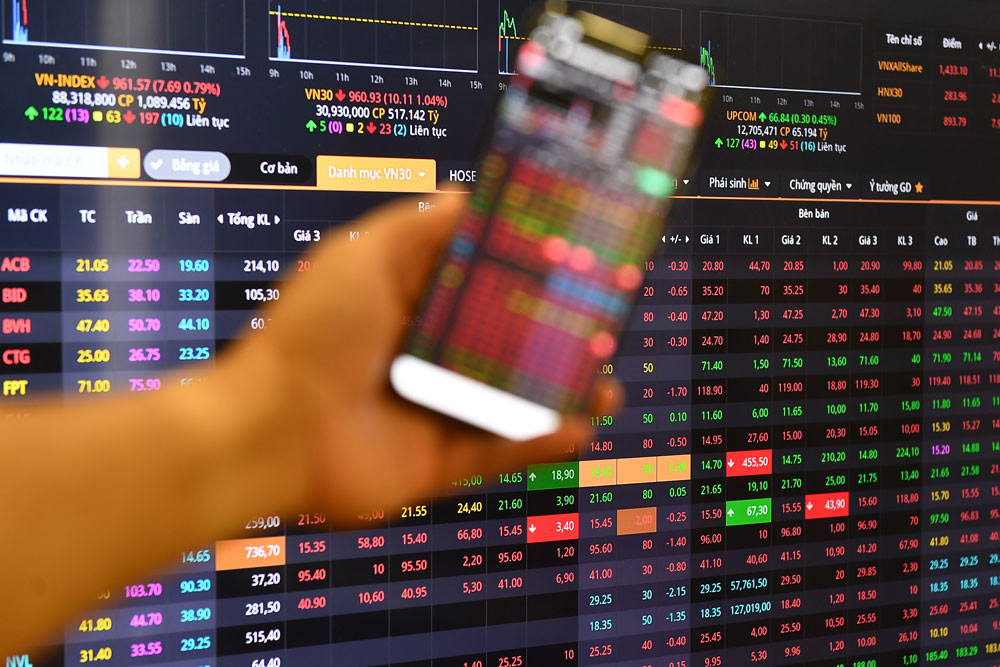
Key stocks in the oil and gas, banking, securities and Vingroup groups helped pull the Vietnamese market back from heavy losses.
After dropping 80 points over the previous two sessions, Vietnam’s stock market entered the March 4 trading day under strong selling pressure as Asian markets tumbled amid growing global uncertainty.
Oil prices surged due to escalating conflict in the Middle East, pushing up transportation costs and disrupting supply chains as tensions spread across the region.
Some Asian stock markets were forced to activate circuit breakers due to steep declines. Thailand’s SET Index dropped about 8 percent, triggering a temporary suspension of trading. South Korea’s KOSPI at one point plunged 12 percent, also activating a trading halt mechanism. Over two sessions, the KOSPI lost roughly 20 percent.
In Vietnam, all three exchanges opened lower and remained under pressure until early afternoon. The VN-Index at one point dropped more than 30 points, following an 80-point decline during the previous two trading sessions.
Many analysts advised investors to remain cautious under such volatile market conditions.
However, a surprise turnaround occurred in the final minutes before the closing auction session. Strong buying activity pushed several blue-chip stocks higher, particularly in the oil and gas, banking, securities and Vingroup sectors owned by billionaire Pham Nhat Vuong.
The VN-Index reversed course from heavy losses to a modest gain, closing up 5.13 points, or 0.28 percent, at 1,818.27 points. Meanwhile, the VN30-Index fell only slightly, losing 2.82 points, or 0.14 percent, to end at 1,956.53 points.
Market liquidity surged to more than VND47.7 trillion on the HoSE exchange.
Oil and gas stocks led the gains, with several hitting their daily ceiling prices as global oil prices continued to climb. West Texas Intermediate crude rose nearly 2.9 percent to around US$76.7 per barrel during the March 4 session, after already surging more than 20 percent in recent trading days.
Shares of Petrolimex (PLX) rose by VND3,400 to VND69,500 per share, while PetroVietnam Gas (GAS) gained VND5,300 to VND128,700 per share.
Banking stocks also performed strongly, including Vietcombank (VCB), BIDV (BID), VietinBank (CTG) and LPBank (LPB). Securities companies likewise recorded positive movements, with SSI rising VND1,100 to VND33,700 per share.
Shares of Vingroup (VIC), led by billionaire Pham Nhat Vuong, also reversed earlier losses to close up VND100 at VND155,600 per share. Vincom Retail (VRE) gained VND1,650 to VND28,000 per share.
On the other hand, some major stocks declined. Shares of VietJet (VJC), owned by billionaire Nguyen Thi Phuong Thao, fell VND900 to VND163,200 per share. Masan Group (MSN), controlled by billionaire Nguyen Dang Quang, dropped VND1,000 to VND76,000 per share.
Shares of Hoa Phat Group (HPG), chaired by billionaire Tran Dinh Long, remained unchanged at VND27,700 per share. Meanwhile, shares of technology firm FPT, led by chairman Truong Gia Binh, continued to decline, falling VND1,900 to VND85,100 per share.
According to Forbes data as of March 4, Pham Nhat Vuong’s net worth stood at US$25.2 billion, ranking 95th globally.
Meanwhile, Nguyen Thi Phuong Thao’s wealth fell by US$100 million to US$3.9 billion, placing her 1,078th in the world. Tran Dinh Long’s fortune declined to US$2.8 billion, ranking 1,461st globally. Techcombank chairman Ho Hung Anh’s wealth dropped to US$2.3 billion, placing him 1,815th.
Nguyen Dang Quang’s net worth stood at US$1.1 billion.
Market experts recommended that investors remain patient and wait for clearer signals before increasing investments, as the Middle East conflict continues to affect global financial and commodity markets.
Despite short-term volatility, Vietnam’s stock market still benefits from a strongly growing economy, improving corporate performance and the high possibility of being upgraded by FTSE to a secondary emerging market.
Manh Ha
.svg)
