 Vietnamnet.vn

 Podcast



At the third plenum of the 14th Communist Part of Vietnam (CPV) Central Committee, General Secretary of the Party Central Committee and President To Lam outlined four major strategic shifts, including a development model built on productivity, knowledge, technology and people.
Experts said the shift gives Vietnam a foundation to reduce its reliance on natural resources and low-cost labour and move into a new growth phase.
Productivity over low-cost labour
Prof. Dr. Nguyen Xuan Cu, Deputy Director of the Centre for Environmental Economics under the Vietnam Association of Environmental Economics, said the transition demands changes in production methods, resource allocation and how competitive advantages are built, not just technology.
A development model based on productivity, knowledge and technology requires long-term capital, a skilled workforce, innovation capacity, technology absorption and incentives for long-term invest. Therefore, Vietnam’s greatest challenge is moving from cost-based advantages to ones based on productivity, technology and added value.
To create a breakthrough in productivity, Cu said every stage of the production chain needs to be optimised. Companies need to identify which resources are being depleted, where sources of pollution are located in, what the actual environmental costs are and which solutions are most appropriate.
Given finite resources and mounting environmental pressures, productivity can no longer be measured solely by labour and capital alone; land, water, energy, raw materials and environmental inputs must be included.
He proposed the association focus on resource efficiency, circular economy, low-carbon development, climate change, waste management and green sectors to move green initiatives from labs to production.
Research should prioritise applicability, emission-reduction potential and feasibility for companies, while policy assessments should be strengthened using science and data to weigh economic efficiency, environmental costs, social impacts and feasibility.
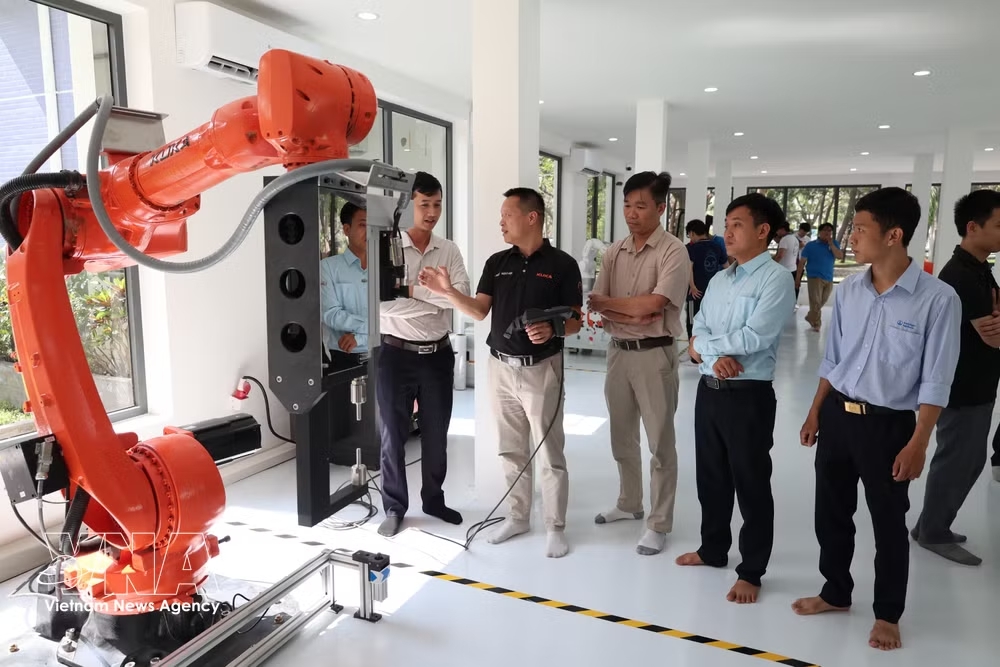
The research-market gap should be narrowed through training, expert networks and links among universities, research institutes, businesses and regulators, he said.
Turning knowledge into assets
Prof. Dr. Nguyen Van Noi, President of the Vietnam Association of Testing Laboratories and former Rector of the University of Science under the Vietnam National University, Hanoi, said the push to turn science, technology, innovation and AI into productivity and added value marks a shift from theoretical research to commercialisation.
A Prime Minister decision, issued on August 4, 2026, approved a plan to develop research and testing centres and national key laboratories focused on strategic technologies, defining their role clearly for the first time.
Labs and testing systems provide measurement and conformity assessment, helping products meet national standards such as QCVN and TCVN and international benchmarks including ISO, CE and FDA, building market confidence and helping overcome technical trade barriers.
Noi said the State should make focused investments in globally standardised testing centres for semiconductors, biotechnology and advanced materials, avoiding scattered investment that leaves equipment asynchronous.
He called for stronger public-private partnerships to encourage major tech companies to invest in and jointly operate national key laboratories. Regulatory sandboxes for emerging technologies that lack legal precedents should also be established soon, with risks managed in a safe and strictly controlled framework.
To make knowledge and skilled workers core development drivers, he proposed a tripartite model involving the State, research institutes and universities, and businesses.
Companies should help design training courses, commission graduation research and provide internships from the start.
Focused investment should target core sci-tech sectors, including scholarships and exceptional funding for basic sciences and key technologies to attract and retain talent.
Noi said the State should give research units genuine autonomy over intellectual property and reduce administrative burdens so scientists can focus on their work./.
.svg)
