 Vietnamnet.vn

 Podcast



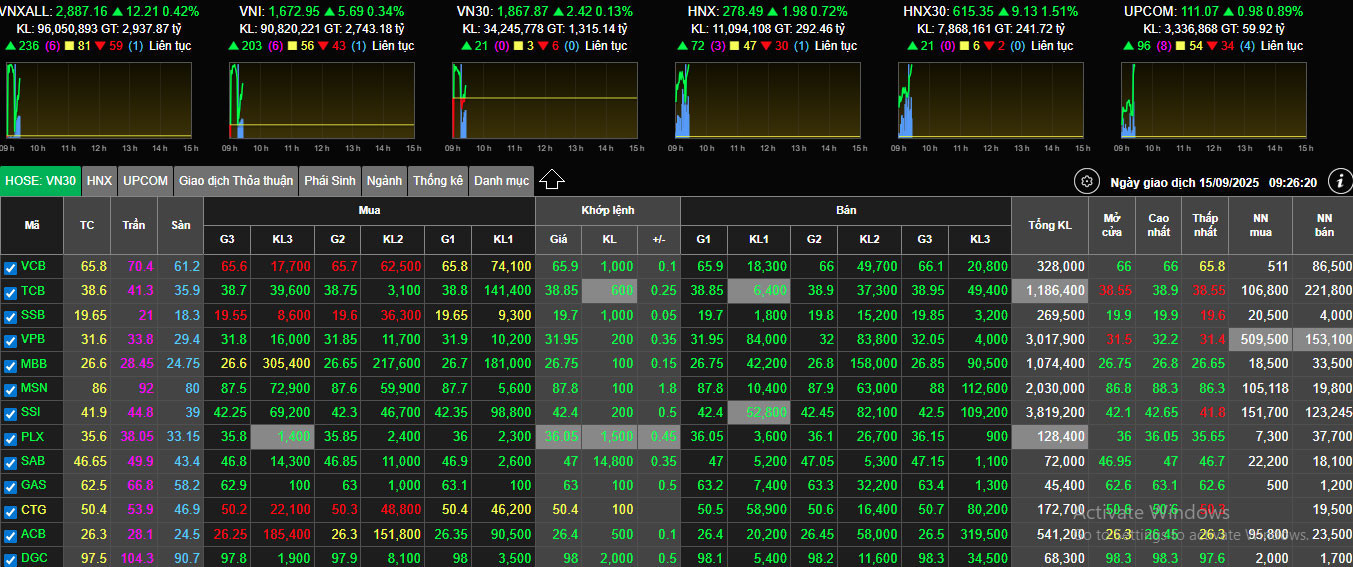
Facing mounting economic challenges, the Vietnamese government has enacted a comprehensive and assertive policy agenda to reshape capital flows and foster sustainable growth.
On September 12, the Prime Minister approved a strategic plan to upgrade Vietnam's stock market classification. This initiative is closely tied to the country’s ambition to establish international financial centers in Ho Chi Minh City and Da Nang.
The envisioned international financial hubs will feature stock exchanges that meet global standards, offering high-quality listed products, including stocks and bonds. These platforms aim to mobilize capital more efficiently and support both enterprises and the broader economy.
On September 13, the government also directed a revision of the Personal Income Tax Law, clearly categorizing profits from gold trading as taxable income. This move is intended to enhance market transparency, curb speculation, and reduce “goldization” of the economy. The urgency stems from instances where the price of SJC gold bars surged past 135 million VND per tael (approximately $5,500), sometimes exceeding global prices by nearly $800, posing significant financial risks.
Alongside gold, real estate prices have soared sharply, especially in Hanoi and Ho Chi Minh City. The rapid increases have far outpaced average incomes, raising fears of asset bubbles and potential bad debt risks in the banking system. These distortions divert speculative money into unproductive areas, skewing the economy’s structure and hindering sustainable growth.
Previously, the government issued Resolution 5 to establish the first legal framework for Vietnam's crypto asset market. The pilot program will run for five years, during which unauthorized crypto trading will be strictly punished, including possible criminal charges, six months after the first licensed entity begins operation.
Strategic roadmap for stock market upgrade
The core goal of the stock market upgrade plan is to develop the stock market into a key medium- and long-term capital mobilization channel. In the near term, Vietnam aims to meet all the criteria for reclassification from “frontier market” to “secondary emerging market” by FTSE Russell in 2025 and maintain that status.
Key objectives include resolving prefunding issues, increasing transparency of foreign ownership limits, simplifying account openings for foreign investors, advancing straight-through processing (STP), implementing omnibus trading accounts (OTA), stabilizing the exchange rate, and modernizing trading systems.
In the long run, the plan seeks to meet the criteria for reclassification to “emerging market” status under MSCI and “advanced emerging market” status under FTSE Russell by 2030. Proposed actions include reviewing foreign ownership caps, building a central clearing counterparty (CCP), allowing securities lending and controlled short selling, enabling same-day trading, and developing a foreign exchange market with hedging instruments.
Redirecting capital flows for broader economic impact
These policy actions form an integrated strategy with far-reaching economic implications.
First, taxing gold profits and tightening control over the real estate market will reduce the flow of speculative capital into these overheated and high-risk sectors. Sharp increases in gold and property prices not only widen wealth inequality but also siphon funds away from productive industries, weakening GDP growth. By imposing taxes, the government encourages capital to move toward more efficient investment avenues.
Many analysts now predict that the stock market will become the primary destination for major capital flows. Despite recent corrections after a strong rally that pushed the VN-Index close to 1,700 points, the long-term outlook remains bullish, particularly with the implementation of the upgrade plan. Mirae Asset Vietnam forecasts the VN-Index could rise to new highs between 1,800 and 2,000 points by the end of this year.
If Vietnam is upgraded by FTSE Russell in the October 2025 review, passive funds tracking FTSE indexes could inject up to $600 million in net purchases in 2026. Total foreign inflows could reach several billion dollars as Vietnam becomes more attractive to emerging market investors.
To attract this capital, the government plans to disclose maximum foreign ownership thresholds clearly and ensure fair access for international investors. Additionally, measures to stabilize the foreign exchange market will help mitigate capital flow volatility.
In the longer term, legal reforms will aim to raise foreign ownership limits, eliminate unnecessary restrictions in certain sectors, and introduce instruments such as securities lending, short selling (via delivery-based short selling), and intraday trading. The development of a hedging-friendly forex market will further reduce risks and increase liquidity.
The ultimate outcome is a powerful influx of both domestic and foreign capital into the stock market, facilitating capital mobilization for businesses and bolstering economic growth.
Mirae Asset highlights specific sectors poised to benefit from the market upgrade, including steel (HPG, HSG), real estate (VIC, VHM, VRE, KDH, KBC, VPI, SIP, PDR), banking (STB, VCB, SHB), securities (SSI, VCI, VIX, VND), food (VNM, MSN), chemicals (DGC, DPM), electricity (GEX, POW), and other industries such as aviation (VJC), retail (FRT), technology (FPT), logistics (VTP), oil and gas (PVD), and construction (CTD). These sectors are expected to lead the market’s recovery, with capital flowing into high-quality stocks.
In summary, this comprehensive policy approach seeks to reorient the economy toward sustainability by reducing reliance on gold and real estate speculation and promoting the stock market as a new growth engine. If effectively implemented, Vietnam could emerge as a regional standout, drawing massive capital flows into equities and delivering long-term benefits for investors and the economy.
As of 11:10 a.m. on September 15, the VN-Index had climbed over 7 points to reach 1,674. Liquidity on the HoSE exchange was strong, with trading volume nearing 16 trillion VND (about $651 million). Meanwhile, the SJC gold price fell to 131.1 million VND per tael (approximately $5,300).
Manh Ha
.svg)
