 Vietnamnet.vn

 Podcast



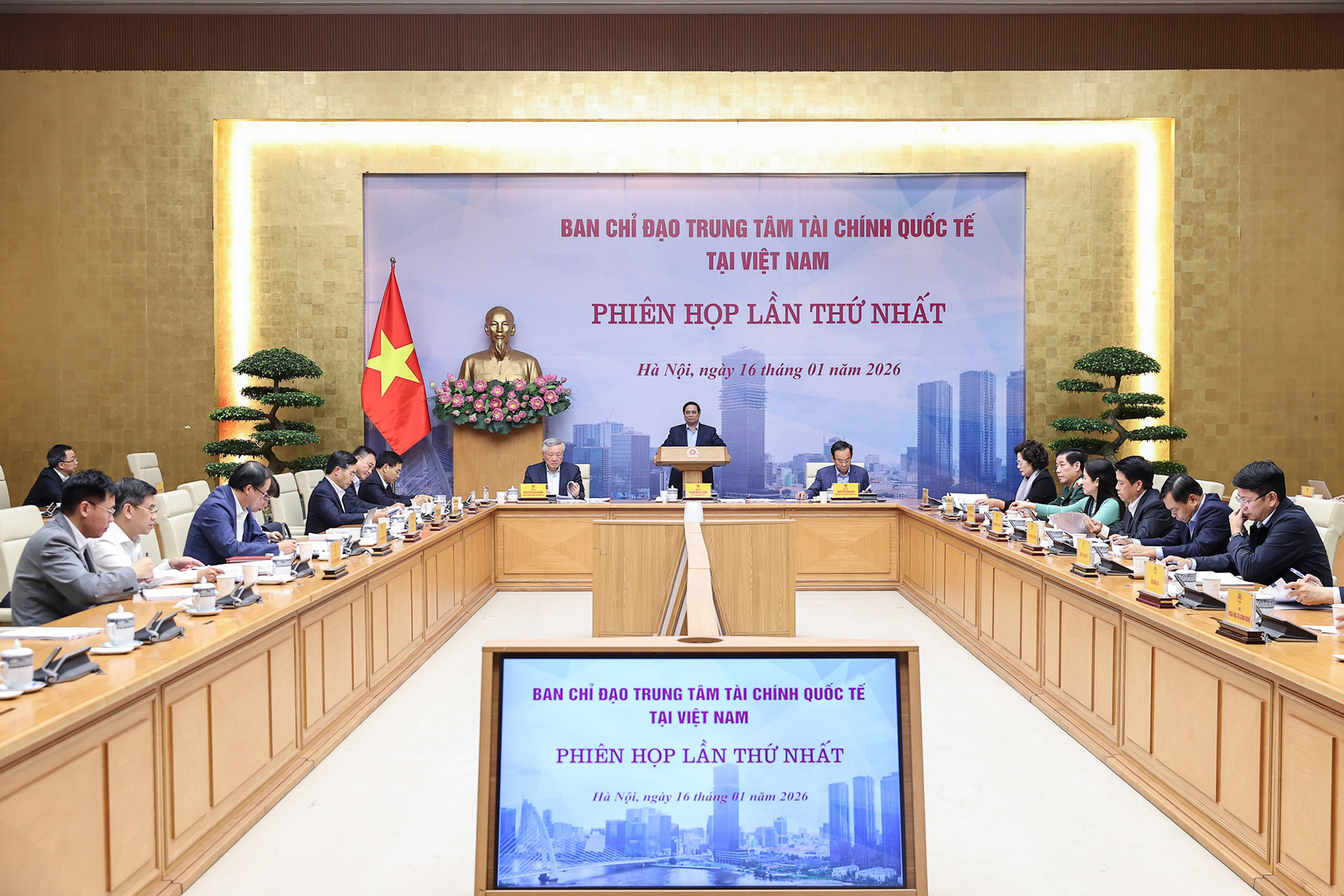
On the afternoon of January 16, Prime Minister Pham Minh Chinh, who also serves as Head of the Steering Committee for Vietnam’s International Financial Center, chaired its first meeting to review the implementation of Politburo directives and plan the roadmap for building, operating, and developing the center in Ho Chi Minh City and Da Nang.
The meeting also covered discussions on tailored policies, governance structures, and operational frameworks for the center.
Among the attendees were key Politburo members, including Permanent Deputy Prime Minister Nguyen Hoa Binh and Nguyen Van Nen, member of the 14th Party Congress Documentation Subcommittee. Leaders from the Ministry of Finance, the State Bank of Vietnam, central ministries, and the cities of Ho Chi Minh City and Da Nang were also present.
In his opening remarks, the Prime Minister stressed the urgent need for Vietnam to define a new role in the global financial network amid a rapidly shifting world economy, changing investment flows, and evolving regional and international financial services.
He emphasized a mindset shift - from mere participation to shaping Vietnam’s position, from isolated projects to ecosystem development, and from ad hoc incentives to a robust institutional framework characterized by professional governance, elite human capital, comprehensive infrastructure, and world-class services.
“This is not about constructing a few buildings. It’s about cultivating a financial ecosystem driven by institutions, markets, infrastructure, talent, and smart governance. Institutions are the backbone. People are the driving force. Infrastructure is the foundation. Governance is the breakthrough. And market trust is the key,” said PM Chinh.
The Steering Committee, he noted, has aligned on a unified vision and action plan, adhering to six principles of clarity: clear assignment of people, tasks, timelines, responsibilities, authority, and results. The working spirit is defined by bold thinking, daring actions, and full accountability - without haste or blind imitation, but grounded in Vietnam’s specific context and aligned with international standards of integrity, transparency, and rule of law.
With the motto “Breakthrough thinking – Decisive action – Tangible results,” the Prime Minister urged continued momentum to realize the vision of a modern, transparent, and efficient financial center that places Vietnam firmly on the global map.
Progress and key takeaways
The committee reviewed prior conclusions and directives from the Politburo, evaluated implementation efforts to date, and outlined next steps for institutional design, infrastructure development, human resource training, and partnerships with global financial hubs.
Vietnam’s efforts so far include the issuance of Politburo directives and the National Assembly’s Resolution No. 222/2025, followed by eight government decrees. A central executive council has been formed, with plans underway for local governance bodies in Ho Chi Minh City and Da Nang.
Both cities have taken steps to prepare the necessary physical infrastructure, staff, and operational logistics.
However, challenges remain. These include intense competition from regional and global financial centers, shortages of high-quality talent and international experts, and the need for stronger urban infrastructure and international-standard services.
Risk management frameworks, compliance oversight, data-sharing protocols, and international monitoring mechanisms still require comprehensive development.
Institutional reform as the cornerstone
Concluding the session, PM Chinh reiterated the government’s approach: no perfectionism, no haste, no missed opportunities. “We act, learn, and scale,” he said.
He outlined six core principles:
First, institutional reform must be the breakthrough. Vietnam, as a latecomer, must selectively learn from global best practices. Its institutional model must be distinctive, globally aligned, and locally relevant - safeguarding sovereignty, financial security, and data safety.
Second, people must be the centerpiece. Vietnam needs competent, ethical, and visionary leaders, managers, experts, and professionals. Building such a team involves strategic recruitment, training, and international talent attraction.
Third, infrastructure must be robust - beyond basic utilities to include digital infrastructure, cybersecurity, data centers, authentication systems, and information-sharing platforms.
Fourth, market and product fit is vital. The center must be able to answer: which institutions will it attract, what financial products will it offer, which markets and customers it will serve, and what added value it brings to the economy, jobs, and society.
Fifth, clear coordination between Ho Chi Minh City and Da Nang is crucial to avoid overlap and inefficiency. The central government will provide strategic direction, while local authorities must take ownership, coordinate closely, and share resources, data, and lessons.
Sixth, Vietnam must intensify global cooperation that is deep, meaningful, and results-driven.
Immediate next steps
The Prime Minister instructed relevant ministries to quickly draft a decree on tailored mechanisms and policies for the Executive Council, as well as operational regulations for the center and the council itself.
Human resources must be recruited and executive offices finalized.
Both cities are tasked with developing a strategic plan for the center through 2035, with a long-term vision to 2045, ensuring feasibility and alignment with global trends.
Technological integration between the two cities is to be prioritized, ensuring real-time, interoperable, and trustworthy data infrastructure.
The Prime Minister set a firm deadline: the international financial center in Ho Chi Minh City must be launched no later than February 9, 2026. Alongside it, an international arbitration center and a dedicated financial court are also to be inaugurated.
He called on all ministries and agencies to act with urgency, discipline, and accountability. For local governments, the guiding principle is: “local decisions, local execution, local responsibility,” with enhanced autonomy in both policy and resource management.
He urged expanded domestic and international cooperation, particularly with other financial centers, and proactive investment promotion to attract major financial institutions and corporations.
With strong political will, unified efforts, and international collaboration, the Prime Minister expressed confidence that Vietnam will succeed in building and developing its international financial center - contributing not just to national growth, but also to regional and global prosperity.
VGP
.svg)
