 Vietnamnet.vn

 Podcast



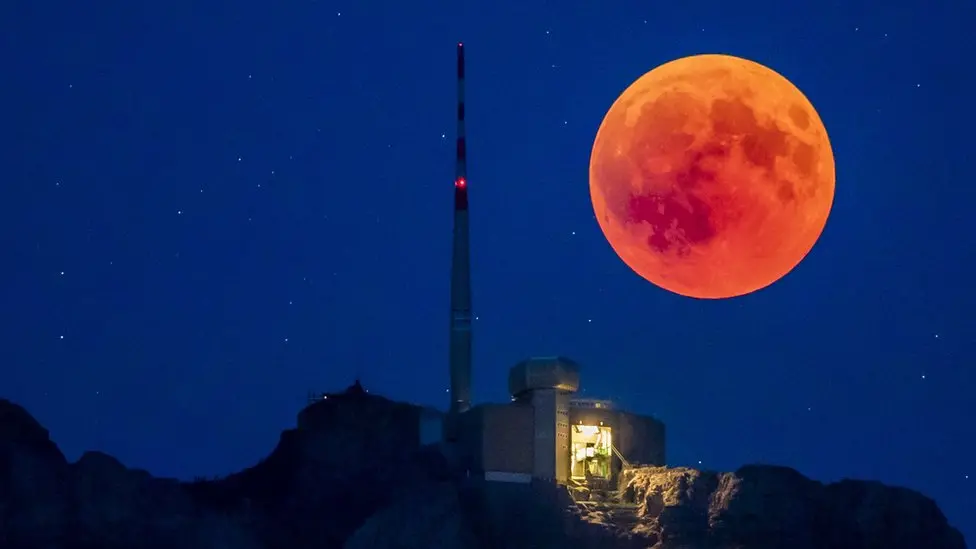
This will be the last total lunar eclipse visible anywhere on Earth until the end of 2028.
Although the phenomenon will be seen in its entirety primarily across North America, the Pacific region, Australia, New Zealand and East Asia, astronomy enthusiasts worldwide can still admire the full Moon rising near sunset local time on March 2-3.
The March full Moon, often called the “Worm Moon,” is the third and final full Moon of winter in the Northern Hemisphere. Its name reflects the thawing soil and the reappearance of earthworms, signaling the approach of spring.
What is a total lunar eclipse or “Blood Moon”?
In the early hours of March 3 North American time, the Moon will pass completely into the darkest part of Earth’s shadow, creating a total lunar eclipse. During this phase, the entire lunar disk takes on a distinctive copper-red hue.
The event will be most clearly visible across North America, particularly in the western United States.
Following this eclipse, the next total lunar eclipse will occur on the night of December 31, 2028. However, North America will not witness another total eclipse until June 26, 2029.
Although totality occurs in the early morning hours, the most visually striking time to observe the Worm Moon will be on the evening of March 2, the night before totality.
At that time, moonrise nearly coincides with sunset, creating one of the most photogenic scenes of the month.
In New York, the Sun sets at 5:48pm EST and the Moon rises at 6:13pm, a 25-minute gap that allows the Moon to appear during the “blue hour,” when lighting conditions enhance its apparent size and color.
In Los Angeles, sunset is at 5:49pm PST and moonrise at 6:34pm, roughly 45 minutes later, resulting in a darker but still dramatic sky.
On the night of March 3 itself, the Moon rises later, after darkness has fully set in, reducing the visual effect near the horizon. The eclipse will reach its peak in the early hours of Tuesday, March 3, 2026.
Totality - when the Moon is completely immersed in Earth’s umbra - is the most spectacular phase, as the lunar surface glows deep red.
A small fraction of sunlight is refracted through Earth’s atmosphere and bent into the umbra, coloring the Moon during totality.
A total lunar eclipse occurs when Earth aligns directly between the Sun and the Moon. The phenomenon unfolds in five stages.
First, the Moon enters the penumbral shadow, causing a subtle dimming.
Next, it moves into the darker umbra, and Earth’s shadow gradually appears to “bite” into the lunar disk - this is the partial phase.
When the Moon is fully inside the umbra, totality begins and the surface turns red-orange. After maximum eclipse, the process reverses through partial and penumbral phases.
Observers who wish to see the curved edge of Earth’s shadow most clearly should watch during the partial phase before totality, as in many locations the Moon will be lower in the sky afterward.
Binoculars or a small telescope can enhance contrast, though the eclipse is perfectly safe to view with the naked eye under clear skies.
Unlike a solar eclipse, a lunar eclipse poses no danger to eyesight. The red coloration comes from sunlight filtered and refracted through Earth’s atmosphere - essentially the combined glow of every sunrise and sunset around the planet at that moment.
According to Meg Thacher, editor of Sky & Telescope magazine, this crimson tint is produced by light from Earth’s ring of dawns and dusks being bent into the umbra.
The “Worm Moon” is one of 13 full Moons in 2026, as the lunar year is about 11 days shorter than the solar year. Among them, three will be supermoons, occurring when the full Moon coincides with perigee, its closest point to Earth.
In 2026, there will be two lunar eclipses. The March 2-3 event is the only total eclipse of the year, while on August 27-28 a very deep partial lunar eclipse will occur, with 96 percent of the Moon entering the umbra.
With favorable viewing conditions across many regions, the March 2026 “Blood Moon” promises to be one of the most memorable celestial events of the decade.
Hai Phong
.svg)
