 Vietnamnet.vn

 Podcast



A scientific paper co-authored by two Vietnamese academics has been officially retracted from the International Journal of Applied Economics, Finance and Accounting (IJAEFA) after one of the authors admitted to using a student’s research without giving them proper authorship credit.
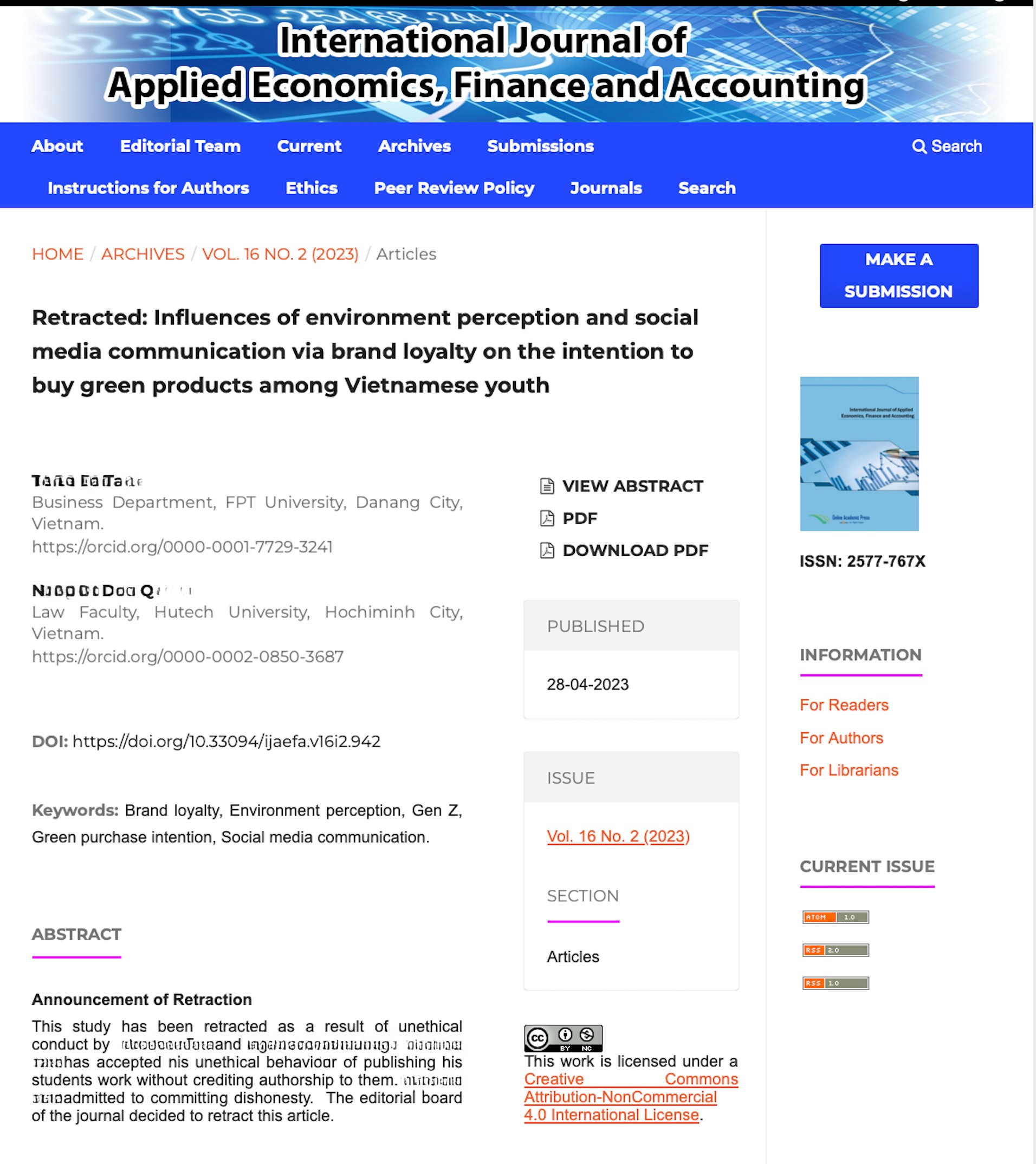
The paper, titled “Influences of environment perception and social media communication via brand loyalty on the intention to buy green products among Vietnamese youth”, was removed from the journal’s system following an internal review and verification process prompted by concerns over research integrity.
According to the journal’s official notice, the retraction was made due to an act deemed unethical in the realm of academic publishing. Dr. T.L.T., a lecturer at FPT University – Da Nang and the lead author of the study, confessed to using a student’s research contribution without listing them as an author. The journal also cited a lack of transparency in the submission and publication process.
The second author listed, M.A. N.D.Q., is a lecturer at Ho Chi Minh City University of Technology (HUTECH). Following the retraction, a HUTECH representative confirmed with VietNamNet that the university had been made aware of the case and launched an internal inquiry.
According to HUTECH’s statement, the paper in question was part of the lecturer’s independent research collaboration and was conducted outside the framework of any institutionally assigned or managed project. The university clarified that the lecturer was not the lead researcher, nor was he responsible for submitting the article or overseeing the publication process.
Furthermore, the lecturer had not included the paper in any personal research declarations submitted for academic evaluation, internal review, or professional appraisal within the institution. As such, the publication did not fall under HUTECH’s scientific research database or management system.
HUTECH emphasized its unwavering commitment to upholding academic ethics and transparency in research. The university stated that faculty members are routinely reminded of regulations regarding authorship, publication standards, and proper academic conduct.
The retraction highlights growing scrutiny over ethical standards in academic publishing, particularly concerning proper attribution of intellectual contributions. It also raises wider questions about how institutions monitor collaborative research conducted outside their official oversight.
As the academic community continues to address issues of plagiarism, ghost authorship, and data misuse, cases like this serve as a reminder of the importance of safeguarding research integrity-both within and beyond university walls.
Le Huyen
.svg)
