 Vietnamnet.vn

 Podcast



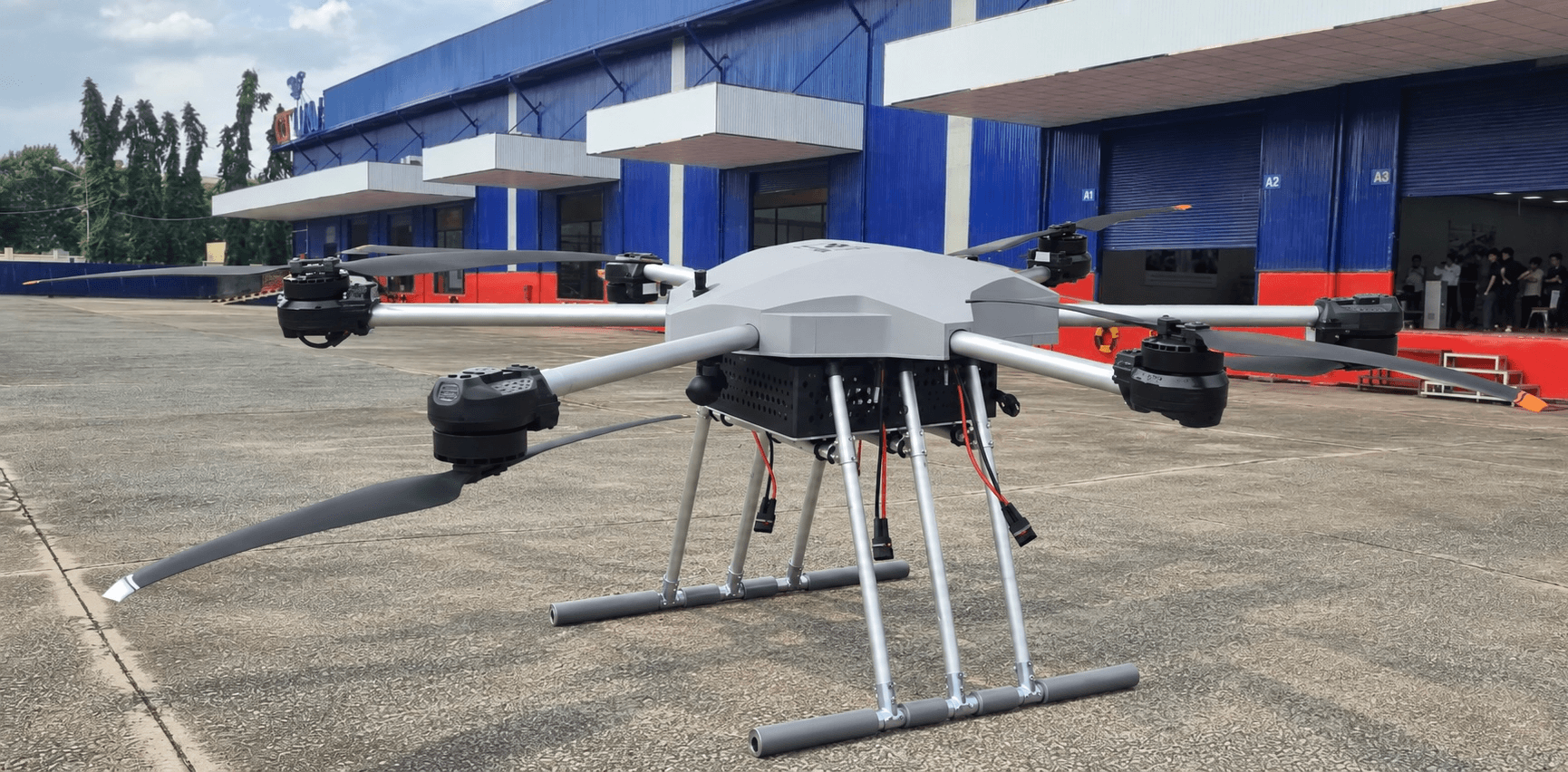
The emergence of UAV models capable of transporting heavy payloads has expanded the application scope of unmanned aircraft in Vietnam, spanning logistics, construction, and energy to search and rescue. This development is viewed as a foundational pillar of the low-altitude economy.
The heavy-lift UAV line demands rigorous technical specifications, ranging from airframe structures, power systems, and flight controllers to stability and wind resistance when carrying heavy loads.
Unlike small-payload civil UAVs, heavy-lift transport drones can execute missions where ground vehicles face difficult access or prolonged transit times.
The CT Pegas 230 is targeted at serving on complex terrains such as the Northwestern mountainous region, highlands, islands, or the canal networks and marshlands of the Mekong Delta.
In construction and mining, the drone can transport materials and equipment to hard-to-reach job sites, hilly areas, remote locations, or rugged terrain.
In the energy sector, the device is oriented toward supporting the transportation and installation of power transmission systems, and wind power and solar power equipment.
For coastal, island and offshore facilities, the UAV can manage cargo transport between the mainland, islands, ships and offshore platforms.
Another application highlighted by CT UAV is search and rescue. During storm and flood seasons, high-payload aircraft can help deliver food, drinking water, medicine and essential supplies to isolated areas, thereby shortening relief response times.
According to CT UAV, it has received orders for 135 products from domestic entities. The firm is also negotiating with partners in several other countries.
From transport drones to low-altitude economic ecosystem
The development of heavy-lift transport drones unfolds as numerous Vietnamese enterprises research and produce UAVs for diverse applications.
Firms such as FPT, HERA, Viettel, and CT UAV are actively joining the formation of a UAV ecosystem serving the low-altitude economy.
Logistics stands out as a sector expected to grow rapidly. As e-commerce expands, demand for same-day or even same-hour delivery escalates.
Meanwhile, ground transportation infrastructure in urban centers faces risks of overload alongside rising transit costs.
UAVs offer a novel transport mode, shortening delivery times, optimizing routes, and proving exceptionally suited for locations difficult for ground vehicles to reach.
Beyond general cargo transport, drones can deliver medical supplies to regions isolated by natural disasters or support supply chains for agricultural production zones far from urban centers.
Agriculture is also an important market. UAVs can undertake spraying fertilizer and pesticides with higher accuracy, thereby reducing chemical use and limiting risks to workers.
According to Tran Anh Tuan, CEO of Vietnam Aerospace and UAV Network, if the digital economy is an important transition of the 21st century, then low-altitude economy can open up a new development space with many industries and services.
Models such as low-altitude logistics, smart cities, 3D digital maps, infrastructure monitoring, and airborne digital services can form new value chains, leading to the development of support enterprises.
Race to master UAV technology
To develop heavy-lift UAVs, companies must solve design challenges but also master a range of technologies related to materials, engines, batteries, propellers, control systems and flight safety.
CT UAV said it currently operates five factories and manufactures nearly all major UAV components, including airframes, circuit boards, propellers, engines and batteries.
The company also owns 22 laboratories in Vietnam, the United States, France, Israel and Taiwan. Its UAV factory in the US is scheduled to be inaugurated on September 21, 2026.
After years of focusing on mastering the underlying technologies, CT UAV said it is moving into a new phase of developing its own inventions and intellectual property.
The company's UAV products have been registered in Vietnam and several other countries, including the US and Australia.
CT UAV said it produces hundreds of inventions, patents, utility solutions, industrial designs and technical improvements each year.
The company is continuing to develop an ultra-heavy UAV capable of carrying a payload of up to 500kg, which is expected to be launched in the near future.
Globally, the low-altitude aviation market is forecast to reach $700 billion by 2035.
Vietnam is considered to have the potential to develop a $10 billion market, driven by urbanization, fragmented terrain and demand for automation in sectors such as agriculture, energy, construction and search and rescue.
Thai Khang
.svg)
