 Vietnamnet.vn

 Podcast


Nguyen Trung Hieu, a 2001-born graduate of Foreign Trade University (FTU), has attracted widespread attention with a simple browser-based game designed to help Vietnamese speakers practice pronouncing the consonants "l" and "n" correctly.
Called Non La (Conical Hat), the game was launched on November 9 and quickly went viral across social media platforms.
Turning pronunciation mistakes into gaming challenges
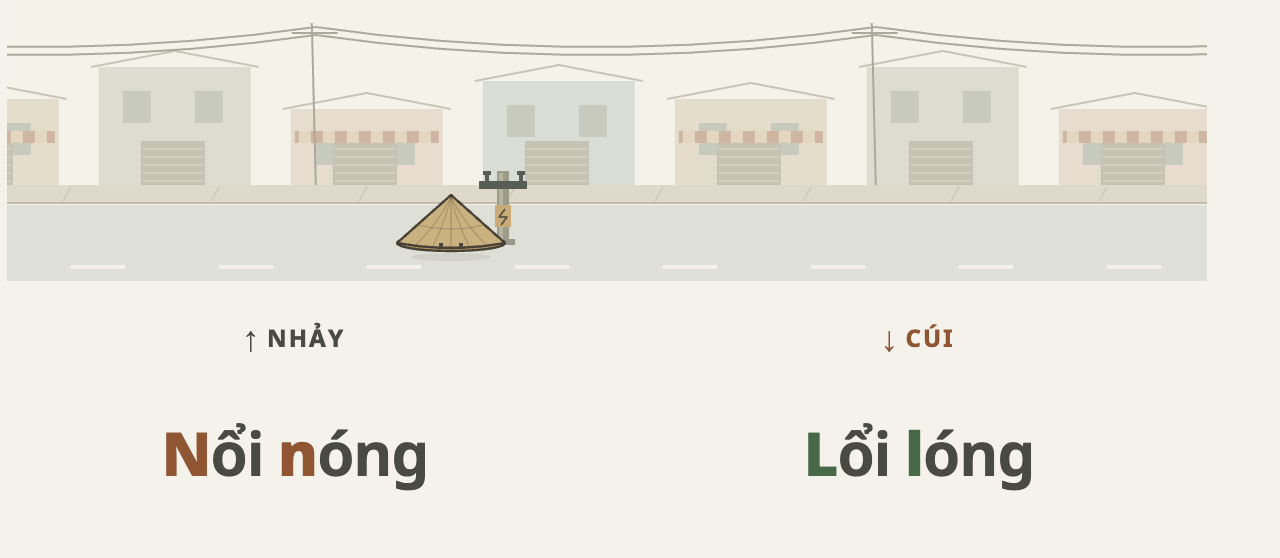
In Non La, players control a traditional Vietnamese conical hat as it moves through a series of obstacles.
However, unlike conventional games that rely entirely on keyboard controls, players must also correctly pronounce Vietnamese phrases containing the consonants "l" and "n" to progress.
Examples include "nang len" (the sun comes out), "lua nep" (glutinous rice) and "noi nong" (losing one's temper).
Although the task appears straightforward, many players struggle when required to pronounce a succession of easily confused sounds.
A pronunciation mistake can cause the conical hat to collide with an obstacle, immediately ending the game.
The concept was inspired by the familiar dinosaur game that appears in Google Chrome when an internet connection is unavailable.
Hieu adapted the simple gameplay into an interactive pronunciation challenge, using speech recognition technology to evaluate players' responses.
He said the idea emerged unexpectedly while he was developing an application to support Chinese language learning.
During that project, he began exploring whether pronunciation practice could be incorporated into the software.
This required investigating how accurately speech recognition technology could identify Vietnamese accents from different regions, particularly when speakers pronounced certain sounds incorrectly.
"I wanted to experiment with speech recognition software to see how well the technology could detect pronunciation mistakes, especially confusion between 'l' and 'n'," Hieu said.
"But a simple testing application would be rather boring, so I decided to turn it into a game that people could try and then provide feedback on the speech recognition system."
Rather than writing every line of code himself, Hieu primarily provided instructions to artificial intelligence tools, which handled much of the programming.
He then adjusted the features and tested the finished product.
The first version of Non La was completed in just one day.
After sharing the game on social media, Hieu was surprised by the rapid growth in player numbers.
Within two days, the game had attracted more than 150,000 players, far exceeding his expectations.
"The game may have spread so quickly because it uses voice interaction, which many other games don't offer. It's also simple enough for almost anyone to play," he said.
Feedback from players has also provided valuable data and practical experience that Hieu can use to improve the Chinese language learning application he is developing.
From economics graduate to technology developer

Hieu's academic background was not originally in information technology.
He attended Thai Binh High School for the Gifted, where he specialized in physics, before enrolling in the International Economics program at Foreign Trade University.
During his university studies, several courses introduced him to data analysis.
He subsequently began teaching himself programming and exploring artificial intelligence applications.
As his knowledge developed, Hieu realized that technology was the field he wanted to pursue professionally.
In his final year at university, he conducted a data research project examining common surnames, given names and hometowns among doctors in Vietnam.
After publishing his findings online, the research unexpectedly attracted widespread attention and was shared across multiple platforms.
The project helped him secure a data analysis position at a major bank in February 2024, shortly after graduating from Foreign Trade University with honors.
However, after nearly two years in banking, Hieu decided to resign four months ago to focus on developing his own technology products.
One of his main projects is an application designed to support Chinese language learning.
Having achieved an IELTS score of 8.0, Hieu believes language learners can improve their skills independently through accessible digital tools rather than relying exclusively on expensive language centers.
He hopes to develop an application that allows users to learn Chinese according to their individual needs, proficiency levels and preferred learning schedules.
Expanding speech recognition for Vietnamese accents
The unexpected popularity of Non La has encouraged Hieu to explore further applications of speech recognition technology.
He is now considering developing a high-quality speech-to-text system capable of accurately recognizing Vietnamese speech across different regional accents.
Such a system could address one of the challenges facing Vietnamese-language speech recognition: variations in pronunciation among speakers from different parts of the country.
For Hieu, the viral game has become more than an entertaining experiment.
It has provided an opportunity to test speech recognition technology with a large number of users, gather feedback and explore how AI-powered tools could make language learning more accessible and engaging.
Thuy Nga

