 Vietnamnet.vn

 Podcast



On August 18, the Vietnam Musicians’ Association National Congress for the 2026-2031 term became a heated forum for deep concerns over the growing presence of artificial intelligence (AI) in music composition. As the boundary between technology and art becomes increasingly blurred, Vietnamese music faces a fundamental question: How can it preserve its cultural soul when machines without human consciousness can create music in a matter of minutes?
Concerns from an older generation
Representing a veteran generation of composers, musician The Bao offered a candid assessment of Vietnam’s current songwriting community. Among the Vietnam Musicians’ Association’s 1,500 members, young musicians still account for a modest proportion, while their professional standards have yet to meet expectations.
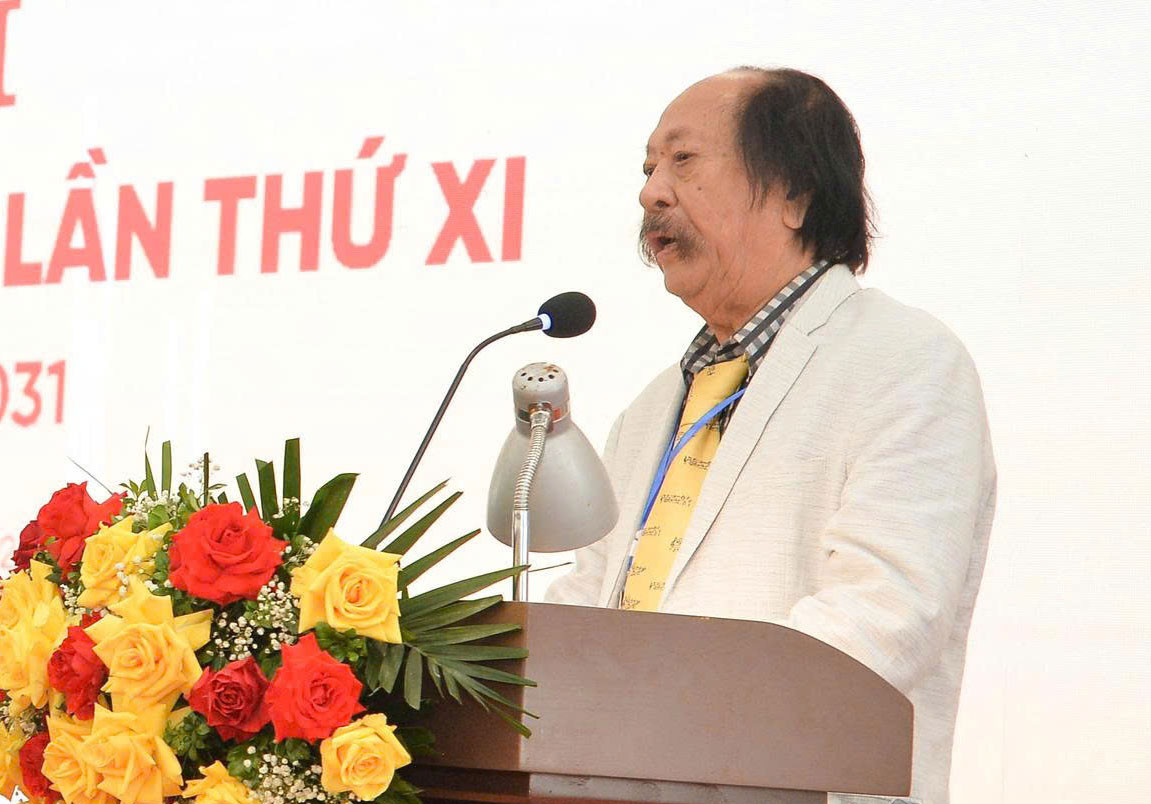
Musician The Bao. Photo: Ho Quang
He noted that today’s younger generation enjoys an invaluable advantage their predecessors could only have dreamed of: access to information technology and vast repositories of audio and text. This allows musicians to independently take a piece from composition through arrangement, mixing and recording almost immediately, rather than waiting for lengthy production processes.
Yet that convenience appears to have come at the expense of artistic depth. According to The Bao, younger composers show weaknesses in incorporating Vietnamese musical identity and lack deeper reflection on traditions of heroism, compassion, and broader issues concerning humanity and the times in which they live. As a result, contemporary Vietnamese music still lacks major works capable of expressing the country’s identity while making an impact internationally.
The Bao stressed that without a focused plan for 2025-2030 to improve members’ professional capabilities, Vietnamese music - from traditional and classical music to symphonic works, pop, rock and rap - will struggle to keep pace with more advanced countries and meet the urgent demands of a new era by 2045. The Vietnam Musicians’ Association, he said, should work closely with the Ministry of Culture, Sports and Tourism to develop new mechanisms that give young musicians greater opportunities to train and learn.
The AI tsunami
Taking the discussion further, musician Mai Kien, representing a younger generation, presented the congress with a more immediate and stark picture of AI’s growing power. A few decades ago, software such as Finale, Sibelius and Cubase served merely as passive tools awaiting human commands. Today, generative AI can independently produce material, musical ideas and complete recordings from just a few simple prompts entered into a browser.
The emergence of these tools is blurring the distinction between an ordinary music enthusiast and a professional musician, pushing composers into an increasingly intense competitive environment. More concerning still, algorithms operating online are facilitating the copying and distortion of traditional musical heritage.
This reality has created a deep psychological divide within the profession:
Fear of being replaced: Some older musicians are increasingly concerned as formulaic tasks in harmonization and arrangement can now be replicated and simulated by AI at extremely low cost.
Laziness and overreliance: At the other end of the spectrum, some younger creators are becoming excessively dependent on technology, leaving machines to churn out “instant” products that are formulaic in sound and hollow in artistic value.
Even so, musician Minh Kien argued that for artists with confidence and expertise, a new AI-assisted workflow could offer major economic and professional advantages. AI can quickly produce drafts and adjust arrangements, reducing workloads and allowing artists to become “creative directors” who retain control over artistic direction and aesthetic judgment.
To protect Vietnam’s musical identity and adapt to the digital era, musician Mai Kien proposed three key measures for the Vietnam Musicians’ Association during its 2026-2031 term:
Implement the Digital Music Museum project. Build an academically standardized digital database to preserve musical heritage, help regulate the market and provide a transparent source of licensed data for AI systems themselves.
Strengthen professional training: Organize composition camps incorporating digital skills and establish rigorous standards for harmonization and arrangement, giving young musicians a solid foundation from which they can master technology and critically challenge algorithmic outputs.
Establish a legal and ethical framework for creativity: Create a digital copyright advisory board and deploy audio-recognition technology to protect intellectual property. In particular, the association should adopt rules that categorically reject works generated entirely by AI - including music, lyrics and recordings - while requiring every submitted work to include a transparent declaration of the extent to which technology was used.
According to musician Do Hong Quan, Chairman of the Vietnam Union of Literature and Arts Associations, technology may turn musical notes on paper into automated commands, but the ultimate authority in art will always belong to humans. AI may perform well at the starting point, but the soul of music must be nurtured by lived experience and emotional resonance. No matter how sophisticated algorithms become, he said, they remain without consciousness and can never assume the identity or standing of a genuine artist.
Tinh Le
.svg)
