 Vietnamnet.vn

 Podcast



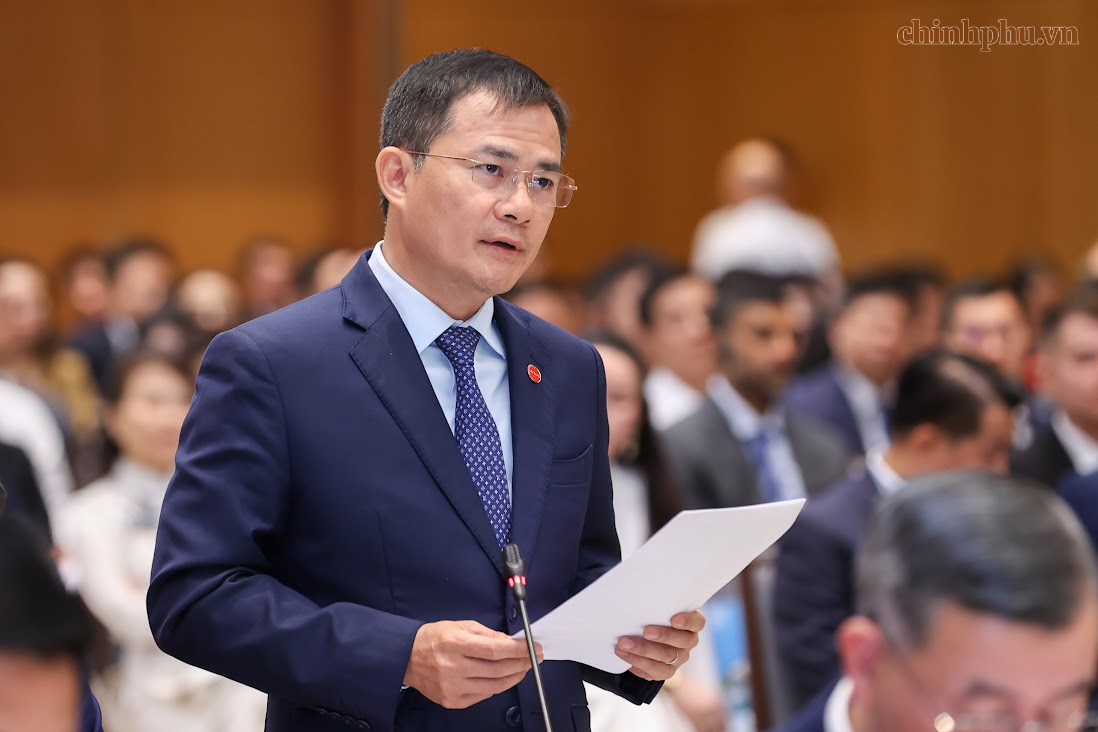
At the Government Standing Committee's meeting with the business community, with the theme "Untying Bottlenecks - Unleashing Resources - Driving Growth" on July 18, Thang expressed support for a report by the Ministry of Finance, which noted that the development mindset is shifting from solving individual difficulties for businesses to building a unified growth ecosystem in which state-owned, private and foreign-invested enterprises can complement one another and grow together.
As a state-owned enterprise operating in industry and high technology, Viettel has made a number of proposals to strengthen the role of leading companies in the country's new phase of development.
The Government was urged to issue a list of large-scale state-owned enterprises that play a leading role in key industries and sectors of the economy, and at the same time assign strategic tasks appropriate to their capacity and advantages.
"Viettel proposes that the Government soon realize this viewpoint with strong policies to form a team of national leading technology enterprises, including Viettel, VNPT, MobiFone, FPT, and CMC. The ‘flagships’ will be assigned tasks, granted mechanisms and given assistance," Thang said.
He said that leading enterprises need to be assigned additional tasks of national significance such as leading technology, developing domestic supply chains, expanding international markets, mastering strategic technologies and participating in key national projects.
"In addition to business efficiency, leading enterprises need to create a spillover effect for the whole economy," he emphasized.
Regarding the policy of promoting the role of state-owned enterprises as "large buyers", "large order placers", Thang suggested that the Government issue guidance for state-owned enterprises to prioritize the use of products and services of Vietnamese enterprises that meet quality requirements.
He also proposed adding evaluation criteria for the spillover level of leading enterprises such as localization rate, domestic procurement value, and number of small and medium enterprises participating in the supply chain or number of technology enterprises supported to develop products.
The goal is that each project of a leading enterprise needs to create growth for the enterprise itself and to pull along the development of the entire ecosystem of Vietnamese enterprises.
A team of national strategic technology enterprises
For the field of science, technology and innovation, Thang said that enterprises must be identified as the center of the product development process.
He proposed that the Government form a team of national leading technology enterprises and create favorable conditions for them to develop to act as ‘locomotives’ in their fields, that lead smaller enterprises.
In addition, he suggested continuing to remove bottlenecks in financial mechanisms, investment, public procurement, technology testing, data access and commercialization of research results.
This is a prerequisite for enterprises to invest in the long term, improve innovation capacity and contribute more to economic growth.
Logistics planning to reduce costs
He proposed that the Government soon issue logistics infrastructure planning in a interconnected direction between the transport system, seaports, airports, railways, logistics centers, warehouses, border gates and large transshipment centers.
A modern and unified logistics network will help reduce logistics costs, improve national competitiveness, and create momentum for e-commerce, exports and economic growth.
Investment Promotion Fund
To support enterprises to expand international markets, Thang proposed that the Government allow enterprises, especially state-owned enterprises, to set aside an Investment Promotion Fund from their pre-tax profit.
To find a suitable investment market, enterprises must survey many countries and work with regulatory agencies and partners for many years, incurring very large costs but not necessarily succeeding.
If there is no clear legal mechanism to recognize and account for these expenses, state-owned enterprises will face many difficulties when expanding investment abroad.
This will contribute to expanding the development space for Vietnamese enterprises, enhancing their position in the international market, and at the same time create additional momentum for economic growth in the new phase.
Thai Khang
.svg)
