 Vietnamnet.vn

 Podcast



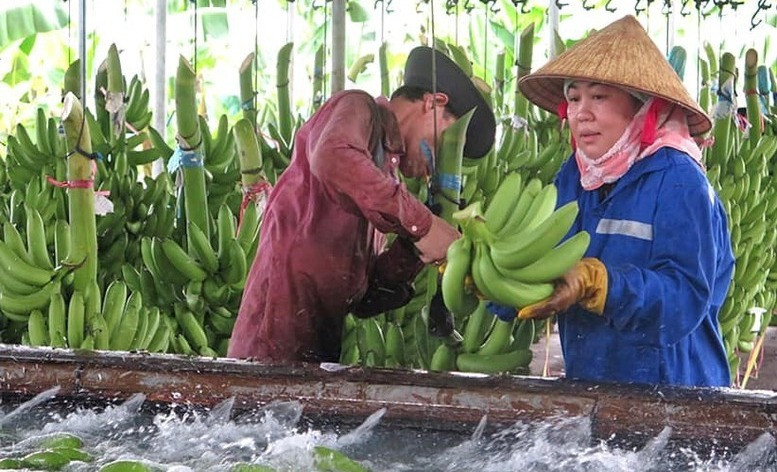
In 2024, Vietnam’s banana exports reached nearly $372 million, marking a notable presence in global markets. Yet, this figure still falls short of expectations given the country’s immense potential, and the long-standing goal of developing bananas into a billion-dollar export industry remains elusive.
Speaking at the “Solutions for Fusarium Wilt in Banana Cultivation” forum on December 13, Associate Professor Dr. Le Quoc Doanh, former Deputy Minister of Agriculture and Environment and current President of the Vietnam Gardening Association, emphasized that the industry holds considerable room for growth. However, he stressed the need for a thorough reassessment of production organization and development strategies.
Bananas are one of Vietnam’s most economically valuable fruit crops, with the largest cultivation area nationwide - approximately 163,000 hectares - and an estimated annual yield of 2.8 million tons. Vietnamese bananas are exported to numerous markets, including China, Japan, South Korea, the Middle East, and Malaysia.
Experts believe that the banana cultivation area could expand by another 50,000 hectares. If supported by proper development and production planning, the banana industry could generate up to $1 billion in export revenue annually.
However, despite consistent growth in both yield and acreage, the $372 million export turnover in 2024 still does not fully reflect the industry's potential. One key reason: other regional nations have already established robust banana export value chains, supported by tight disease control protocols and strict quality standards.
According to Nguyen Quoc Manh, Deputy Director of the Plant Protection Department, the biggest challenges facing Vietnam’s banana industry are plant diseases - most notably Fusarium wilt (also known as Panama disease) - and the increasingly visible impacts of climate change.
Beyond plant health, the industry also struggles with fragmented production, weak supply chain linkages, and limited post-harvest infrastructure for storage and processing.
To help Vietnam’s banana exports reach the billion-dollar milestone and position the country among the global leaders in banana production by 2030, Dr. Mary Grace B. Saldajeno, an expert with Dole Group, emphasized the urgent need to develop disease-resistant banana varieties.
Globally, methods such as somatic mutation, conventional crossbreeding, induced mutation, accelerated hybridization, and gene editing are being explored. Among these, gene editing is seen as a breakthrough thanks to its ability to precisely target plant genomes without introducing foreign genes - improving disease resistance and climate adaptability.
From a strategic standpoint, Associate Professor Dr. Le Quoc Doanh noted that disease prevention measures alone are insufficient. The sector requires supportive policies, stronger production linkages, the development of resilient banana varieties, and brand-building efforts in international markets.
“If we can fully leverage our natural advantages and systematically address bottlenecks, bananas can contribute significantly more to Vietnam’s fruit and vegetable export earnings - worthy of their role as a strategic export crop,” Doanh affirmed.
Vu Diep
.svg)
