 Vietnamnet.vn

 Podcast



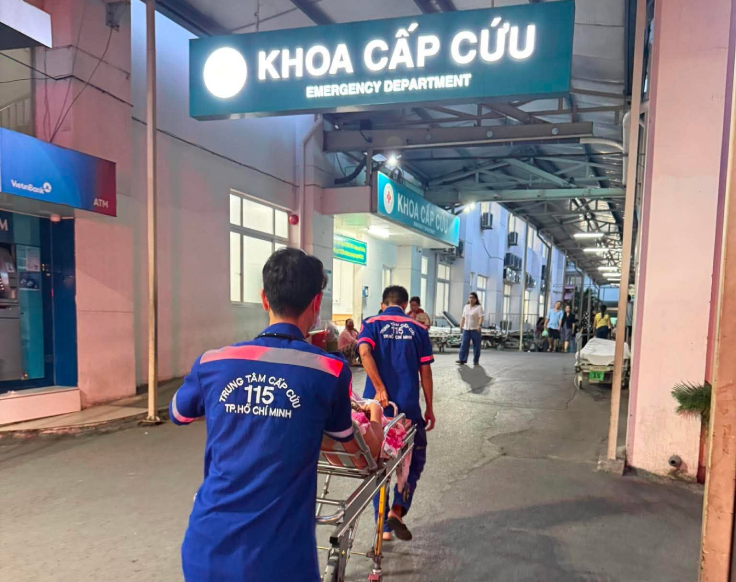
On June 20, T.T.P.H. called her son N.H.A and spoke very unclearly, repeatedly saying she fell when trying to stand up. Sensing something wrong with his mother, A. immediately rushed home and found her with facial droop, left-side weakness, and difficulty opening her eyes.
Without delay, A. called 115 emergency. While waiting for the ambulance, he followed medical staff instructions, kept his mother still, and prepared her citizen ID and necessary papers.
About an hour after the first call, H. was taken to People’s 115 Hospital. CT results confirmed the patient had a brain hemorrhage due to hypertension, a stroke type with severe prognosis, high risk of death and lasting sequelae.
“Right after admission, my mother had a CT scan, IV medication, and very close monitoring. The doctor also explained my mother was in serious condition, at risk of coma,” A. recalled.
After completing admission procedures, the family paid a VND3 million advance. H. received intensive care in the Emergency Department before being transferred to the Treatment Department when her condition gradually stabilized.
What surprised the whole family most was that on discharge day, the hospital refunded VND2.7 million. Thus, the entire inpatient treatment, medication, and intensive care incurred only about VND300,000 thanks to health insurance coverage.
“I was really surprised. Without health insurance, the hospital bill burden would certainly be huge. What impressed me is that during emergency care, the doctor didn’t even ask if we had health insurance but only needed the citizen ID; all information was already integrated very conveniently,” A. shared.
Including the 115 ambulance cost of VND450,000, the total amount H.’s family had to pay during a week of stroke treatment was only about VND750,000.
Currently, H. has been discharged with stable health conditions, speech is more fluent but her left side remains weak and she continues physical therapy for functional recovery.
Health insurance acts as "protective shield"
Assoc. Prof. Dr. Nguyen Huy Thang from Nhan Dan 115 Hospital emphasized that health insurance not only eases financial burdens but also enables patients to receive continuous post-stroke treatment.
He recounted the case of a male patient born in 1982 who was admitted with total paralysis of his left arm and leg. A CT scan showed a massive cerebral infarction in the right hemisphere caused by an occlusion of the right middle cerebral artery. An electrocardiogram subsequently revealed atrial fibrillation, a major stroke risk factor, which had gone undiagnosed until then.
The patient was indicated for emergency thrombectomy. However, right before the procedure, the family disclosed that they had only 5 million VND left.
"The patient’s younger sister said that due to financial hardship, her brother did not buy health insurance. He worked as a ride-hailing motorbike driver to support his 10-year-old son. Despite their circumstances, the medical team decided to proceed with the intervention immediately," the doctor said.
Thanks to the timely emergency intervention and thrombectomy, by the following morning, the patient showed remarkable motor recovery, regaining 4/5 of his muscle strength.
Post-treatment, Dr. Thang advised the patient to enroll in health insurance immediately upon discharge. This would help him sustain treatment, attend regular follow-ups, and significantly reduce financial pressure throughout his monitoring process.
Under current regulations, emergency patients at any medical facility are covered by the health insurance fund according to the benefit level stated on their card, regardless of their initial registered healthcare provider. In stroke cases, which qualify as medical emergencies, patients are guaranteed full benefits based on their health insurance tier.
The Ministry of Health notes that Vietnam ranks among the nations with high stroke rates, recording 222,000 cases annually, yet the majority fail to reach emergency systems in time.
Only 23.2 percent of patients arrive at the hospital within the first 4.5 hours of symptom onset, the "golden window" for effective intervention. Furthermore, only about 20% of patients are transported via professional emergency services.
Dao Viet Phuong, Deputy Director of the Stroke Center at Bach Mai Hospital, pointed out several "bottlenecks" in the stroke emergency pipeline. These include the public’s failure to recognize early symptoms, patients self-transporting to hospitals instead of calling for an ambulance, or undergoing multiple transfers before reaching specialized care.
Phuong Thuy
.svg)
