 Vietnamnet.vn

 Podcast



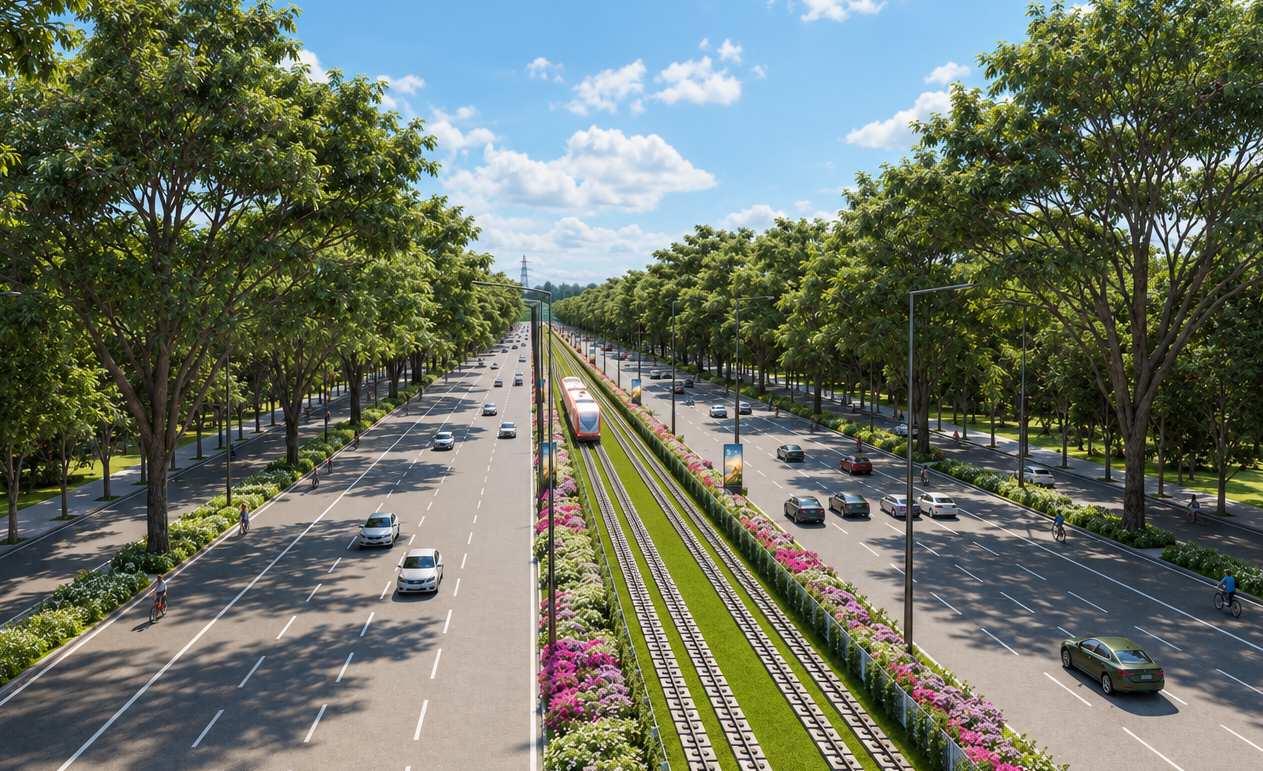
The Phu Quoc light rail transit (LRT) line will run 17.59 kilometers and has a total investment of nearly $346 million, connecting Phu Quoc International Airport with the APEC Convention Center.
The line will use electric trains on standard-gauge 1,435mm tracks. Of the total route, 14.81km will run at ground level, 0.78km on elevated sections and 2km underground through the core APEC area.
The track system uses 60R2 grooved rails measuring 180mm high, with each rail section 25 meters long. Vietnam Railways and China Railway 16th Bureau Group Co., Ltd. (CRCC16) are carrying out a contract to supply, install and calibrate the rail system.
Technology is not the bottleneck
According to Dang Sy Manh, Chairman of Vietnam Railways, this is the first time the railway operator has directly undertaken construction of an LRT line under current conditions. However, the project’s main construction tasks are not particularly new to the industry.
“Reinforced concrete, structural installation, track laying and rail welding are all areas in which the railway sector already has experience,” Manh said.
Vietnam Railways has previously participated in urban rail projects including Hanoi’s Cat Linh-Ha Dong line and Ho Chi Minh City’s Ben Thanh-Suoi Tien metro line. It has also sent officials, engineers and workers to study railway technologies in Vietnam and abroad.
According to Manh, the Phu Quoc LRT presents no major technological challenge. Fundamentally, it remains a rail-based railway system.
Although the technical requirements are stringent, each component is built, inspected and accepted step by step. Consultants at the construction site have also rated the project’s construction organization and quality control highly, he said.
Beyond construction, Vietnam Railways also has experience operating railway systems. Its involvement alongside the investor from an early stage is therefore seen as an advantage in bringing the project into operation.
Under the design, the Phu Quoc LRT can operate up to 14 trains. During the first phase, An Giang authorities and the investor plan to put six to 10 trains into service, each consisting of three cars and using clean energy.
The entire line will be capable of carrying around 4,500 passengers per hour.
Once completed, travel time from Phu Quoc International Airport to the APEC Convention and Exhibition Center, as well as resorts and entertainment destinations in the southern part of the island, is expected to fall to about 20 minutes.
Racing against time
For the Phu Quoc LRT, the difficult part is not the technology but the race against time.
A large volume of work must be completed before February 2027, leaving contractors with a very tight schedule.
Manh said site handover and weather are the factors most likely to directly affect progress.
“The challenges here are handing over cleared sites to contractors for construction, and the weather and climate, which can be unpredictable at times,” he said.
Under these conditions, Vietnam Railways must closely monitor the project’s critical path, proactively deploy construction teams and coordinate resources to avoid being caught off guard by problems arising at the site.
Dinh Ba Long, who heads a team installing tracks on the Phu Quoc LRT, said the track installation alone must be completed before March 2027 so the system can be handed over to the investor for trial operations.
Construction teams are therefore maintaining three to four shifts a day, taking advantage of every spell of favorable weather to accelerate track installation.
When it rains, engineers and workers erect mobile shelters so they can continue working.
“This is considerable pressure, but it is also an honor,” Long said. “The project will serve APEC, so everyone is determined to do their utmost to complete their part of the work.”
A test for Vietnam’s urban rail ambitions
According to Manh, the Phu Quoc LRT is more than an infrastructure project for APEC 2027. It is also an opportunity for Vietnam Railways to gain experience for future urban railway projects.
The lessons extend beyond the technical work of laying and welding rails. They include managing a construction site under a tight deadline, mobilizing multiple organizations and coordinating workers and equipment around critical tasks.
“This is also a step toward demonstrating that Vietnam Railways is capable of delivering projects like this, as well as projects involving more advanced technologies, for example in cities and urban areas and across different forms of urban rail, including light rail,” Manh said.
Vu Diep
.svg)
