 Vietnamnet.vn

 Podcast



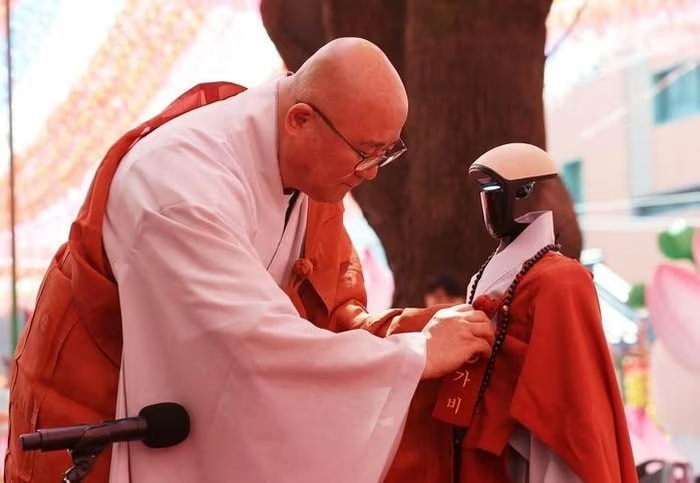
As AI moves closer to temple life, questions are emerging about how far technology can support religious practice - and what parts of spiritual cultivation remain uniquely human.
The recent appearance of the humanoid robot Gabi at Jogyesa Temple in Seoul, South Korea, has drawn widespread attention.
During a ceremony organized by the Jogye Order of Korean Buddhism, the 1.3-meter-tall robot received the Dharma name “Gabi” and took part in a refuge ceremony.
Some Buddhist precepts were even reinterpreted for the technological age, including principles such as causing no harm, avoiding falsehoods, conserving energy and not damaging other robots.
This is not the first time technology has entered temple grounds.
In Vietnam, Giac Ngo Pagoda in Ho Chi Minh City introduced the “novice monk” robot Giac Ngo 4.0 in 2019.
The robot was capable of chanting sutras, receiving questions and answering around 3,000 topics related to Buddhist teachings.
Developments like these can feel strange and even controversial.
Can a robot formally enter Buddhist practice?
Can machines chant sutras?
Does technology diminish the solemnity of sacred spaces?
But viewed more broadly, the appearance of robots and AI reflects a deeper reality: religious life is also adapting to the digital age.
Over the past several years, religious spaces have changed significantly under the influence of technology.
Dharma talks are livestreamed, scriptures are digitized and meditation retreats can now be registered for online.
Young people increasingly learn about Buddhism through social media, podcasts, short videos and meditation apps.
In that context, robots chanting sutras or AI systems answering questions about Buddhist teachings are simply further steps in the process of technology becoming a tool for spreading religious knowledge.
On the positive side, technology can help Buddhism reach people who may have limited access to temples, scriptures or traditional classes on Buddhist teachings.
A robot capable of answering basic questions about Buddhism may help newcomers feel less intimidated.
An AI-supported system carefully designed around Buddhist teachings could assist with scripture searches, explain philosophical concepts and recommend Dharma talks suited to individual needs.
For younger generations accustomed to consuming information through digital devices, such formats may spark initial curiosity and open the door to Buddhist teachings in a more accessible way.
Yet the very appeal of technology also reveals limitations that should be acknowledged clearly.
Robots lack human experience and emotional depth.
At the core of Buddhist practice lies not the repetition of rituals, but mindfulness and awakening.
A person chants sutras not merely to produce sound, but to listen inwardly, reflect upon themselves, cultivate compassion and transform suffering.
People visit temples not only to witness ceremonies, but also to rediscover inner peace, let go of attachment and desire, and learn to care more deeply for themselves and others.
No matter how advanced technology becomes, those experiences still belong to human life.
For that reason, the central question is not whether robots or AI should enter Buddhist spaces.
The more important questions are why they are being introduced, to what extent and who bears responsibility for the content technology delivers.
If AI is used simply as a support tool - helping people search teachings, guiding beginners or reminding users to practice kindness - it may become a useful means of support.
But if technology becomes the center of attention and turns rituals into performances, then the sacred dimension of religious life can easily be overshadowed by curiosity and spectacle.
From the story of robot Gabi in South Korea to Giac Ngo 4.0 in Ho Chi Minh City, it is clear that religion does not stand outside the flow of technological change.
At the same time, religion should not be swept away merely by the novelty of technology.
For Buddhism, every tool must ultimately guide people back toward what matters most: reducing suffering, living mindfully, cultivating compassion and taking greater responsibility for one’s life.
In the end, technology may only serve as a means of bringing people to the threshold of faith.
Crossing that threshold - and practicing mindfulness in everyday life - remains the work of each individual.
Hong Phuc
.svg)
