 Vietnamnet.vn

 Podcast



Hanoi is set to pilot a low-emission zone starting July 1 in the core area of Hoan Kiem ward. To support residents and limit high-emission vehicles entering the city center, authorities have announced a list of parking locations surrounding the zone.
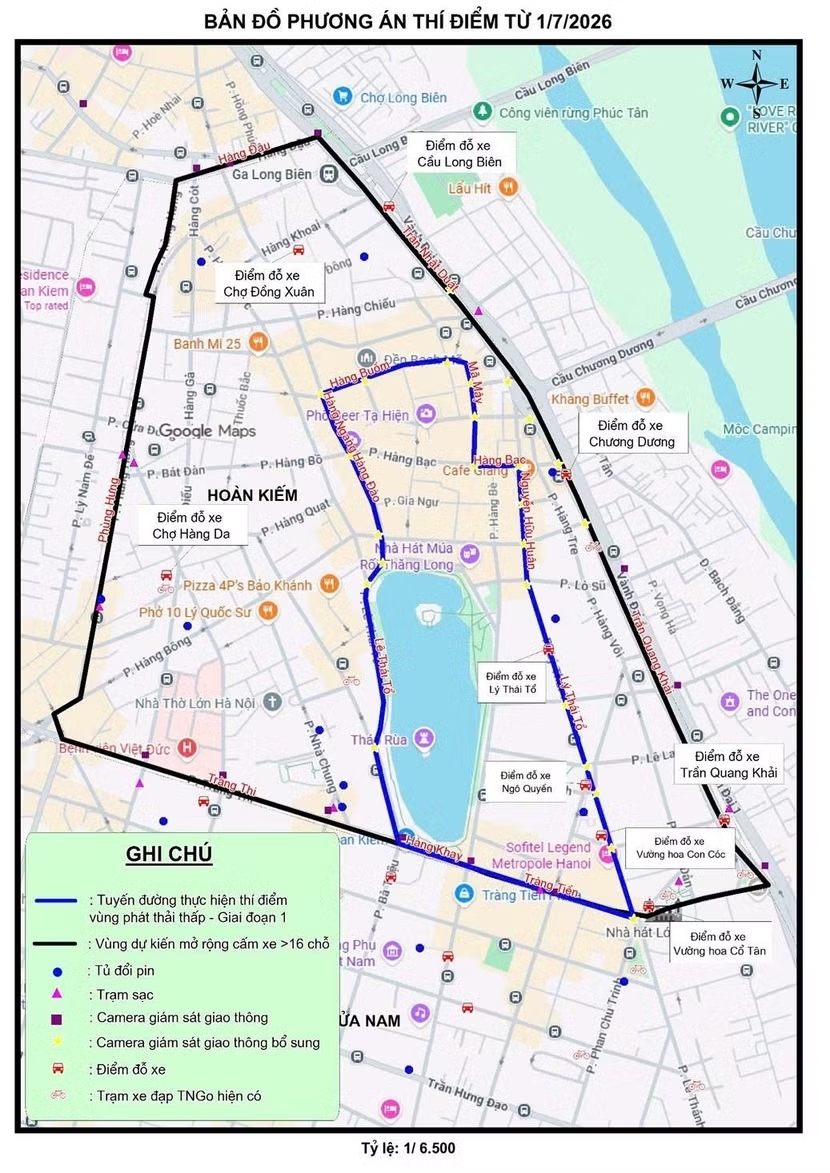
A view of the pilot low-emission zone area in Hanoi.
According to the Hanoi Department of Agriculture and Environment, establishing a low-emission zone within Ring Road 1 is a new initiative and the first of its kind in Vietnam. The move aims to reduce polluting vehicles, promote a shift to greener transport, and increase the use of public transportation.
The plan will be implemented in three phases. From July 1 to December 31, the pilot will cover the core area of Hoan Kiem ward. In 2027, it will expand to Cua Nam ward, encompassing 14 surrounding streets. From 2028 to 2029, the policy will be applied across the entire Ring Road 1 area.
Choosing Hoan Kiem as the pilot core
Explaining the selection of Hoan Kiem as the pilot area, city officials noted that the district is less affected by large-scale construction and has minimal external emission sources. It also has experience in traffic restriction through its long-running weekend pedestrian street model.
Infrastructure supporting the transition is relatively well prepared, including a network of charging stations and battery swap points in the area and nearby zones. An AI-powered traffic camera system has also been installed to monitor vehicles entering and exiting the pilot area.
Multiple parking sites around Hoan Kiem and the city center
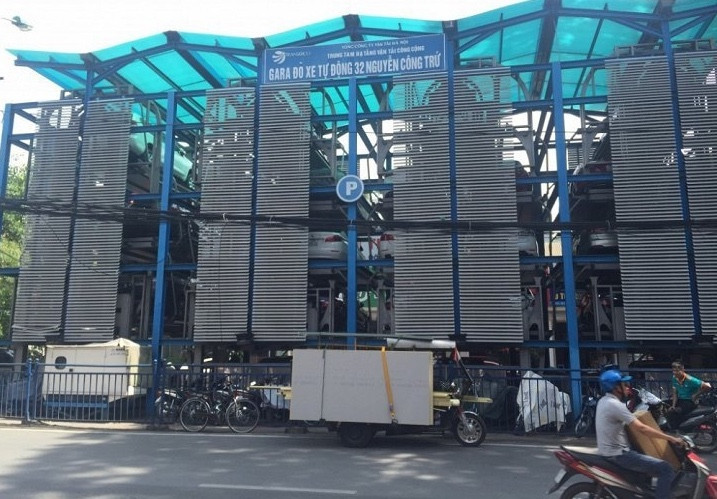
A multi-storey parking facility in Hoan Kiem district. Photo: VTC.
To support the pilot phase, authorities have identified existing parking locations around the central area.
Around Hoan Kiem Lake, parking is available along Dinh Tien Hoang Street (from the fountain area to Thang Long Theatre), Ly Thai To Street (from Lo Su to Tran Nguyen Han), Ngo Quyen Street (in front of numbers 16-22 and the Le Lai - Le Thach area), and Dien Hong Garden on Le Phung Hieu Street.
In the Opera House and Trang Tien area, parking sites include the garden of the Revolution Museum at 25 Tong Dan and Phan Chu Trinh Street, Co Tan Street near the Opera House, and the Melia hotel area at 44B Ly Thuong Kiet Street, which does not accept overnight parking.
Along major routes, parking is arranged on Quang Trung Street (section from Tran Hung Dao to Trang Thi, operating 24/7), the Vietnam-Soviet Friendship Cultural Palace at 91 Tran Hung Dao, Ly Thuong Kiet Street, and Hai Ba Trung Street, where licensed roadside parking is available.
Expansion of multi-storey and smart parking
In addition to traditional parking areas, the city is introducing multi-storey and smart parking facilities.
Notably, a large-capacity multi-storey parking facility at 502 Tran Nhat Duat Street, beneath the Chuong Duong Bridge approach, operates around the clock. Smart parking systems using automated technology have also been deployed on Tran Hung Dao and Ly Thuong Kiet streets.
At markets and commercial centers, residents can park at Dong Xuan Market, the basement of Hang Da shopping center, or the parking area in Chuong Duong Do.
For motorbikes, most streets in Hoan Kiem have licensed sidewalk parking. Key locations include Phu Doan and Trieu Quoc Dat streets near major hospitals, Ba Trieu and Hang Bai streets, and temporary parking points within the weekend pedestrian zone.
According to the Department of Agriculture and Environment, arranging parking around the core zone is intended to help residents leave private vehicles outside and switch to public transport or green mobility options when entering the city center.
The initiative is seen as a significant step toward changing travel habits, reducing traffic pressure, and improving air quality in Hanoi’s inner districts in the coming years.
Vu Diep
.svg)
