 Vietnamnet.vn

 Podcast



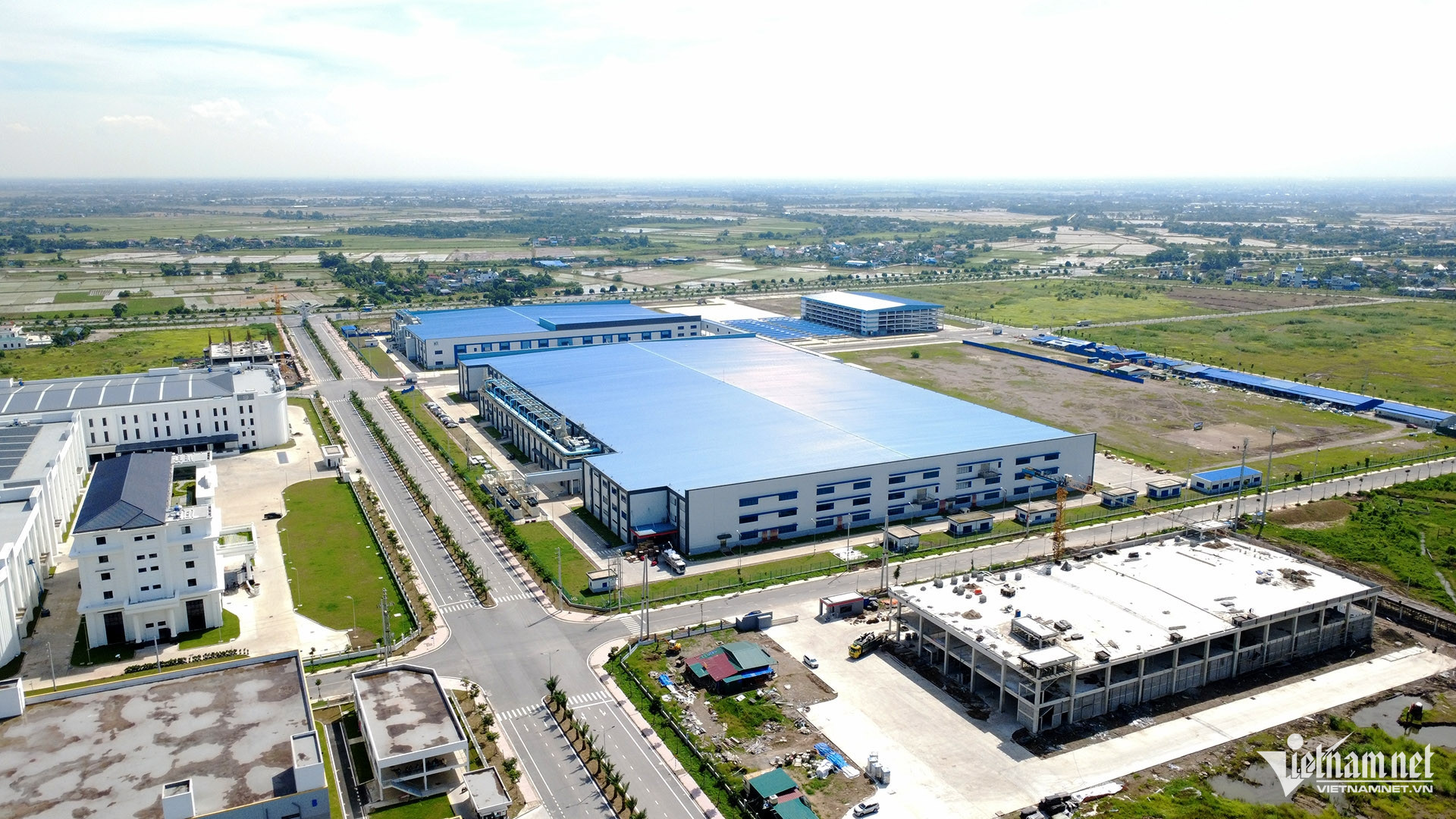
In mid-April 2026, QMH Computer Company, belonging to Quanta Group at My Thuan Industrial Park (Ninh Binh) is ramping up production activities, shipping batches of laptops to meet order deadlines.
In 2025, this plant's laptop output increased by 517.1 percent; in the first quarter of 2026, it continued to rise by 233.3 percent compared to the same previous periods.
This enterprise is also accelerating recruitment, having opened a supplementary round for about 1,000 technical workers in April, with monthly incomes ranging from VND9–14 million.
The current production expansion momentum is believed to stem from a decision two years ago, when a $120 million project was licensed in a very short time.
In April 2023, Quanta Computer Inc. signed an agreement to develop a computer manufacturing project at My Thuan Industrial Park (which then belonged to Nam Dinh, now Ninh Binh).
As one of the world's leading laptop manufacturers, Quanta's choice of this locality as its first base in Vietnam necessitated rapid procedural handling to retain the investor.
The entire licensing process took place in approximately 36 hours.
On May 4, 2023, the enterprise submitted its application. During the day, relevant agencies completed reports and reached a consensus on the policy. By the afternoon of May 5, the Investment Registration Certificate for the $120 million project (over VND2,829 billion) was signed.
Quanta's project is not alone. The investment wave into Ninh Binh is spreading with an increasing scale. By the end of March 2026, industrial parks in the area had attracted 1,135 secondary projects, including 550 FDI projects and 585 domestic projects, with total registered capital reaching $10.6 billion and VND135,735 billion.
The disbursement rate remains high. Japanese investors alone have 112 projects with a total capital of $1.473 billion and a disbursement rate of approximately 95 percent.
New strategy after the merger
The "landing" of numerous big investors in Ninh Binh recently reflects the synergy between infrastructure development and administrative management.
Nguyen Hoang Anh, head of the Management Board of SEZs and Iindustrial Parks, said the advantage after the nationwide administrative merger lies in a relatively complete connection system, with transport axes such as the North-South Expressway, the Ninh Binh – Hai Phong route, railways, and an inland waterway network spanning nearly 265 km.
Alongside this, several infrastructure projects are being implemented, such as a coastal road with an 8-lane scale and a total investment of approximately VND9,100 billion, and the Phu Thu intersection (about VND1,400 billion), aimed at increasing connectivity from industrial parks to seaports.
Improved connectivity infrastructure also creates conditions for preparing land funds to serve new projects. According to the 2021–2030 planning, Ninh Binh expects to develop approximately 12,144 hectares of industrial land.
Among the ongoing projects, the Hai Long Industrial Park (VSIP) with a scale of 180 hectares and a total capital of over VND2,200 billion, is oriented toward a low-carbon industrial park model.’’
Administration is considered one of the vital factors in enhancing Ninh Binh's appeal to investors. Changes in administrative methods are initially reflected through economic indicators. Cumulatively by the end of 2025, enterprises in industrial parks had revenue of approximately VND461,834 billion, contributing nearly VND22,000 billion to the budget.
Secretary of the Provincial Party Committee Tran Huy Tuan said at a conference on April 21 that since July 1, 2025, the locality has operated under a two-level government model amid many challenges, yet economic indicators recorded positive results.
In 2025, the provincial GRDP increased by 10.65 percent, ranking third nationwide. In the first quarter of 2026, growth reached 11.63 percent, ranking second; the industrial production index (IIP) rose by 28.74 percent, in which processing and manufacturing increased by 29.05 percent. The entire province attracted 328 new projects, including 84 FDI projects.
Regarding trade, the total import-export turnover in 2025 reached approximately $57 billion, a 57 percent increase over the previous year, with a trade surplus of $2.44 billion. The first quarter of 2026 reached $14.7 billion, up 51.8 percent compared to the same period last year.
These results show that Ninh Binh's growth momentum is shifting clearly toward industry - export - international integration, in which the business sector, especially FDI and import-export enterprises, holds a key role.
Doan Bong
.svg)
