 Vietnamnet.vn

 Podcast



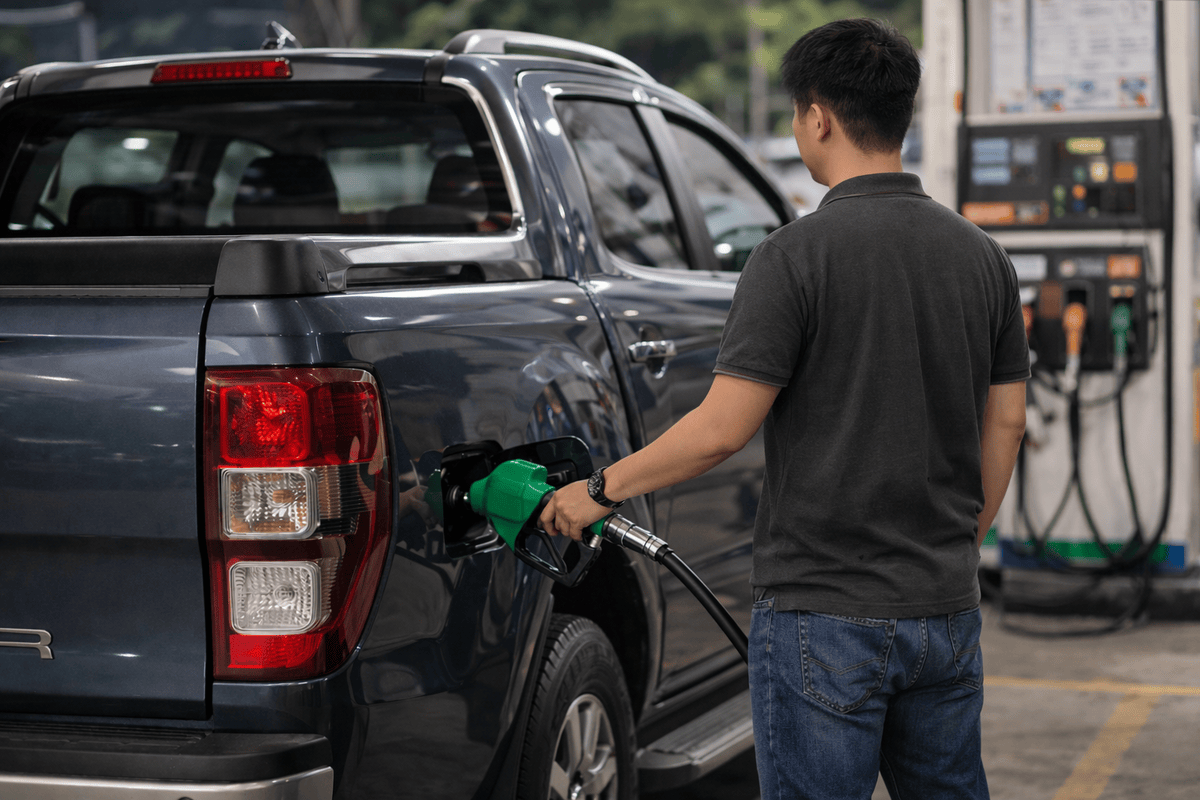
Diesel prices are at a high level of up to VND44,780/liter, creating pressure on car users, especially pickup trucks that use diesel engines with large fuel tanks.
Observers say most pickup models in Vietnam have fuel tank capacities ranging from 75–85 liters. At current diesel prices, the cost for a single tank filling ranges from VND3.3 to 3.84 million, or nearly VND4 million.
Ngoc Duc (Hai Ba Trung, Hanoi), owner of an older Toyota Hilux from the 2000 model year, said his car has a 70-liter tank capacity; previously, each full tank cost only over 1 million VND. However, with the current diesel price reaching nearly 45,000 VND/liter, the cost has nearly doubled.
“I have to temporarily put the car away and use a motorbike and a gasoline-powered car to be less wasteful. It sounds funny, but this is an unavoidable choice while fuel costs are escalating,” he said.
Le Quang Hoang (Dong Da ward) has also changed his habits, switching to a motorbike for short trips within the city. “The pickup is now only for long-distance trips or carrying heavy loads. Driving around the city and burning hundreds of thousands of VND in diesel every day is really unbearable.”
Vu Duc Long (Long Bien ward, Hanoi), who drives a Ford Ranger 2.0 Bi-Turbo, said he used to fill up his tank before long trips. However, with current prices, he has had to adjust.
“Now I only buy VND1-1.5 million worth of diesel each time and use it gradually. Watching the meter jump so quickly at the gas station really hurts,” he said.
According to Long, with an 80-liter tank, a full refill now costs nearly VND3.6 million, compared to about VND2.7 million just a few weeks ago.
Not only private users, but many drivers who rely on pickups for work are also facing similar challenges. Tran Minh Quoc (Gia Lam, Hanoi), who uses an Isuzu D-Max 1.9L with a 76-liter tank, said rising costs have forced him to rethink his travel schedule.
“Previously, I drove freely between job sites. Now I have to consolidate trips and limit unnecessary travel. Each full tank now costs over VND3.4 million, nearly VND900,000 more than before. Without careful calculation, I would incur losses,” he said.
Meanwhile, Nguyen Thanh Phuong, who transports construction materials using a Toyota Hilux 2.4L, described a “lose-lose” situation. “Yesterday, I took a job that paid less than VND1 million, but fuel costs alone took up more than half. Add toll fees, and there’s basically no profit left.”
He refuels two to three times a week, equivalent to about VND7–10 million per month, several million VND more than before.
Tighter regulations add further strain
Many pickup drivers said they are overwhelmed by both rising costs and regulatory pressure. From stricter emissions inspections, where rapid acceleration during testing raises concerns about engine damage, to restrictions on operating hours in inner-city areas, all factors are making vehicle use more complex and costly.
"Before having time to breathe easily when there was information about loosening some restrictions, users continued to face a sharp increase in diesel prices, pushing operating costs high. The concentration of many disadvantages in a short time is forcing many vehicle owners to adjust their travel plans, and even reconsider the economic efficiency of using pickup trucks," Phan Nguyen Thanh (Dong Anh District, Hanoi) said.
Do Manh Cuong (Nam Tu Liem, Hanoi), who drives a 2022 Ford Ranger 2.0L, said: “Recently, there has been a lot of 'suffocating' news. Going for inspection, one worries about failing, or the engine being affected by forced acceleration. Going to fill diesel, the 'wallet hurts.' Going out on the road, one has to watch the clock to avoid banned routes. It feels like using a car always requires calculation.”
High fuel prices, inspection costs, and the pressure of circulation control are creating a “double problem” for pickup truck owners. Car users will need to consider more carefully, moving toward electric vehicles and energy-saving cars, which are both suitable for future trends and contribute to environmental protection.
Y Nhuy
.svg)
