 Vietnamnet.vn

 Podcast



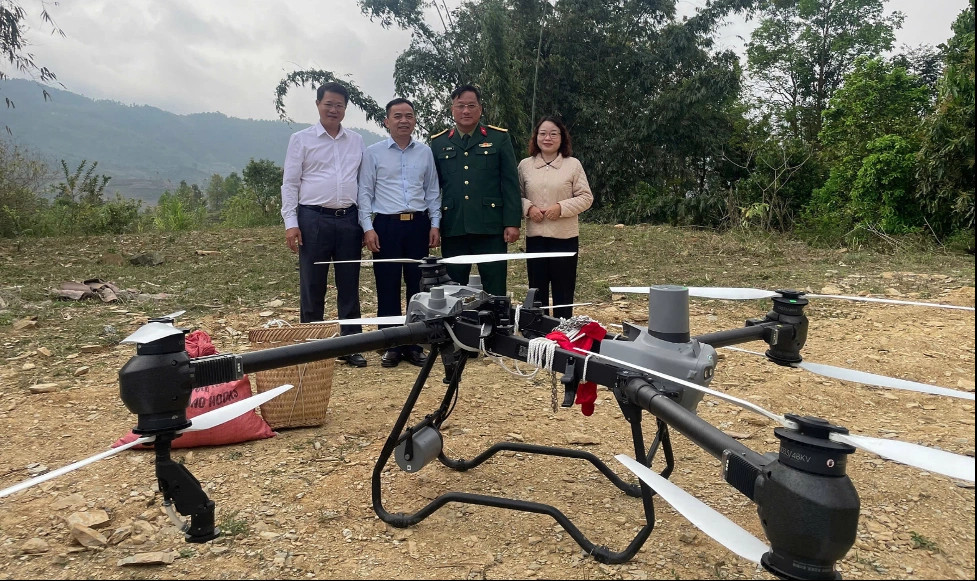
The initiative is considered a pioneering step toward unlocking the potential of the low-altitude economy and creating a foundation for developing policies and regulations for this emerging sector.
Under the decision, the Dien Bien Department of Science and Technology will take the lead, coordinating with provincial departments, agencies and organizations to implement and supervise the pilot program.
Vietnam Post will serve as the lead operator for deployment and trial operations. FPT Corporation, together with other UAV manufacturers, will provide technical support, technology solutions, UAV equipment and flight-control software systems.
Other participants include providers of UAV operation, maintenance and repair services, as well as local organizations, cooperatives, businesses and residents in Dien Bien, who will act as users, beneficiaries and partners in evaluating the effectiveness of the model.
The pilot program will run from the effective date of the decision through May 31, 2027, focusing on four sectors: agriculture, logistics, healthcare, and digital mapping.
Trial activities will include transporting agricultural products, farming inputs, medicines, medical supplies, laboratory samples and essential goods; supporting seed sowing, crop spraying, fertilization, crop monitoring and pest detection; and conducting topographic surveys, digital mapping and digital elevation model (DEM) development.
Dien Bien aims to conduct 6,000 UAV flights during the pilot period, with a target flight safety rate exceeding 99 percent.
The province also plans to establish databases for flight management, flight monitoring, digital mapping and digital elevation modeling within the pilot areas.
The sandbox program will be implemented in several key agricultural and healthcare locations across the province.
In agriculture, pilot sites include tea-growing areas in Sinh Phinh Commune, coffee plantations in Muong Ang, macadamia-growing areas in Tuan Giao, and rice cultivation zones in Thanh Nua.
In healthcare, the province will establish an emergency UAV transport network linking Muong Ang Medical Center with healthcare facilities in Na Tau Commune and the health stations of Muong Dang, Ngoi Cay and Ang To communes. The network will transport medicines, medical supplies and laboratory specimens, improving access to healthcare services for local residents.
Under the decision, all flights conducted within the pilot framework must be registered, evaluated and approved in accordance with existing regulations. Operations must comply with requirements related to national defense, security, airspace management, flight safety, radio frequency management, information security, and public order.
During the initial phase, flight permits are expected to be issued on a monthly basis to allow authorities to evaluate results and gain operational experience before considering broader deployment.
The Dien Bien UAV sandbox is expected to generate valuable data and practical experience for assessing socio-economic impact, operational feasibility, and risk management, while supporting the development of regulatory frameworks for Vietnam's low-altitude economy in the time to come.
Speaking at the recent Dien Bien Investment Promotion Conference 2026, Deputy Minister of Science and Technology Bui Hoang Phuong said that many of Dien Bien's long-standing challenges, including rugged terrain and long distances between residential areas and economic centers, could become new development opportunities if solved by technology.
This is a new economic model as well as a policy test to improve the institutional framework for science and technology, innovation, and national digital transformation.
“The participation of large corporations and companies such as SunGroup, Vingroup, and FPT will play a leading role and form an ecosystem, creating a strong spillover effect within the province,” Phuong said.
Dien Bien was chosen as the testing place because around 70 percent of the cultivation area are hillsides, difficult to mechanize, with high labor costs and expensive logistics. These are the "bottlenecks" in which UAV technology can intervene.
Nguyen Van Khoa, CEO of FPT and chair of the Low-Altitude Economic Alliance of Vietnam (LEAP), said that UAVs in agriculture can help reduce spraying time from fiur hours down to 10 minutes per hectare; increase seeding and fertilizer spreading productivity up to 40 to 64 hectares per day; and reduce around 40 percent of logistics costs for transporting agricultural products.
Thai Khang
.svg)
