 Vietnamnet.vn

 Podcast



Before the introduction of a centralized data platform, reporting across Viettel relied on a fully manual, multi-layered process. Each district had its own reporting staff, data was consolidated at the provincial level, and then further aggregated at the group level. The result was fragmented data, slow updates and inevitable inconsistencies.
“To get a complete picture, information had to pass through many intermediate layers. Decision-making was neither fast nor accurate,” Dong recalled.
This bottleneck became the starting point for a nearly four-year journey to build Viettel’s big data platform, known as VLP.
Rather than serving as a simple storage system, VLP was designed as a data backbone - collecting, processing and standardizing information from multiple sources in real time.
Once deployed, it fundamentally changed how the organization operated. Data was no longer a static end-of-day report but a continuous stream supporting real-time management decisions.
When data becomes the core of decision-making power
Dong’s work goes beyond technology. At its core lies a shift in management culture.
Data, he argues, only has value when it is activated. Scattered across software systems, paperwork or individual memory, even vast amounts of data become meaningless.
“To make data-driven decisions, you first need data. But more importantly, you need systems that turn it into usable information,” he said.
For a multi-sector, multinational corporation like Viettel, the sheer volume of data is enormous. Yet fragmentation had long been its biggest barrier.
The VLP platform addresses this by unifying and standardizing data, enabling real-time analytics. Leaders can now monitor daily revenue, evaluate the performance of individual service packages, and detect operational anomalies - insights that previously took days or even weeks to compile.
In this context, data is no longer just a support tool. It becomes the very foundation of decision-making power.
Democratizing AI and breaking the expert barrier
If data is the foundation, artificial intelligence is the tool that unlocks its value. But AI has traditionally been seen as a domain reserved for specialists.
Dong and his team set out to change that.
They developed Viettel’s machine learning platform (vMLP) with a clear goal: to automate the entire AI lifecycle, from data processing to model deployment.
The result is striking. Development time for AI applications has been reduced by up to 75 percent, enabling various units to adopt AI without requiring large teams of experts.
“We want AI to no longer be the privilege of a few, but a tool accessible to many,” he said.
This philosophy extends to GenBI, a system that allows users to query data using natural language instead of relying on technical reports.
It marks a shift from “reading reports” to “asking data.”
Hundreds of billions in value and the Make in Vietnam equation
The platforms developed by Dong and his team have moved far beyond the conceptual stage.
Viettel’s big data platform has been deployed across the entire corporation and in all 10 of its international markets. It also serves major clients including the Party Central Office, the Ministry of Natural Resources and Environment, Vietnam Oil and Gas Group, Vietnam Airlines, and Northern Power Corporation.
The system has generated more than VND260 billion (approximately US$10.4 million) in revenue while saving Viettel around US$9.2 million in costs by replacing foreign solutions.
Meanwhile, the vMLP platform contributes roughly VND12 billion (approximately US$480,000) in annual value, and GenBI delivers additional savings of tens of billions of VND by substituting comparable international products.
Yet the numbers tell only part of the story.
More significant is the fact that a Vietnamese engineering team has successfully built core technology platforms - an area traditionally dominated by global tech giants.
“We are not just building for internal use. We are proving that Vietnamese engineers can master core technologies,” Dong emphasized.
A small team, massive infrastructure, and no ready-made answers
Behind these achievements lies a demanding journey.
The core development team consists of around 10 engineers, yet they manage a system spanning hundreds of servers and vast volumes of data.
The challenge extends beyond individual technologies. It lies in integrating multiple components into a stable, continuously operating system capable of handling real-world pressures.
“The hardest part is not any single technology, but ensuring everything works together seamlessly and reliably,” Dong said.
Without predefined formulas, the team had to learn, experiment and optimize continuously - studying global technologies while building and refining their own solutions from scratch.
Their approach reflects a distinctly Viettel philosophy: launch a functional version, deploy it, and then continuously improve.
Taking Vietnamese data platforms to the global market
Having proven their effectiveness internally and across major domestic clients, Viettel’s data and AI platforms are now entering a new phase - expanding internationally.
From the outset, the systems were designed not only for internal use but as open architectures adaptable to various industries and markets.
“If we only solved internal problems, the product would struggle to grow long term. So we designed it to be packaged and deployed across different sectors and countries,” Dong explained.
The advantages of “Make in Vietnam” platforms go beyond cost competitiveness. They offer flexibility in customization and, crucially, stronger control over data security - an increasingly sensitive issue worldwide.
As governments and businesses grow wary of dependence on foreign technology platforms, Viettel’s solutions are finding opportunities in markets seeking alternatives.
However, the global arena presents intense competition against established tech giants with decades of experience, mature ecosystems and rigorous standards.
To compete, products must meet international benchmarks not only in functionality, but also in performance, stability, security and scalability.
“We go through strict evaluation processes, directly compared with leading global platforms. The pressure is high, but so is the opportunity,” Dong said.
A key strategy lies in ecosystem integration. Rather than entering markets in isolation, Viettel’s data and AI platforms can accompany the group’s telecommunications, e-government and digital transformation projects already underway in multiple countries.
This approach shortens market entry time while leveraging local knowledge and existing relationships.
Beyond one engineer: a broader question for Vietnam
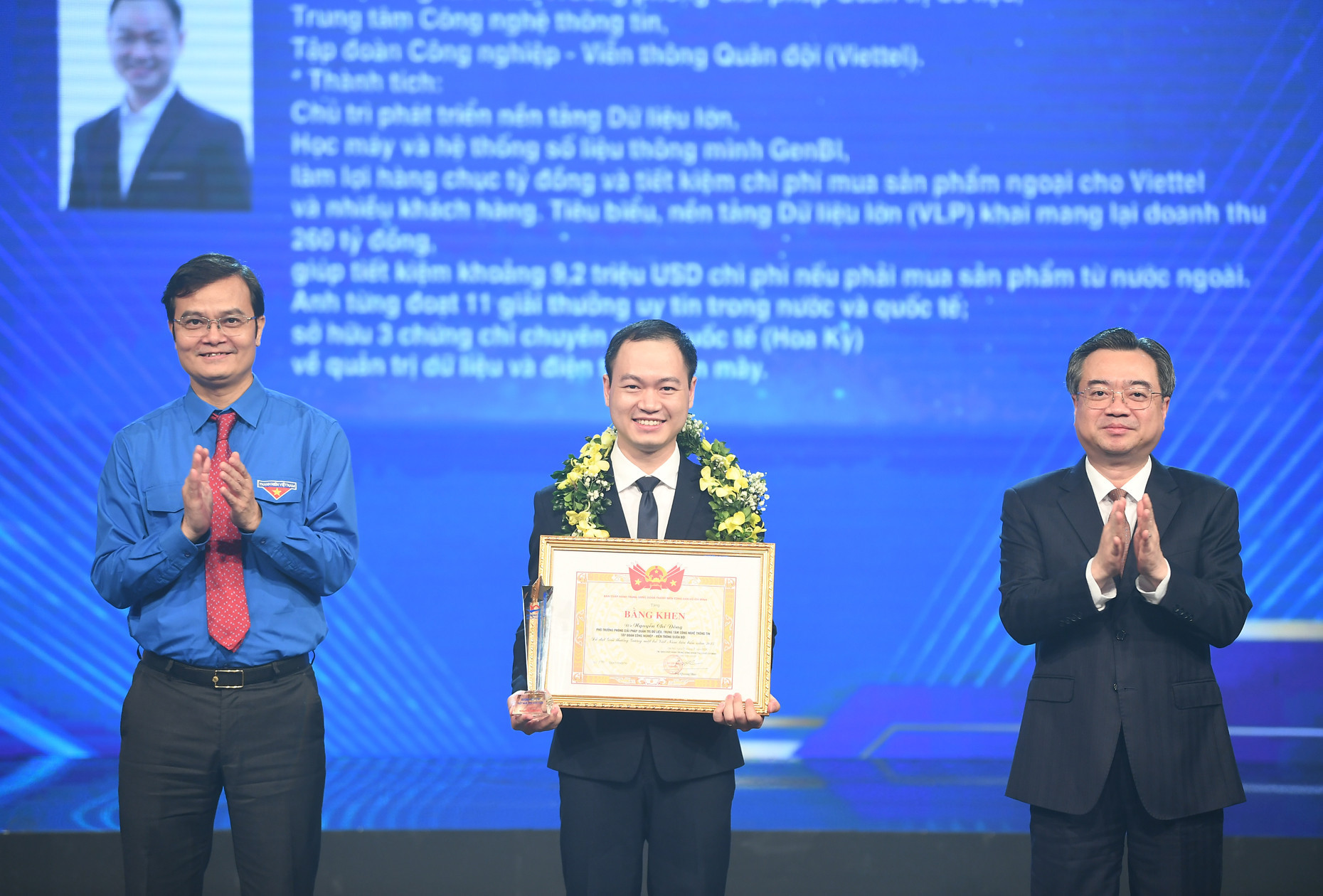
Nguyen Chi Dong’s recognition as one of Vietnam’s Outstanding Young Faces in 2025 reflects not only individual achievement, but a broader shift.
As data and AI become foundational across industries, his story raises a critical question: are Vietnamese organizations truly ready to embrace data-driven decision-making?
Because, as Dong himself noted, technology is not the biggest barrier. Mindset is.
“When every organization truly treats data as its foundation, when every decision is based on numbers, that’s when digital transformation truly begins,” he said.
Perhaps that is the larger challenge engineers like him are pursuing - not just building systems, but reshaping how an entire economy operates.
Thai Khang
.svg)
