 Vietnamnet.vn

 Podcast



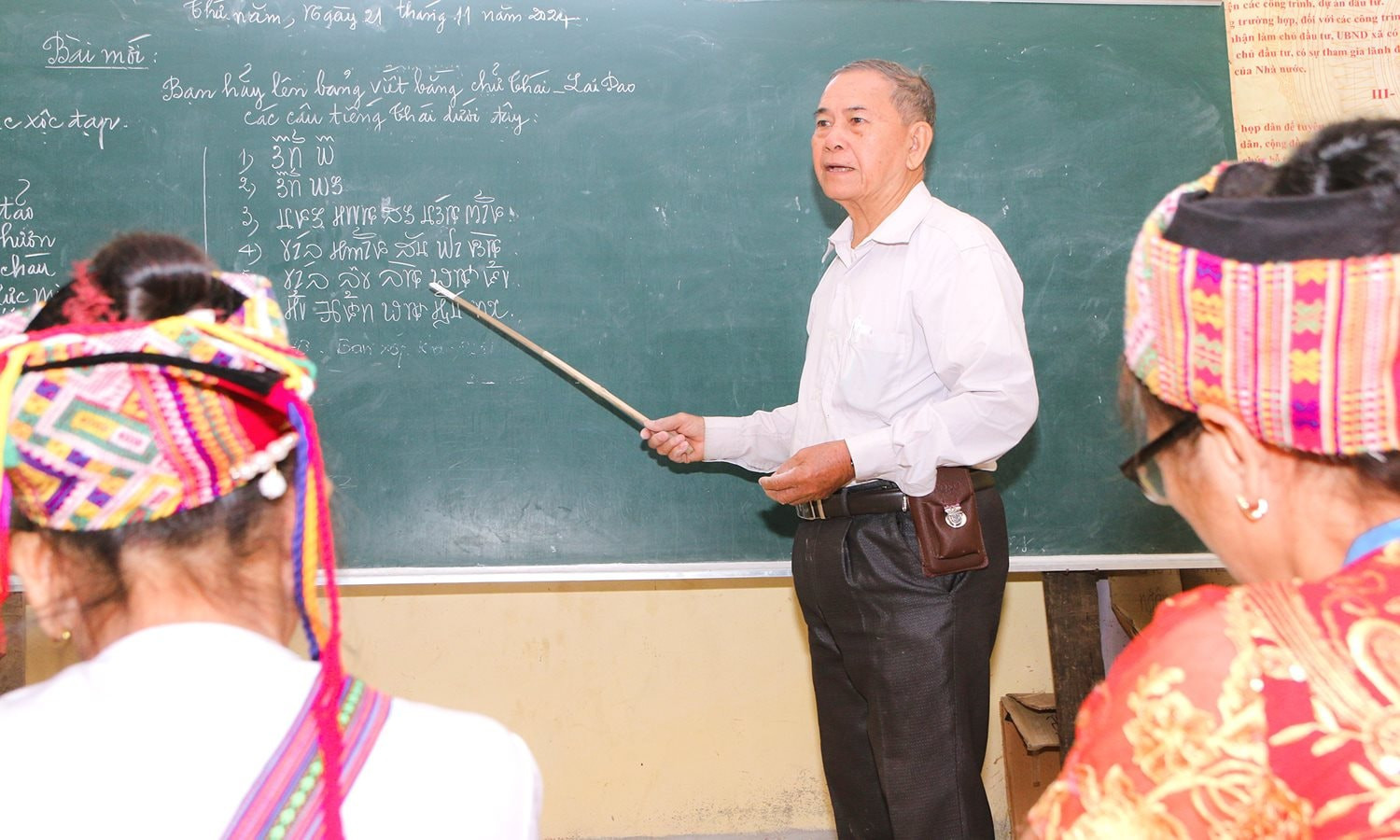
Once on the verge of being lost, the Thai Lai Tay script in Nghe An has now been recognized as a national intangible cultural heritage. Even more remarkably, it has been digitally codified as part of Unicode 17.0, joining the global family of written languages.
A search for identity through script
For nearly three decades, 61-year-old Sam Van Binh from Yen Luom village, Quy Hop commune, has roamed remote hamlets across Nghe An in pursuit of the Thai language. As a teacher and linguistic researcher, he has devoted his life to collecting and studying the Thai dialect, script, and cultural practices.
Through tireless effort, he has become fluent in both reading and writing the Thai script, recovering roughly 90% of the language’s classical vocabulary. “Without a writing system, preserving customs becomes nearly impossible,” Binh explained. “When the script lives, so does the culture.”
Driven by this belief, Binh compiled a comprehensive five-volume teaching series for the Lai Tay variant of the Thai script, and published a 14,000-word Thai–Vietnamese dictionary. His 12-volume collection Lời ai điếu của thầy mo (Laments of the Shaman) goes beyond linguistics, serving as a rich archive of the community’s spiritual and cultural life.
Elders across the mountainous villages of Nghe An share his mission, quietly safeguarding and passing down their cultural identity to younger generations.
Preserving language, passing on pride

Vi Kham Mun, now 80 years old, lives in Xieng Lip village, Yen Hoa commune. Over many years, he has developed materials to teach the Lai Pao script and travelled widely to collect Thai proverbs, folktales, and traditional expressions to enrich his lessons.
Between 2010 and 2020 alone, he taught around six classes per year - reaching hundreds of students. To aid instruction, he wrote a Thai Lai Pao language manual, praised for its clarity and ease of use. “Teaching the Thai script isn’t just about reading and writing,” he said. “It’s about transmitting the values and traditions of our people.”
Equally devoted is Sam Thi Xanh, 66, from Chau Tien commune. In addition to teaching the ancient script, she teaches children how to sing traditional lam, nhuon, and lam vong melodies, and to play instruments like gongs. Her classes - often lively and filled with dance and music - create a joyful space where learning and play blend seamlessly.
These vibrant art forms have become cultural staples in Hoa Tien, a riverside community tourism village along the Hieu River, drawing both domestic and international visitors.
Through the commitment of these cultural guardians, learning the Thai script has become more than literacy - it is a source of pride, a statement of identity, and a bridge to cultural continuity.
From intangible heritage to digital code

Among Nghe An’s ethnic minorities, the Thai people make up over 50% of the population. Though the writing system was once at risk of disappearing, efforts to restore it have brought both the Lai Tay and Lai Pao scripts back into use - particularly in education, cultural events, and community rituals.
On June 27, 2025, the Ministry of Culture, Sports and Tourism officially recognized the Thai language and script in Nghe An as a national intangible cultural heritage, under Decision No. 2191/QĐ-BVHTTDL.
Then came another milestone: the Thai Lai Tay script - under the name Tai Yo - was added to the official Unicode 17.0 update, released globally on September 9, 2025.
This achievement marked the end of a three-year journey, from proposal to approval. With this recognition, the Lai Tay script has moved beyond regional use and into the digital era. All 55 characters are now standardized across digital platforms, eliminating the technical barriers that once hindered its visibility and use online.
A passport to the digital world

The inclusion of the Thai Lai Tay script in Unicode is more than a technical update. It is a symbolic passport - allowing this ancient writing system to take its place among hundreds of world languages in the digital age.
But recognition is only the beginning. The next challenge lies in integration: bringing the script into everyday life, into classrooms, into keyboards, and into the hands of new generations.
Only then will this heritage go beyond symbols on paper, becoming a living, beating heart of Thai culture for generations to come.
Thanh Hai
.svg)
