 Vietnamnet.vn

 Podcast



Instead of fearing displacement, Chip Huyen - the author of AI Engineering: Building Applications with Foundation Models - believes the only way forward is to master the technology and turn it into a powerful tool for product thinking.
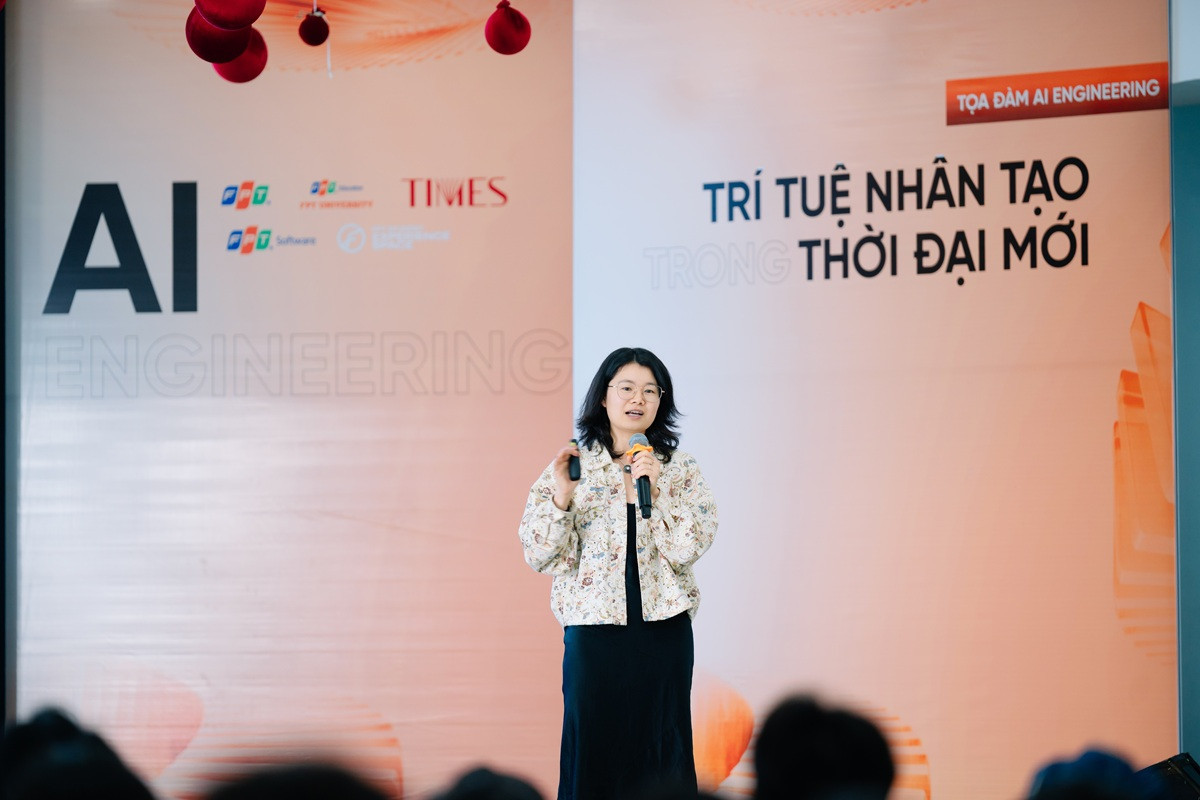
Chip Huyen discusses the shift from machine learning engineering to foundation models. Photo: Organizers
The rise of foundation models like GPT and Gemini has dramatically lowered the barrier to entry in artificial intelligence (AI). Once considered a mysterious and elite field, AI has become a tool that nearly anyone can access.
But this democratization has also sparked deep anxiety, especially among younger generations and university students. Will AI take away human jobs? What should one study to stay relevant in the age of machines?
These were the central questions at a recent AI talk held in Hanoi, featuring Chip Huyen and leading experts from FPT.
Fear is real, but hiding won’t help
When asked about AI’s automation threat, Chip Huyen didn’t sugarcoat it. She acknowledged that AI is already replacing humans in many fields.
She cited the example of interpretation, where once millions of professionals were needed. Today, AI handles most of the work at faster speeds and lower costs.
A former Stanford instructor, Chip Huyen sees this not as a dystopia but a natural evolution - comparable to the arrival of steam engines or automobiles. “We didn’t stop progress just to preserve horse-drawn carriages,” she said. “AI is the same - it’s a technological wave that won’t be reversed.”
Her message is clear: “The more afraid you are, the more you need to jump in.”
When we actively engage with a technology - understanding how it works, what it can and cannot do - fear gives way to mastery. In her words, “You stop being scared once you understand how to control the tool.”
When everyone has access to models, value comes from data and ideas
One of the biggest shifts in AI development, according to Chip Huyen, is the move from model-building to product-building.
In the past, engineers needed to build models from scratch - a resource-intensive process feasible only for major corporations. But foundation models have flipped that reality. Now, anyone can build a product quickly by leveraging pre-trained AI.
That changes the game. With the same models available to everyone, differentiation no longer comes from the model itself.
“What makes you different is your product idea - and your data,” she explained.
She gave a vivid example. In the US, people prefer text-based chatbots. In Vietnam, voice-based chatbots dominate. Why? Because most Vietnamese use motorbikes and can’t type while commuting. Typing Vietnamese with diacritics is also slower. These local nuances shape product direction - and highlight the power of contextual understanding.
Don’t overuse AI where it’s not needed

Chip Huyen also cautioned against applying AI to problems that don’t require it.
She recalled turning down an investment in a project that used AI to detect abnormal heart rhythms in hospitals. The task, she said, could be handled more accurately and cost-effectively using simple statistical algorithms.
“AI is not a magic solution for everything. Sometimes the simpler method is the better one,” she said.
The 10,000-hour rule still applies - even in the AI age
Nguyen Xuan Phong, Director of AI at FPT Software, agreed with Chip Huyen's emphasis on deep engagement.
Referencing the “10,000-hour rule” from Outliers by Malcolm Gladwell, he emphasized that it’s not the field you choose, but the persistence with which you pursue it, that matters.
To become exceptional in any domain - be it robotics, hardware, or software - you need time and focus.
He himself has spent 15 years working in AI, evolving from basic machine learning algorithms to managing complex data systems and leading global projects.
AI isn’t distant anymore - it’s knocking on every door
In an educational context, Ta Ngoc Cau, Vice President of FPT University Hanoi, noted that AI is no longer confined to academic labs. It has permeated every corner of life - from offices to living rooms, and even bedrooms.
The key now, he said, is to face it and use it.
“We must go beyond being passive beneficiaries,” he urged. “We must roll up our sleeves and leave our mark - as individuals, organizations, and as a nation.”
Lending his voice to this spirit of engagement, Le Thanh Hung, founder of the "AI for Everyone" community, promoted the mindset of lifelong learning.
He sees AI as “an extended arm” to help individuals climb faster in their careers.
With the motto “improve by 1% every day,” he believes consistent learning combined with AI tools can create stunning breakthroughs.
He shared the story of a community member who, after studying AI in their forums, landed a job at a multinational company - escaping a period of unemployment.
Du Lam
.svg)
