 Vietnamnet.vn

 Podcast



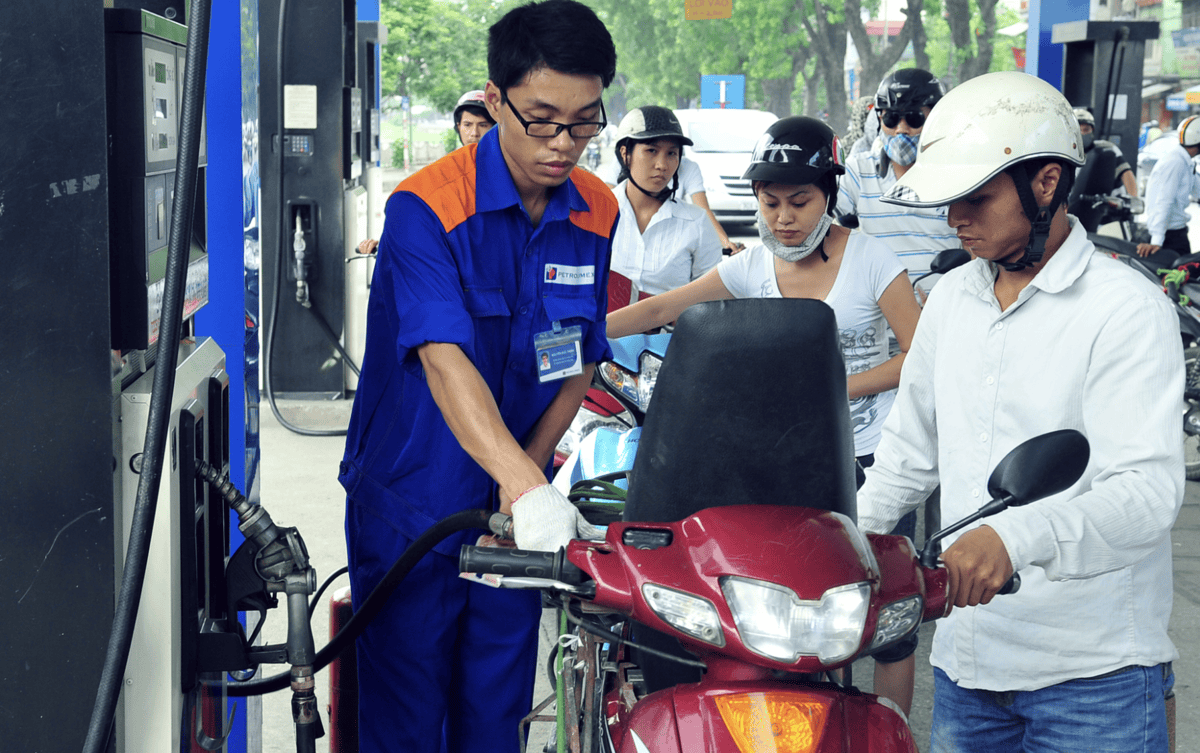
On March 26, at a conference discussing the Prime Minister's instructions on the roadmap to switch to biofuel (E10) in April 2026, Petrolimex said the basic legal conditions for E10 blending and formulation activities have been completed.
The blending facility system has been granted certificates of eligibility, and the enterprise is currently upgrading to meet the requirements of switching from mineral gasoline to E10.
The distributor affirmed that the supply of both base gasoline and ethanol is guaranteed. However, the ethanol supply structure shows a significant dependence on imports. Accordingly, the ethanol demand of this enterprise alone is 45,000-50,000 m3/month, of which 20-30 percent is from domestic sources, and the remainder must be imported.
PVOIL also noted that the enterprise made early preparations by deploying E10 business in four major cities since 2025, with nearly 100 filling stations. Practical implementation shows that the product is accepted by the market and no significant issues have arisen.
To date, PVOIL has been licensed for 13 blending locations nationwide, including seven points capable of continuous high-capacity blending. The total blending capacity currently reaches about 300,000 m3/month and is expected to increase to 350,000-380,000 m3/month by the end of 2026. Additionally, the enterprise is increasing its ethanol storage capacity to about 40,000 m3/month.
It stated that E10 gasoline business could be deployed on a large scale by mid-April, earlier than the original plan.
Other enterprises will also deploy E10 sales across their entire directly-managed station systems from early April, while remaining ready to expand supply in May if partners have the demand.
According to the Vietnam Petroleum Association, the blending capacity of its members currently reaches about 965,000 m3/month. With this capacity, it is entirely possible to meet the demand for biofuel on a nationwide scale.
Enterprise must report supply capability and sources
Although the total system capacity is sufficient, Trinh Quang Khanh, General Secretary of the Vietnam Petroleum Association, warned that biofuel requires blending time and cannot be sold immediately like mineral gasoline. If management is not reasonable, especially at the time of transition, local bottlenecks in supply may occur.
Pointing out that consumers still have concerns about biofuel, especially regarding cars, Khanh said there needs to be official and clear information about which vehicle models are suitable for E10 to avoid unnecessary hesitation.
Furthermore, during actual operation, due to storage and transportation, E10 gasoline might drop to the E8 level. This is still a quality product, even evaluated as good, but without clear guidance, enterprises may face risks during inspection and processing, he emphasized.
Regarding technical regulations, according to Petrolimex, domestic gasoline currently has very low or no oxygen content, while this content in imported gasoline is usually 1.3-1.5 percent. When blending an additional 10 percent ethanol, the total oxygen content may exceed the current regulatory threshold of 3.7 percent.
In some cases, oxygen content can reach 5.1-5.2 percent. If regulations are not adjusted accordingly, the production and supply of E10 gasoline, especially high-quality gasoline lines meeting Euro 4 and Euro 5 emission standards, will face difficulties or even fail to be deployed.
Along with that, enterprises need about one month to complete the system transition process. During this time, mineral gasoline and E10 gasoline will have to coexist; the entire system cannot be switched immediately.
At the conference, Deputy Minister of Industry and Trade Nguyen Sinh Nhat Tan emphasized that the roadmap starting from June 1, 2026, where unleaded gasoline (according to current national technical regulations) must be blended and formulated into E10 biofuel for nationwide use, is mandatory with no adjustment or postponement. The issue discussed at the conference is accelerating the roadmap. It depends on the level of preparation of the enterprises.
"We are striving to shorten the roadmap by about one month, meaning implementation right in April 2026. This is a very high requirement, not easy, and requires the entire system to get involved with a spirit of more urgency and determination than usual," the Deputy Minister said.
He said issues regarding regulations and technical conditions are being handled. The most concerning matter now is not the volume. With a 10 percent blending ratio, the ethanol demand is 100,000-110.000 m3/month.
“This is a fixed figure, and we must answer the question of whether we can meet it,” Tan said.
Tam An
.svg)
