 Vietnamnet.vn

 Podcast



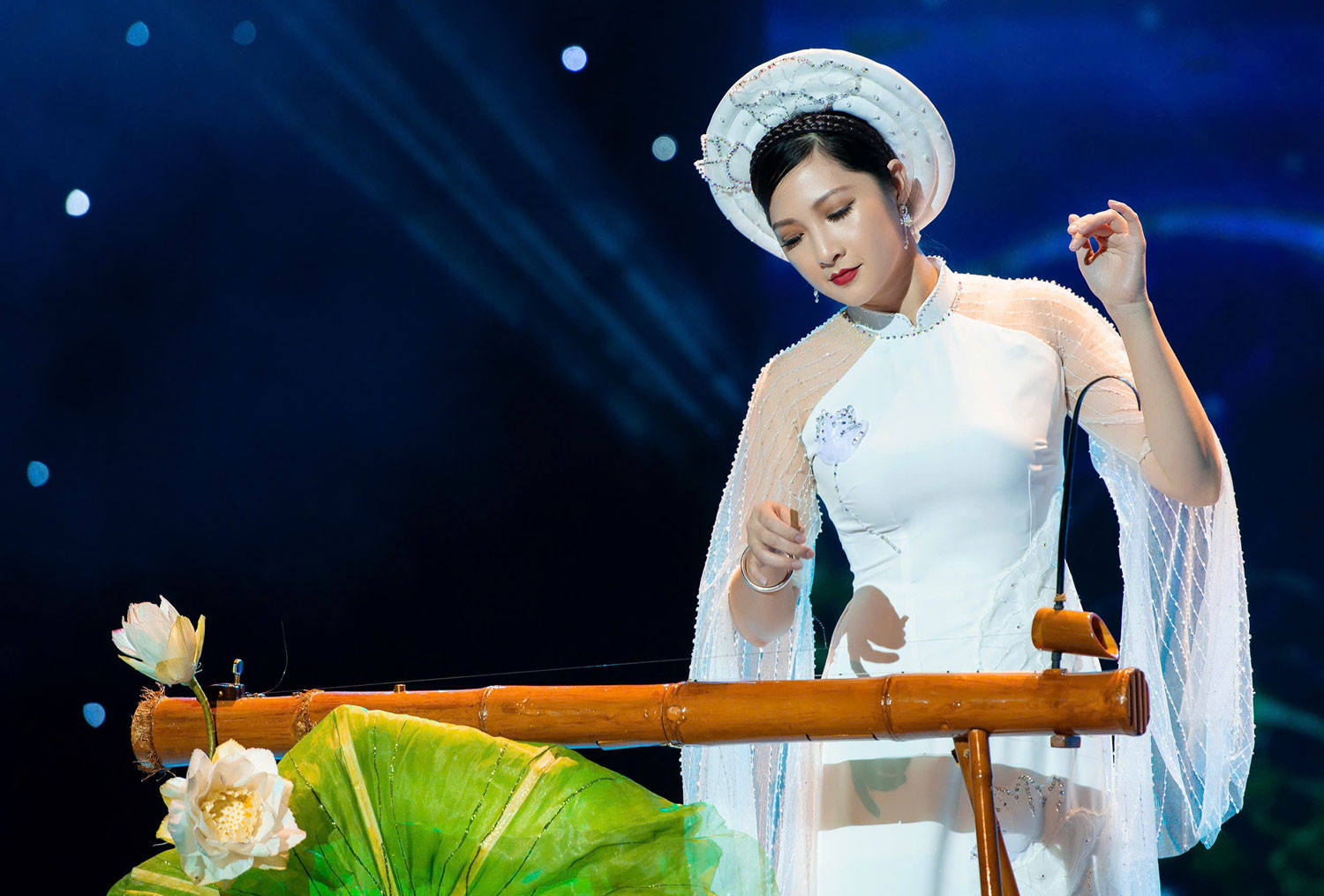
On a brightly lit stage, an artist appeared with a youthful, modern look, far from the traditional image of a the dan bau player in the traditional ao dai (long dress). She is Le Giang, who has dedicated over 30 years to the dan bau, a single-stringed music instrument that carries the soulful melodies and heartfelt essence of Vietnam.
3 decades, a singular love
“When I was still in school, most of my friends thought I was studying piano. No one imagined I’d choose the dan bau, a traditional instrument. Perhaps my style and appearance didn’t match the typical image of a the dan bau player,” Le Giang recalls with a smile.
Her connection with the dan bau began in childhood. Her mother, a dan tranh (zither) performer, raised her in a musical environment where she was exposed to artists’ performances from a young age. One day, while watching television, the sound of the the dan bau captivated her instantly, prompting her to ask her mother to let her study it.
That love has stayed with her through a long journey: seven years of primary training, four years of intermediate, four years of university, and two years for a master’s degree.
After 15 years of study, Le Giang became a lecturer at the Vietnam National Academy of Music.
For her, the dan bau is not just an instrument but a soulmate. “All my joys, sorrows, and memories are expressed through the dan bau. I can’t part with it,” she said.
Each time she performed abroad and sees international audiences moved by the the dan bau’s sound, she finds renewed strength. “They look at me with respect and admiration for my instrument. I know I couldn’t give up,” she said.
Giang has performed across continents, sometimes visiting a country 15–20 times. Japan left the deepest impression due to its audience’s love for Vietnamese traditional arts. Some followed her troupe for an entire month, attending every show.
“I remember playing a Vietnamese melody and seeing the audience in tears. Some asked to touch the the dan bau and try playing it. In those moments, I knew music had touched their hearts,” she says emotionally.
In 2019, she was honored with the title of Distinguished Artist, a fitting recognition of her tireless contributions. In her career, Le Giang won three individual Gold Medals at the National Solo and Ensemble Music Festival (2010, 2015, 2018) and numerous other awards.
Beyond performing, she passionately teaches, passing the torch to the younger generation.
“I’m grateful to my family, teachers, and the craft for giving me this love and connection with the dan bau. Now, I want to pass that love to my students, the ones who will carry forward our nation’s sounds,” Le Giang said.
She once considered other careers but chose to stay, giving her heart to the dan bau.
Le Giang revealed that her family’s support allowed her to fully dedicate herself to nurturing the dan bau’s sounds, and the instrument doesn’t let her down. It has taken her around the world, bringing fame, a career, and, above all, the joy of living her passion.
“Just love, give your all, and you’ll receive in return,” she smiled. For Le Giang, the dan bau is the most precious gift the life has given her.
Once performed at Dieu Con Mai 2023 (Things Everlasting, a concert organized by VietNamNet once a year, on the National Day September 2), this year Le Giang returns to perform the solo piece Motherland (by composer Tran Manh Hung) with the Sun Symphony Orchestra, conducted by Olivier Ochanine.
“In the flow of contemporary Vietnamese music, Motherland by Tran Manh Hung is a remarkable work. Not only did it win second prize at the Vietnam Musicians’ Association Awards in 2010 for the dan bau compositions, but it also creates a unique blend of traditional Vietnamese music and Western symphonic orchestration.
Tinh Le
.svg)
