 Vietnamnet.vn

 Podcast



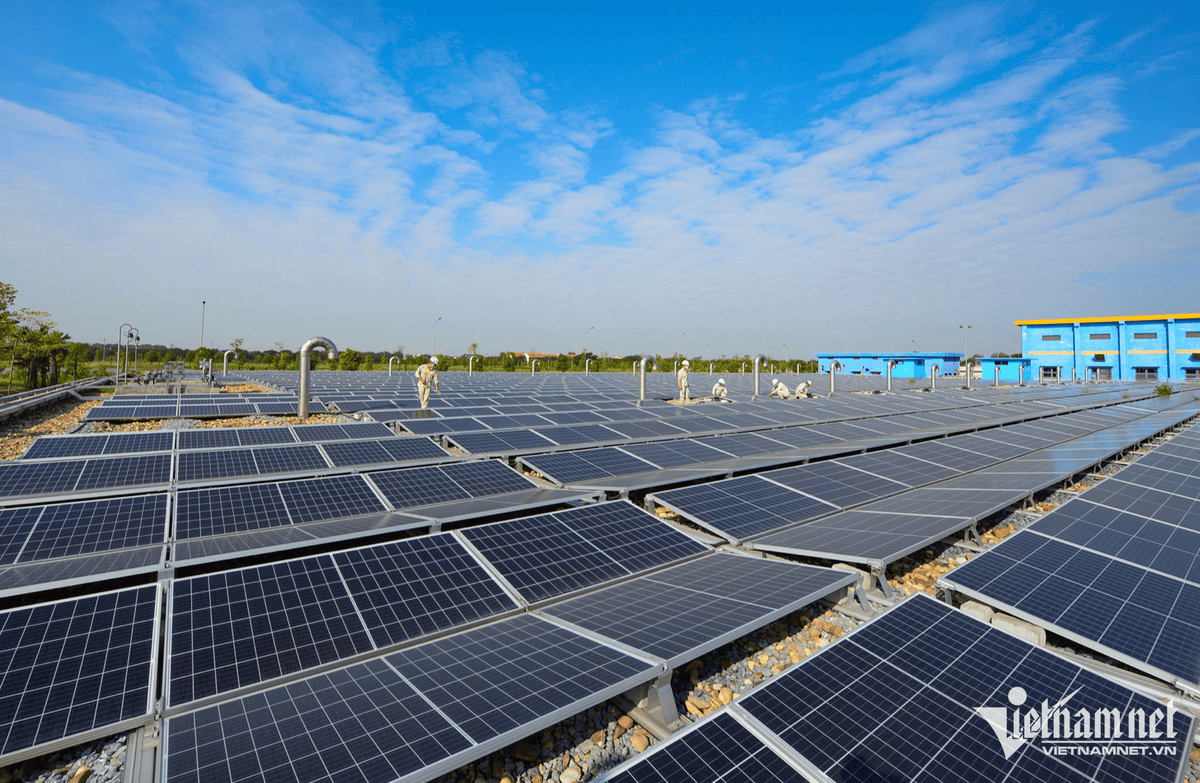
In comments on the proposed 2026 electricity generation price framework, EVN estimated that the price range for solar power projects with battery energy storage systems (BESS) would be around VND1,104.43-1,549.7 per kWh, depending on the region (North, Central, or South) and the assumptions used to calculate storage investment costs.
For floating solar projects equipped with BESS, the estimated price ranges from VND1,298.73-1,822.63 per kWh.
To develop the pricing framework, EVN assumed that storage capacity would equal 10 percent of the solar plant’s generation capacity. BESS investment costs were benchmarked against procurement results from several power corporations, the Chinese market, and global average costs.
Under the current pricing framework issued by the Ministry of Industry and Trade, solar projects with battery storage are eligible for generation prices that are VND140-190 per kWh higher than projects without storage, an increase of 11-14 percent.
EVN argued that adding storage systems increases total project investment costs, resulting in higher generation price ceilings for solar projects combined with BESS compared with projects without storage.
As a result, power purchasers are likely to pay more for projects equipped with storage, while the investment efficiency and benefits to the overall power system remain unclear.
Energy expert Nguyen Huy Hoach said that under Vietnam’s power development strategy through 2030, solar power capacity is expected to continue expanding rapidly. At the same time, policies encouraging rooftop solar installations are expected to accelerate the growth of distributed generation nationwide.
This means the power system will require not only additional generation capacity but also greater flexibility to balance supply and demand throughout the day.
Solar power typically reaches peak output around midday. During late afternoon and evening hours, when electricity demand reaches its highest levels, solar generation declines rapidly and eventually disappears after sunset.
In practice, the gap between the time electricity is generated and the time it is consumed is becoming an increasingly significant challenge for system operators. The value of each kilowatt-hour also varies depending on when it is delivered.
Against this backdrop, the greatest value of BESS lies not in generating additional electricity but in shifting electricity from periods of surplus generation to periods of shortage, helping optimize system operating costs during peak demand hours.
While this value is difficult to capture in individual project financial models, it holds massive significance for power system operations.
The economic value brought by BESS must be clarified. According to Hoach, from the perspective of the unit that buys electricity and resells it to customers, EVN has the responsibility to consider every factor that could increase the cost of supplying electricity to the economy.
If a solar power project combined with BESS enjoys a higher generation price, but the values that the power system receives are unclear, or cannot be quantified, then that cost portion will ultimately still be allocated to customers through electricity prices.
Meanwhile, Vietnam does not yet have a complete market mechanism for the service costs that BESS can provide, such as frequency regulation, voltage regulation, capacity reserve, or system balancing. This leads to a reality where the majority of current storage investment costs can only be recovered through electricity selling prices.
Therefore, EVN's request to clarify the economic value of BESS before building the generation price framework is a well-founded request both technically and economically.
The expert emphasized that if viewed at the project level, adding storage batteries may increase investment costs. However, with the national power system, storage batteries can help reduce operational costs, reduce investment demand for peak-shaving power sources, and enhance renewable energy integration.
He explained that BESS investment costs arise at the project level, but the benefits spread to the entire power system. There needs to be a mechanism to quantify and reasonably allocate the value that this technology brings.
EVN's recommendation is essentially a request to build a sufficiently clear economic basis before converting storage costs into electricity prices that the system has to pay.
According to this expert, the problem lies not in whether to develop BESS or not, but in how to correctly price the value that this technology can bring to the power system. This will be one of the central issues of the energy transition process in the coming decades.
Tam An
.svg)
