 Vietnamnet.vn

 Podcast



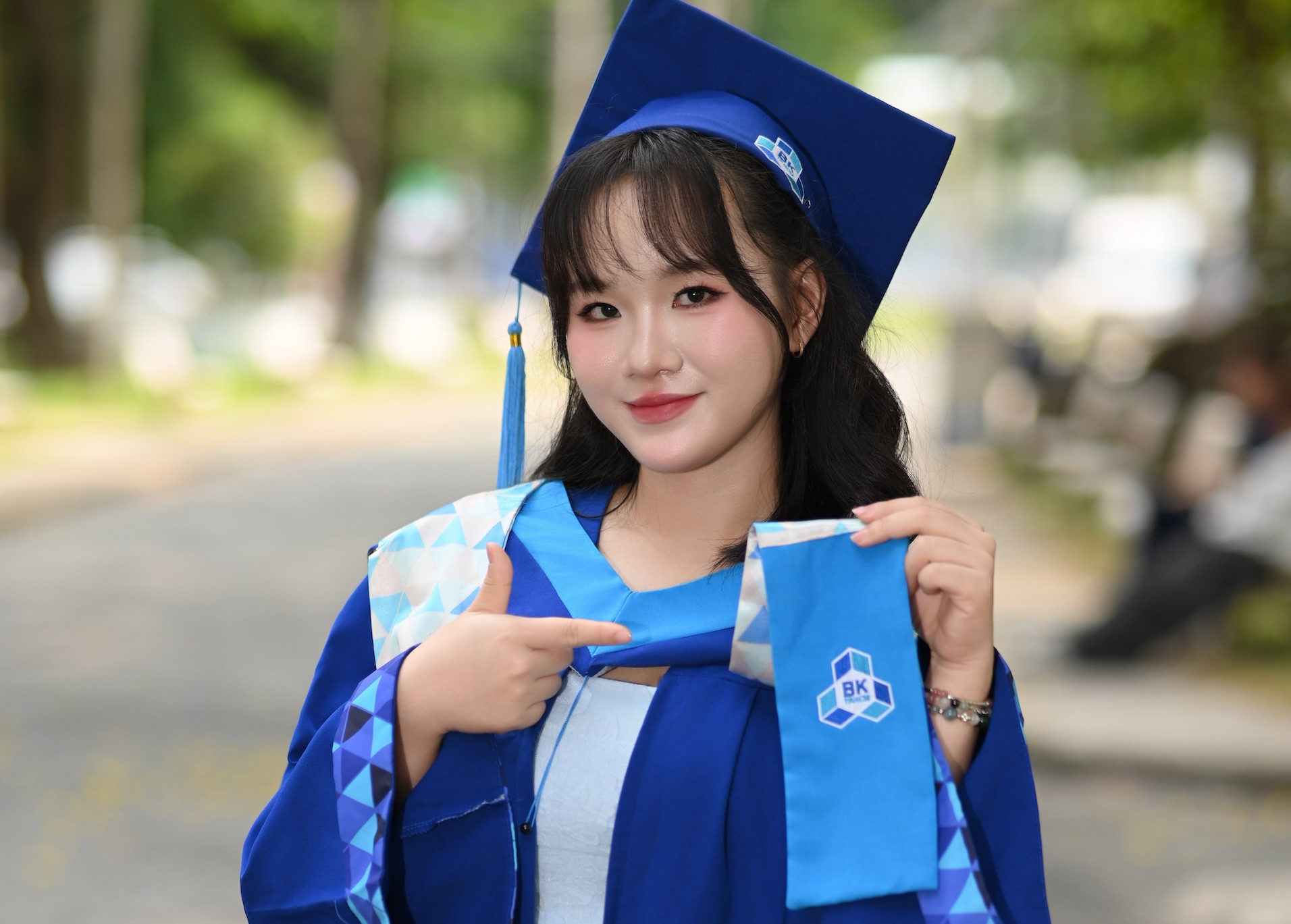
Four years ago, as a student at Nguyen Binh Khiem High School for the Gifted in Vinh Long, Han pursued an advanced natural sciences curriculum. The environment helped her build a strong foundation in core subjects, particularly physics and chemistry.
Winning a bronze medal at the April Olympic competition in physics marked a turning point, shaping her logical thinking and analytical skills - key qualities for engineering.
Despite her strength in physics, Han chose to pursue polymer materials, a field requiring deep knowledge of chemistry. For her, the appeal lies in the intersection of the two disciplines.
“If physics explains the laws and properties of matter, chemistry allows us to explore its structure and create new materials. That combination makes materials science both fascinating and suitable for me,” she shared.
Throughout her studies at Ho Chi Minh City University of Technology, scientific research became an integral part of her journey. Early on, she actively engaged in laboratory work and research projects.
In 2024, she participated in two projects focused on bio-based thermoset plastics for fiberglass composites and sustainable plastics derived from used cooking oil - research directions aligned with environmentally friendly materials.
In 2025, she expanded into mechanical sensing polymer materials, gaining both experimental skills and a comprehensive understanding of the field, from theory to application.
Her most dedicated research direction is self-healing materials. This was also the focus of her graduation thesis, titled “Synthesis of self-healing Poly(amide-urethane) based on Dithiodipropionic Acid”, which received a score of 8.9 out of 10.
More importantly, it marked a clear academic direction, focusing on smart polymer systems capable of repairing themselves after damage.
Strong academic record and language skills
Alongside her academic and research work, Han consistently maintained strong performance. She was recognized as an outstanding student in the 2023-2024 academic year and an excellent student in 2024-2025. She also received multiple academic scholarships, including the Fuji Seal Scholarship in 2024 and the Tran Dai Nghia Talent Scholarship for 2024-2025.
Despite studying in a technical environment, Han achieved a TOEIC score of 735 and a DELF B1 certification, enabling her to access academic materials in both English and French - a significant advantage in research.
To graduate one semester early from the demanding PFIEV program, she developed a clear study strategy from the beginning.
She maintained a habit of reading materials and preparing lessons in advance, making learning more proactive. Course registration was carefully planned, with flexible adjustments to take additional subjects. She also made full use of summer terms to complete political modules, reducing pressure during main semesters.
To balance coursework and research, Han adopted a phased approach. Early in the semester, she focused more on laboratory work, while during exam periods, she shifted her attention to revision.
The biggest challenge, she said, was not the workload but internal pressure - the fear of not meeting her own expectations.
“Looking back, I’m grateful for that pressure. It shaped me into a more disciplined version of myself and motivated me to keep moving forward,” she shared.
Beyond academics, Han participated in extracurricular activities such as volunteer programs during the Lunar New Year and summer campaigns. These experiences helped her step out of her comfort zone, develop communication and teamwork skills, and maintain a positive mindset throughout her journey.
Looking ahead, Han plans to continue her academic path at the postgraduate level over the next two to three years, focusing on smart polymer materials, particularly self-healing systems - an area gaining increasing attention in modern materials science.
Le Huyen
.svg)
