 Vietnamnet.vn

 Podcast



Associate Professor Le Hong Quang, head of the Breast Surgery Department at K Hospital in Hanoi, said one of the most significant improvements has been the shift toward early diagnosis.
"In the past, around three-quarters of patients arrived at the hospital with advanced-stage disease," Quang said. "Today, the situation has reversed, with approximately three-quarters of patients diagnosed at an early stage."
Earlier detection has substantially improved treatment outcomes and long-term survival.
Precision medicine replaces one-size-fits-all treatment
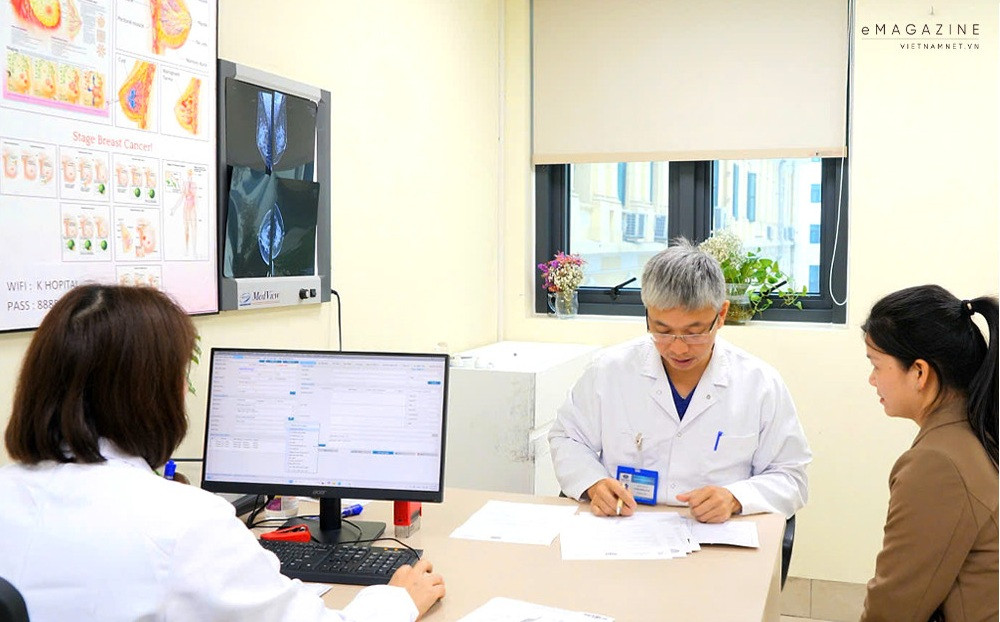
Modern breast cancer treatment is increasingly tailored to each patient's individual disease rather than applying the same therapy to everyone.
Advances in diagnostic imaging, pathology, immunohistochemistry and molecular biology allow doctors to analyze the biological characteristics of each tumor in far greater detail.
This enables physicians to classify cancers more accurately and design treatment plans based on each patient's specific disease profile.
"Accurate assessment leads to accurate treatment," Quang said, describing what has become a core principle of contemporary breast cancer care.
Beyond determining the stage of the disease, doctors routinely evaluate hormone receptor status, HER2 expression, biomarkers and other biological indicators before selecting the most effective therapy.
Associate Professor Pham Cam Phuong, director of the Nuclear Medicine and Oncology Center at Bach Mai Hospital in Hanoi, said every patient is discussed by a multidisciplinary team that includes oncologists, radiologists, pathologists, breast surgeons, nuclear medicine specialists and other experts.
Depending on the stage of the disease, patients may undergo surgery first or receive neoadjuvant treatment - including chemotherapy, targeted therapy or immunotherapy - to shrink tumors before surgery.
Targeted therapies deliver major breakthroughs
Among the most important advances is targeted therapy for HER2-positive breast cancer, an aggressive subtype more commonly seen in younger women and historically associated with poorer outcomes.
Pham said dual HER2-targeted therapy using trastuzumab and pertuzumab has significantly increased the rate of pathological complete response.
For some patients, no cancer cells remain in surgical tissue samples following treatment.
Medical innovations have also made treatment more convenient.
Where patients previously required lengthy intravenous infusions for both medications, they can now receive a combined formulation administered by subcutaneous injection.
"Patients used to spend several hours in hospital receiving intravenous treatment," Pham said. "Now they simply come in for testing, receive an injection in five to eight minutes, remain under observation for about 30 minutes, and can then return home and continue their normal daily activities."
Doctors say this reflects a broader evolution in cancer care - extending survival while improving patients' quality of life.
Improving life after cancer
Quang said advances in radiotherapy have significantly reduced treatment-related side effects compared with previous generations of technology.
At the same time, breast reconstruction and oncoplastic surgery have become increasingly common, allowing many women to preserve their body image, confidence and emotional well-being after treatment.
Pham said oncologists at Bach Mai Hospital work closely with reconstructive surgeons to offer breast reconstruction whenever appropriate.
The objective of modern breast cancer care is no longer limited to prolonging survival.
Patients now receive comprehensive support addressing physical recovery, psychological health, nutrition and reintegration into everyday life.
Quang emphasized that successful treatment depends on close collaboration among multiple medical specialties rather than any single physician or medication.
Thanks to advances in screening, diagnosis and treatment, breast cancer is increasingly being transformed from one of the most feared diseases into one that can be effectively managed.
For many women, doctors say, a breast cancer diagnosis is no longer the end of hope but the beginning of a realistic opportunity to recover and return to a healthy, active life.
Phuong Thuy
.svg)
