 Vietnamnet.vn

 Podcast



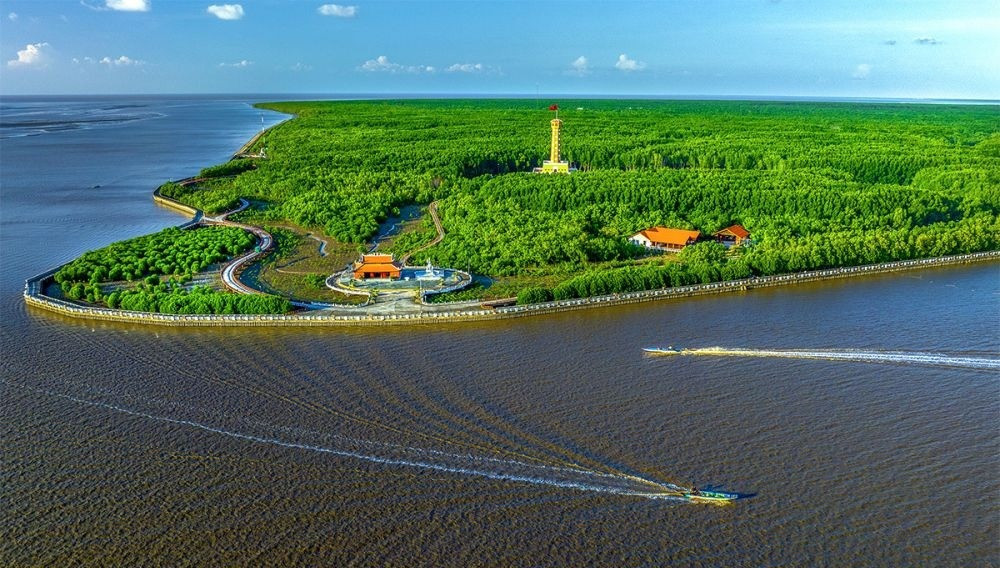
By focusing on four key pillars - infrastructure, marine economy, high-tech agriculture, and symbolic tourism - the province aims to turn its unique geographical advantages at the southern tip of Vietnam into powerful growth drivers for the 2025-2030 period.
After the infrastructure development as the first pillar, Hai mentioned the development of the sea-borne economy as the second pillar. Identifying the sea as a space for survival and sustainable development, the province is focusing on developing the seaport system, especially the Hon Khoai seaport, turning it into an international trade gateway.
The province is also strongly developing the renewable energy industry (wind power, solar power, green hydrogen energy) and Liquefied Natural Gas (LNG) to not only achieve energy self-sufficiency but also become a clean energy center for the whole country, aiming for electricity export.
In addition, the province is promoting the maritime economy, logistics services, and the cultivation of seafood toward an industrial, high-tech direction associated with deep processing, protecting resources and the marine environment.
Third, the great advantages of Ca Mau are shrimp and mangroves. The province will focus on developing the shrimp industry value chain toward a large scale, applying modern technology, and targeting high-end export markets; and exploiting economic value under the forest canopy such as shrimp, forest crabs, mangrove eco-tourism, toward sustainability and adaptation to climate change.
Simultaneously, the province promotes the development of rice-shrimp production areas and specialized rice areas toward an ecological, high-tech, effective, and sustainable direction, building the Ca Mau agricultural product brand with prestige in domestic and international markets.
Fourth, developing tourism into a spearhead economic sector.
Ca Mau is home to nationally symbolic landmarks along with a distinctive mangrove ecosystem, notably the Mui Ca Mau Ramsar site covering nearly 42,000 hectares. Leveraging these strengths, the province will invest in synchronized tourism infrastructure and diversify tourism products, including ecotourism, cultural-historical tourism, and coastal and island resorts. In particular, Ca Mau will prioritize tourism products imbued with the cultural identity of the riverine region, turning the province into a must-visit destination on Vietnam’s tourism map.
Throughout the process of exploiting its potential and advantages, the province remains steadfast in the principle of “fast but sustainable development,” absolutely not trading the environment for short-term economic growth. All investment projects must undergo stringent environmental impact screening. Ca Mau will focus on the green economy and the circular economy to preserve its unique and diverse ecosystems for future generations.
What plans and solutions does Ca Mau have to achieve fast and sustainable development in the new phase after the merger?
First, the current key task is to finalize and submit for approval the adjusted Provincial Master Plan for the 2021–2030 period, with a vision to 2050, in early 2026. This will provide a solid legal foundation for effective implementation and open up new development space for the province.
After the merger, adjusting the master plan is essential to ensure connectivity, synchronization, and unity in the development space. The plan must be long-term in vision while remaining flexible and highly adaptive to climate change and sea-water level rise.
Next is accelerating the application of science and technology, promoting digital transformation and innovation. This is a “leapfrogging” solution to raise labor productivity and competitiveness. The province will focus on building a digital government to better serve people and businesses; develop the digital economy, especially in agriculture and tourism; and build a digital society so people can benefit from modern, convenient services. With the Startup and Innovation Center recently put into operation, the province has also issued special mechanisms to encourage and support enterprises in applying modern technologies in production and business processes.
Third, investing in transport infrastructure with inter-regional connectivity. Ca Mau has been coordinating drastically to deploy key transport projects: the Ca Mau - Dat Mui expressway (a continuation of the Can Tho - Ca Mau expressway already in operation), other expressway projects, upgrading Ca Mau Airport, and the access road to Hon Khoai General Port, etc to connect with major economic centers. When transport infrastructure is seamless, investment attraction increases and logistics costs decrease, creating a huge competitive advantage for the province.
The fourth solution is socio-cultural development and improving the people's lives, while the fifth is ensuring national defense-security and political stability.
Ngan Anh
.svg)
