 Vietnamnet.vn

 Podcast



Despite upcoming mandatory regulations requiring child restraint systems in cars, newly released research shows that usage remains very limited in Vietnam. Experts say changing public attitudes will be just as important as enforcing the law.
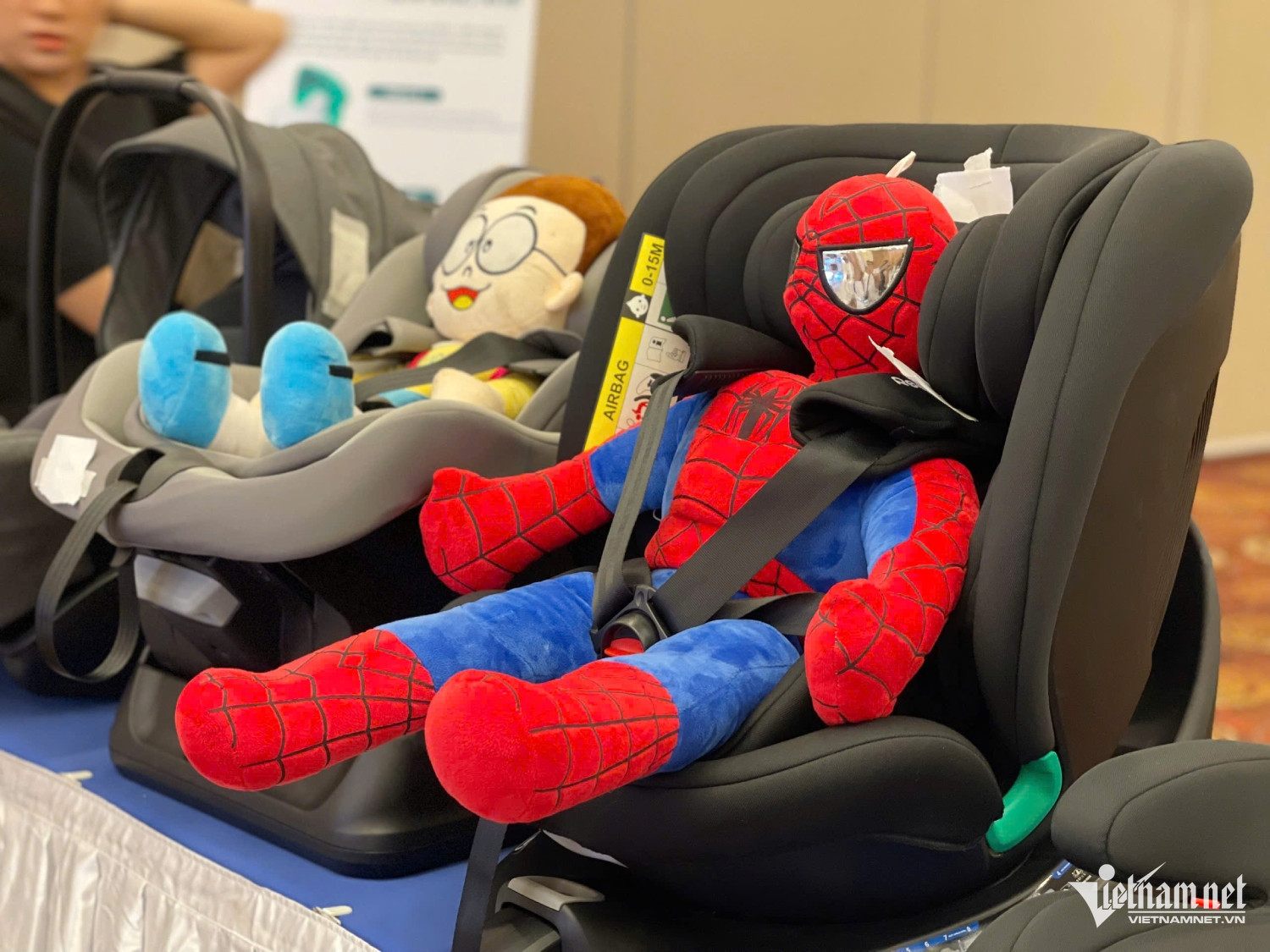
A scientific conference on child road safety in Vietnam, organized by the University of Public Health on August 6, brought together researchers, road safety specialists and government representatives to discuss improving protection for children traveling in passenger vehicles.
The event presented new findings on the use of child restraint systems (CRS) in Vietnam and offered recommendations to support the implementation of new regulations aimed at reducing child deaths and injuries in road crashes.
Many children still ride in the front seat
According to Dr. Duong Kim Tuan, Director of the Center for Injury Policy and Prevention Research at the University of Public Health, a nationwide survey conducted in 2024 observed 23,049 privately owned passenger vehicles.
The study found that 10.08% of the vehicles were carrying children under the age of 10 or shorter than approximately 1.35 meters.
One of the most concerning findings was the number of children traveling in the front passenger seat.
Among vehicles carrying children, 42% had children seated in the front. Of those, 22.8% involved children sitting alone in the front seat, while 19.2% had children sharing the front seat with an accompanying adult.
The study also found that the use of child restraint systems in Vietnam has improved but remains extremely limited.
"In 2022, only about 1.3% of vehicles were equipped with child restraint systems. By 2024, the figure had risen to 4.62%, but this is still far below the level needed to effectively protect children and remains low compared with many other countries," Dr. Tuan said.
A separate survey on public awareness found that around 75% of respondents agreed that children should be protected by dedicated safety devices while traveling in cars.
Researchers said the findings suggest public awareness is gradually improving, providing hope that adoption rates will continue to increase.
The study also examined why many families still choose not to use child car seats.
Among respondents, 33.33% cited the cost of child restraint systems as the biggest barrier.
Another 29.17% believed that simply riding inside a car was already sufficiently safe and that additional protection for children was unnecessary.
Dr. Tuan said introducing mandatory regulations is an important step, but legislation alone will not solve the problem.
"It is equally important to help people understand the real safety benefits of child restraint systems and to provide guidance on selecting, installing and using them correctly," he said.
He added that further research will be conducted after the new regulations take effect, expressing hope that usage rates will increase significantly.
"If awareness improves, parents will choose to protect their children because they understand the benefits, not simply to avoid penalties," he said.
Children are not simply smaller adults

Speaking at the conference, Dr. Duong Khanh Van, representing the World Health Organization (WHO) in Vietnam, emphasized that children are among the most vulnerable road users and have the right to travel safely.
She noted that many people mistakenly believe holding a child in their arms or fastening the vehicle's standard seat belt provides adequate protection.
"Children are not simply smaller adults," she said.
Because children's bodies are still developing - with proportionally larger heads, softer bones and weaker neck muscles - adult seat belts cannot provide sufficient protection.
Purpose-built child restraint systems, designed according to a child's age, height and weight, have been scientifically proven to significantly reduce the risk of death and serious injury in traffic crashes.
However, Dr. Van stressed that these safety benefits are only achieved when the correct type of seat is selected, properly installed and appropriately used.
She also cited Vietnam's experience with motorcycle helmets as an example of why legislation alone is not enough.
"When I look around, out of every 10 motorcycle helmets, perhaps only three are capable of providing real protection. The rest are fashion helmets with thin shells that offer little protection in a collision," she said.
According to the WHO representative, successful implementation of safety regulations requires a broader support system.
She identified six essential elements: clear legal requirements, technical standards, thorough preparation before enforcement, policies that help people comply, phased implementation, and continuous monitoring and evaluation.
"No country has succeeded simply by passing a law without creating the conditions needed to support its implementation," she said.
New regulations take effect on August 15
Dr. Tran Huu Minh, Deputy Director General of the Department of Transport and Traffic Safety under the Ministry of Construction, said road traffic crashes remain one of the world's leading causes of child mortality.
He cited global data showing that road crashes are the leading cause of death among children and adolescents aged 5 to 19, with more than 90% of fatalities occurring in low- and middle-income countries.
"Every year, more than 186,000 children lose their lives in road traffic crashes, while hundreds of thousands more suffer serious injuries or lifelong disabilities," Dr. Minh said.
He emphasized that Vietnam's new regulations are intended to protect children rather than simply increase penalties.
Beginning August 15, drivers who fail to use child restraint systems will initially receive an official warning under Decree No. 238/2026/ND-CP, which amends Decree No. 168/2024/ND-CP.
Allowing children to sit in the front passenger seat will be subject to fines of up to VND1 million (approximately US$38).
Dr. Minh said issuing warnings during the initial implementation period gives the public time to adapt to the new rules.
However, he cautioned against assuming that a warning carries no consequences.
"A warning is an official administrative sanction. It is documented, recorded in the system, and repeat violations will result in more severe penalties," he said.
Experts attending the conference agreed that the new regulations will only achieve their intended impact if legal requirements are supported by technical standards, public education campaigns and gradual changes in parental behavior.
Only when child restraint systems become standard equipment every time a child travels by car, they said, can the risk of traffic-related deaths and serious injuries be sustainably reduced.
Hoang Hiep
.svg)
