 Vietnamnet.vn

 Podcast



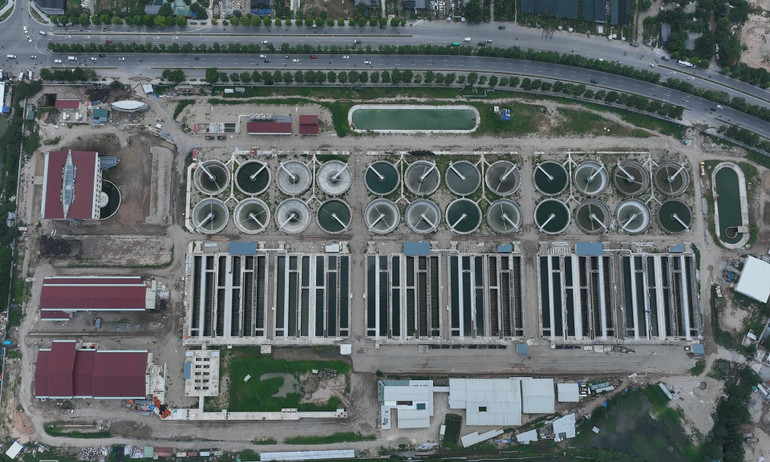 |
| The Yen Xa Wastewater Treatment Plant in Thanh Tri District is expected to treat To Lich River water by 2025. Photo: Ngoc Thanh/Nhan Dan |
Although the number of environmental violations and fines has increased in recent years, river pollution has barely improved. While authorities continue to treat the “symptoms,” several initiatives are now tackling the root causes.
The endless cycle of punishment
Across provinces, hundreds of cases of illegal wastewater discharge have been fined. The Phu Yen Cassava Starch Joint Stock Company was fined VND3.4 billion (approximately US$139,000); Thai Nguyen Environmental JSC was fined more than VND900 million (US$37,000); Vu Bang Textile Company in Ha Nam faced a VND2.6 billion (US$106,000) fine; and Sinh Loc Production & Trading Co. in Quang Ngai was fined VND330 million (US$13,500). In Tay Ninh, ten cassava-processing firms were fined a total of VND3.3 billion (US$135,000) for repeated violations.
In Hanoi, 2022 inspections covered 3,298 facilities, with 2,009 fined a total of VND21 billion (US$860,000). In 2023, joint inspections by the Department of Natural Resources and Environment and the city’s police led to 1,657 fines totaling VND14 billion (US$573,000).
Yet, according to Associate Professor Dao Trong Tu, despite tighter enforcement, the actual number of violations is likely far greater. “It’s nearly impossible to monitor businesses that dump waste at night or during rainstorms,” he said. “We must impose harsher penalties. Allowing rivers to be poisoned day and night is a national disgrace.”
Setting priorities and resources
At the 7th National Assembly session (15th tenure), river restoration drew special attention. Minister of Natural Resources and Environment Dang Quoc Khanh proposed establishing a River Basin Management Committee to coordinate responsibilities across ministries and provinces. He emphasized the need to prioritize funding for polluted rivers between 2026 and 2030.
Associate Professor Truong Manh Tien, Chairman of the Vietnam Association for Environmental Economics, argued that cleanup must be interprovincial and regional. Environmental scientist Phung Chi Sy added that dredging and embankments merely treat the surface; only centralized wastewater collection and treatment plants can deliver real results.
From a local perspective, Ngo Thai Nam, Deputy Head of Hanoi’s Environmental Protection Agency, urged continued investment in wastewater systems for industrial clusters lacking centralized treatment. He called for prioritizing budget allocations for urgent environmental projects, increasing city-level funding each year, and ensuring that current treatment plants are maintained and operated effectively.
Hanoi’s Department of Natural Resources and Environment also pressed for faster completion of key projects: the Yen Xa wastewater treatment system (scheduled for 2025), the Yen Nghia pumping station project in western Hanoi, and the restoration of the Tich River. New projects are also being planned under the city’s mid-term public investment program.
To revive river flows, Hanoi is studying the construction of Xuan Quan Dam on the Red River and Long Tuu Dam on the Duong River. The goal is to raise water levels and improve irrigation capacity for the Day, Nhue, and To Lich rivers. Deputy Minister of Agriculture and Rural Development Nguyen Hoang Hiep noted that raising the Red River’s level would help maintain continuous flow in these tributaries, allowing them to self-purify once again.
A glimmer of renewal
In Ho Chi Minh City, about 1.5 million cubic meters of urban wastewater is generated daily-but only 12.6% is treated. The rest flows untreated into rivers and canals. Former Deputy Director of the city’s Biotechnology Center Nguyen Quoc Binh stressed that wastewater treatment requires massive funding and public-private partnerships.
Currently, the city operates only three main treatment plants: Tham Luong–Ben Cat (131,000 m³/day), Binh Hung (141,000 m³/day), and Binh Hung Hoa (30,000 m³/day), supplemented by small neighborhood facilities. By 2025, the city plans to expand to 12 plants with a total capacity exceeding 3 million m³ per day.
The long-delayed Yen Xa Wastewater Treatment Plant in Hanoi’s Thanh Tri District, expected to begin operations in 2025, is seen as key to cleansing the To Lich River.
Still, examples of success do exist. The Nhieu Loc–Thi Nghe Canal in Ho Chi Minh City stands as a symbol of what determined governance can achieve. Once a fetid, black channel, it is now a clean, flowing waterway lined with parks and public spaces. “The Nhieu Loc–Thi Nghe project was executed systematically and scientifically,” said Associate Professor Dao Trong Tu. “Fish and shrimp have returned, and the people can finally enjoy the river again. Other localities should take note.”
In Bac Ninh, authorities are moving to relocate the notorious paper-production facilities of Phong Khe Village-long blamed for polluting the Cau River. Under a new plan, all paper workshops within residential areas must relocate by December 31, 2024, and those in the Phong Khe I and II industrial clusters must cease operations by the end of 2029. Provincial Party Secretary Nguyen Anh Tuan directed the city to provide retraining and job transition support for affected workers and enterprises.
According to the Ministry of Natural Resources and Environment, the revised Water Resources Law (2023) now includes incentives for private investment in water protection and restoration. The ministry is developing a national plan to rehabilitate degraded, depleted, and polluted water sources. Current pilot studies are focusing on the heavily contaminated rivers of Bac Hung Hai, Nhue–Day, and Ngu Huyen Khe, alongside new frameworks for maintaining minimum ecological flows in rivers and streams.
Nhan Dan
.svg)
