 Vietnamnet.vn

 Podcast



Among the many ethnic groups living along the Truong Son mountain range, the Co Tu people in Da Nang have preserved a rich cultural heritage. Beyond music and festivals, they uphold a distinct communal tradition - the brotherhood oath ceremony.
Village elder A Lang Chuc (84), from Ra Lang hamlet in Song Kon commune, explained that the ceremony was historically held to resolve conflicts between two villages, often triggered by land disputes, bride kidnapping customs, or hunting territory encroachments. The Co Tu call this ritual Pơr’ngoóch, meaning "to forge a better relationship."

To host the ceremony, the main village erects a sacred neu pole and prepares offerings such as buffalo, pigs, rice wine, and other items for Giang - the spirit. The visiting village brings similar offerings to show sincerity. A council of elders and respected villagers serve as arbitrators to ensure fairness and voluntary participation.
A hallmark of the ceremony is the erection of a wooden Bhanooc statue beside a sacred gong at the village border. This becomes a living covenant, symbolizing that both villages are now united as one, and all past grievances are to be forgotten.

“The ceremony is not just to end conflicts, but also to foster unity. Many couples from the villages have fallen in love thanks to this ritual, without being bound by heavy dowry customs. It carries deep humanistic values preserved through generations,” elder A Lang Chuc shared.
Preserving a ‘living heritage’ in the highlands
In late September, the three communes of A Ting, Jo Ngay, and Song Kon (formerly part of Quang Nam province) jointly held the brotherhood oath ceremony. It was the first time this sacred ritual was conducted at the commune level, following the merger of the three into the new Song Kon commune under Da Nang City.
With the new commune headquarters located in the former Jo Ngay area, the Jo Ngay elders were selected as the hosts, welcoming guests from A Ting and Song Kon.

The festival space was meticulously prepared. A towering neu pole stood at the center, with a buffalo tied at its base as the main sacrificial animal. Forest leaves and flowers were tied to the pole to invite the spirits’ presence.
Next to it, a colorful ga’nau hut - the ceremonial hut of the Co Tu - was adorned in vibrant brocade, serving as a welcoming space where elders waited with rice wine for their honored guests.

As the guests approached, the sound of gongs and drums rose in intensity. Youths in traditional attire emerged with trays of rice wine and bright smiles. Elder Jo Ngay, representing the host, stepped forward, lifting a prized wine jar to welcome his brothers from A Ting and Song Kon.
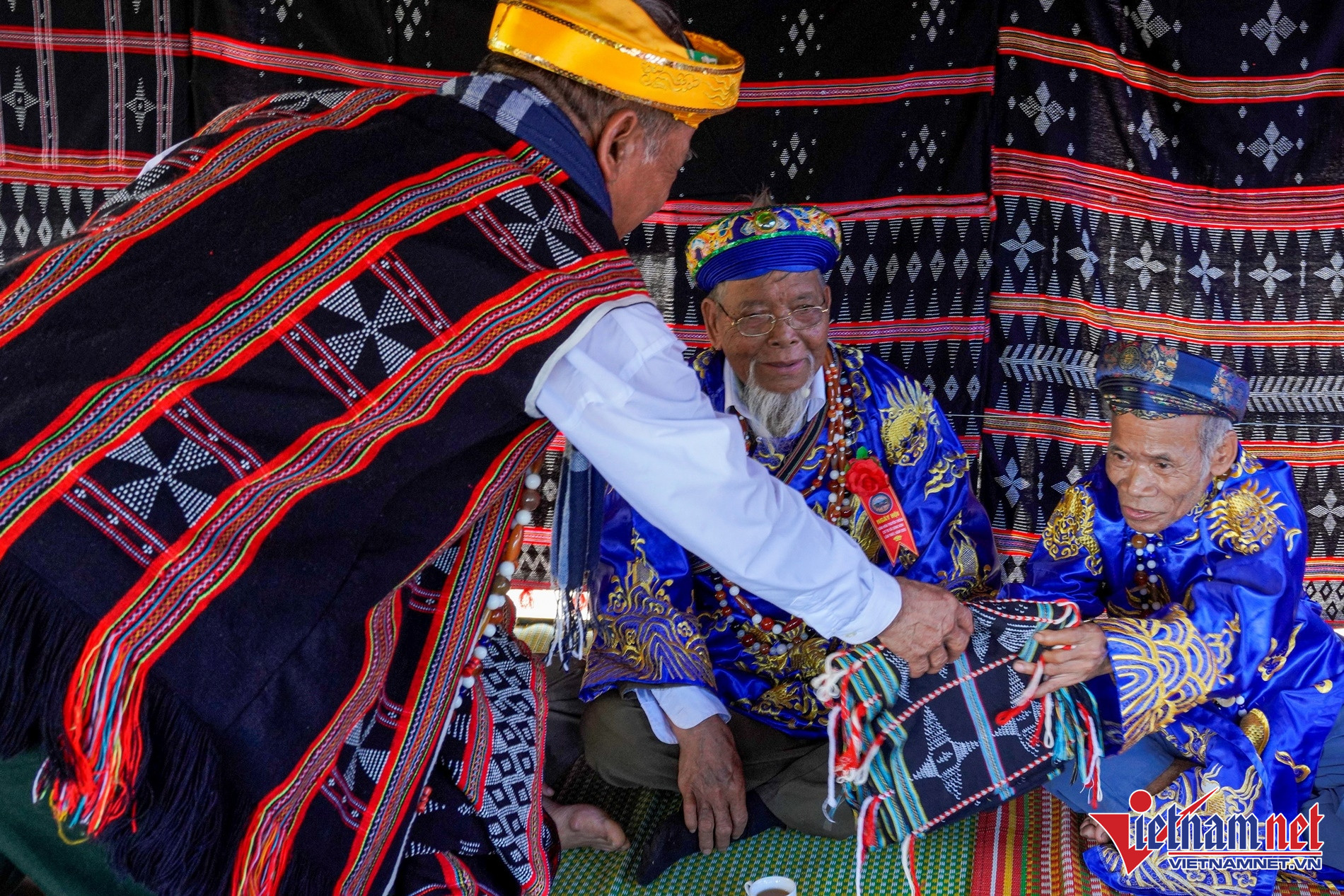
After the warm greetings, the elders sat across from each other around trays of meat covered in banana leaves. The air filled with the hat ly and noi ly - traditional Co Tu folk singing, sometimes poetic like Vietnamese ca dao, other times solemn like a solemn vow to bury old grudges. The message was clear: from now on, the three communes are united like blood brothers.
The back-and-forth singing continued until mutual agreement was reached and all heads nodded in consensus.


The most pivotal moment came when the banana leaves were removed, revealing the shared meat. From this point, the parties officially divided and ate from the same tray - a symbolic act of unity and solidarity.
Following the feast, a ritual was held at the communal Guol house. Buffalo blood was smeared on the neu pole and Bhanooc statue, accompanied by rhythmic gong sounds - a spiritual contract sealed in front of the divine.


Once a sacred tradition to end disputes, the brotherhood oath ceremony of the Co Tu people has now evolved into a symbol of communal solidarity.
"From now on, the three communes are one family, drinking from the same spring and sharing the same forest. We will live together like woven rattan in a basket, like the stream that flows from the trough to the fields," said elder Ploong Jui, a respected figure from A Roch hamlet.

The celebration climaxed as villagers held hands and danced around the neu pole. The Tâng tung da dá dance resounded joyously, rice wine was passed around, and drums and gongs beat in harmony. The traditional dance not only honored the spirits and prayed for a bountiful harvest but also affirmed the deep solidarity of the community.

According to Do Huu Tung, Chairman of Song Kon Commune People’s Committee, this brotherhood ceremony holds special significance, unifying the three formerly separate communes into a cohesive whole with one voice. The local government will continue to promote this tradition, integrating cultural preservation with socio-economic development, new rural construction, poverty reduction, and maintaining security in highland areas.
Ha Nam
.svg)
