 Vietnamnet.vn

 Podcast



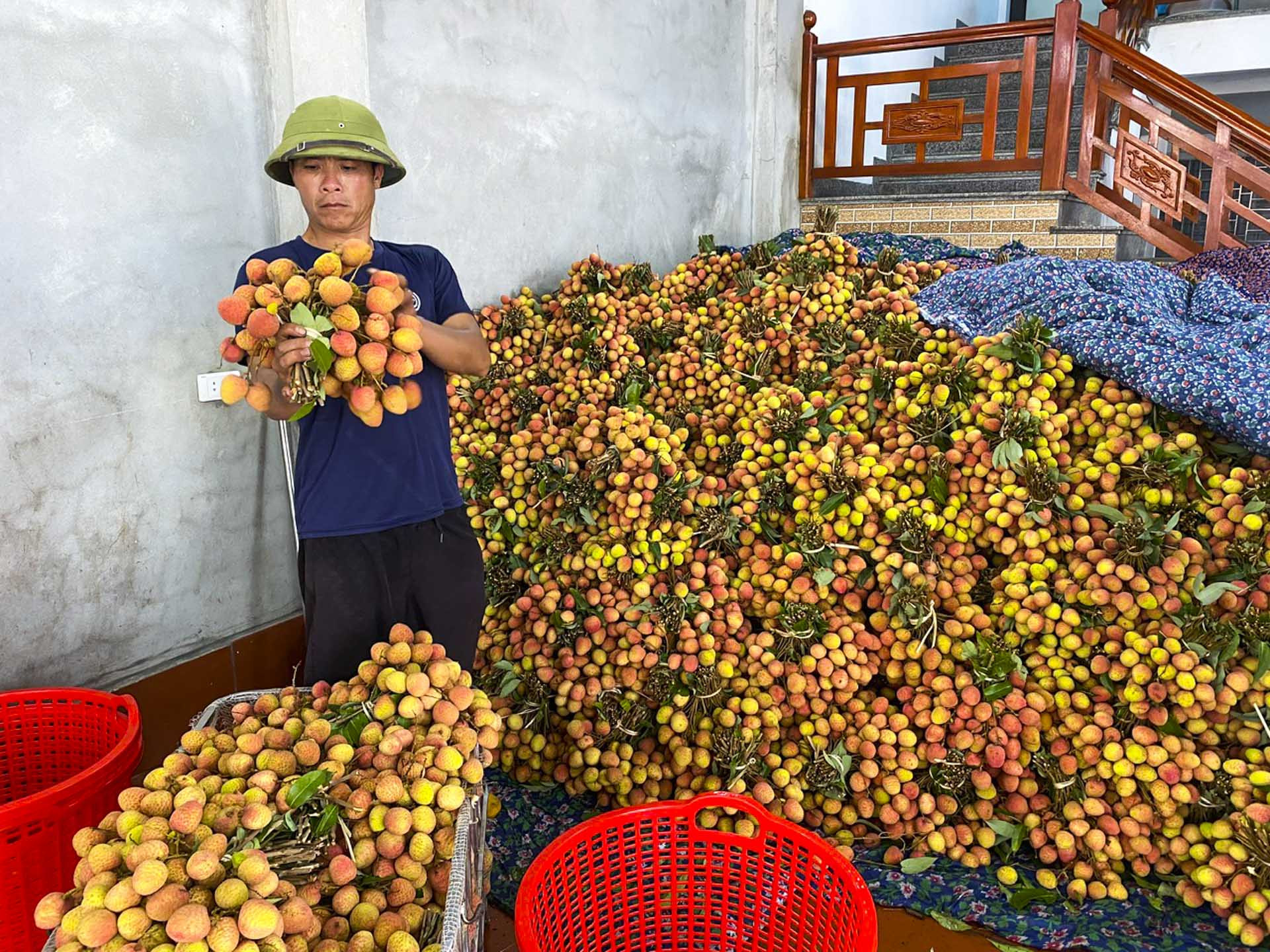
At the start of the harvest season, high-quality lychees are being purchased for more than VND30,000 (USD1.16) per kilogram, while lower-grade fruit affected by pests and poor appearance is selling for as little as VND10,000 (USD0.39) per kilogram.
“It now takes days to collect enough for one truck”
Phuc Hoa Commune in Bac Ninh Province is one of northern Vietnam’s key early-lychee growing areas, covering around 845 hectares.
In 2026, total output is estimated at roughly 7,500 tonnes, down 50-55% from last year due to unfavorable weather conditions during the flowering stage, which significantly reduced blossom and fruit-setting rates.
Beyond the poor harvest, pest infestations - especially stem borers - have also spread widely, directly affecting fruit quality.
As a result, the market has entered the season with an unusual situation in which prices depend less on overall supply and more on product quality and appearance.
According to observations at purchasing stations in Phuc Hoa on May 14-15, visually attractive and export-grade lychees suitable for the Chinese market were consistently bought at high prices.
Meanwhile, smaller fruit with uneven coloring or pest damage was heavily discounted.
Nguyen Van Lap, a trader from Lao Cai Province, said lychee prices this year ranged from VND10,000 to VND33,000 (USD0.39-1.27) per kilogram, but high-quality supply remained extremely limited.
According to Lap, export-grade fruit accounts for only around 30% of this year’s total output, far lower than previous seasons.
“In earlier years, we could collect enough for two or three truckloads per day. This year, it takes several days just to gather one truck,” he said.
Dang Thi Thanh, a trader supplying wholesale markets in Thai Nguyen, said demand this season has been relatively weak despite prices being significantly higher than last year.
“There are too many fruits damaged by pests. Customers at the market often pick them up, look at them and then walk away, so traders have to think carefully before buying,” Thanh said.
As a result, many growers in Phuc Hoa are hesitating to sell early, hoping prices will improve further as supply tightens in the coming weeks.
Higher prices fail to offset falling yields
Although lychee prices this year are not low, many farmers are still seeing significantly lower income because of steep declines in production.
Nguyen Thi Tho’s family in Luc Lieu Hamlet began harvesting about a week ago.
According to Tho, premium lychees sold for around VND35,000 (USD1.35) per kilogram at the start of the season but have since eased to VND29,000-30,000 (USD1.12-1.16).
Her family owns nearly 200 lychee trees but expects to harvest only about four tonnes this year, down by more than half from the previous season.
“The fruit still looks quite good overall, but with such a poor harvest, total income will not be high,” she said.
The situation in Phuc Hoa highlights a broader reality this season: although prices are higher than last year, many growers are still facing the painful combination of “high prices but poor harvests,” leaving profits well below expectations.
Not every orchard, however, has struggled.
Ngo Van Cuong from Quat Du 2 Hamlet said his family’s 1.2-hectare orchard is expected to maintain around 80% of last year’s production and will begin harvesting on May 23.
Notably, all of his output has already been contracted by businesses for export to Japan and South Korea at VND40,000 (USD1.54) per kilogram.
To secure such prices, however, growers must comply with strict production and food-safety standards.
In response to the widening quality gap, local authorities in Phuc Hoa have implemented various measures to support farmers.
The commune currently maintains 25 export planting area codes while expanding production under VietGAP and GlobalGAP standards.
Local police have also been tasked with traffic management plans around purchasing stations to ensure smooth transportation during the harvest season.
Bac Ninh accelerates lychee promotion efforts
To support sales this year, Bac Ninh Province is ramping up trade promotion activities on a large scale.
The highlight will be a lychee and agricultural products promotion conference scheduled for May 28, expected to attract around 500 participants, including logistics companies, distribution systems, e-commerce platforms and international partners, particularly from China.
Beyond traditional distribution channels, Bac Ninh is also accelerating digital transformation in agricultural sales.
Livestream sessions promoting lychees and OCOP products will be organized to connect directly with consumers online.
According to the plan, a livestream event will take place in Nam Duong Commune on May 20 to introduce growing areas, cultivation processes, harvesting and digital sales channels.
In addition, the “Welcome Early Lychee Season” event scheduled for May 23 in Phuc Hoa - featuring activities such as running through lychee orchards, fruit-picking experiences and showcasing “beautiful orchards” - is expected to stimulate consumption and attract tourists.
In 2026, Bac Ninh officially recognized 143 “beautiful lychee orchards” across 15 communes and wards to strengthen the local lychee brand while linking agriculture with tourism and trade promotion.
According to official statistics, Bac Ninh currently has nearly 29,800 hectares of lychee orchards, with estimated production exceeding 95,000 tonnes.
Of that total, early-season lychees account for around 8,200 hectares and more than 40,000 tonnes.
The province now has 243 planting area codes and 42 packaging facilities eligible for exports to markets including China, Japan, the United States and Australia.
As quality differences become increasingly pronounced, the key challenge this season is no longer simply whether prices are high or low - but whether growers can produce fruit that meets export standards and truly benefits from the market.
Bao Khanh
.svg)
