 Vietnamnet.vn

 Podcast



In the early morning, 81-year-old Nguyen Huu Tam from My Yen commune, Tay Ninh province (formerly Long Hiep commune, Ben Luc district, Long An province) carefully made his way through the family graveyard to pay tribute at the restored Long Hiep House - a historic residence once belonging to his ancestors.
This house played a pivotal role in Vietnamese revolutionary history, serving as the secret location for the first provincial Party committee meeting of Cho Lon in November 1930. It originally belonged to Tam’s great-grandfather Nguyen Van Trieu, known locally as Cai Tong Cheo, and was later inherited by his grandfather Nguyen Tan Tao, also known as Xa Tao.
Due to years of neglect and war damage, the house had fallen into ruin. In 2021, the former Ben Luc district government funded its restoration, aiming to replicate the original architectural style and interior.
Now covering 238 square meters, the restored home features three main chambers and two wings, with a stone foundation and decorative European-style arches and concrete columns. The interiors boast intricately carved wood panels with lotus flowers, birds, and symbolic motifs, alongside a scroll above the central altar inscribed with the phrase "Duc Luu Phuong", meaning “A virtuous family’s fragrance endures.”
The house was designated a provincial historical monument in 1994 by Long An authorities.
Tam recalls his childhood in the grand house, which originally faced the river and was constructed with high-quality wood such as rosewood, redwood, and blackwood. It had a traditional tiled roof, French-inspired facade, and hexagonal tiled floors. The structure followed central Vietnamese timber-framed design, with four rows of columns dividing the space into three sections.
The central chamber, once used for high-level revolutionary meetings, included a long wooden bench, round table, and altar. Beneath a wooden bench lay a secret escape tunnel, used during clandestine gatherings.
While working on the restoration, Tam and construction workers discovered a hidden underground chamber beneath the green stone floor. Inside were large ceramic jars filled with ancient copper coins. Other coins were found scattered within the soil under the house. Many bore the inscription “Canh Thinh Thong Bao”, minted during Vietnam’s late 18th century Canh Thinh era.
Tam believes his ancestors were wealthy officials during the feudal period, which would explain the hidden treasure. The ancient coins were later collected and studied by the former Long An Provincial Museum, though the family retained a portion as keepsakes.
He reflected, “Had we not restored the house, we would never have discovered the coin stash beneath the foundation. I suspect these coins were hidden long ago by our ancestors. At one time, our family owned nearly 100 hectares of land, making us among the wealthiest in the region. After my father passed away when I was just a year old, my mother raised all of us alone, supported by this land and legacy.”


The house exterior reflects European architectural influences. Photo: Ha Nguyen


Central chamber once used for secret revolutionary meetings. Photo: Ha Nguyen

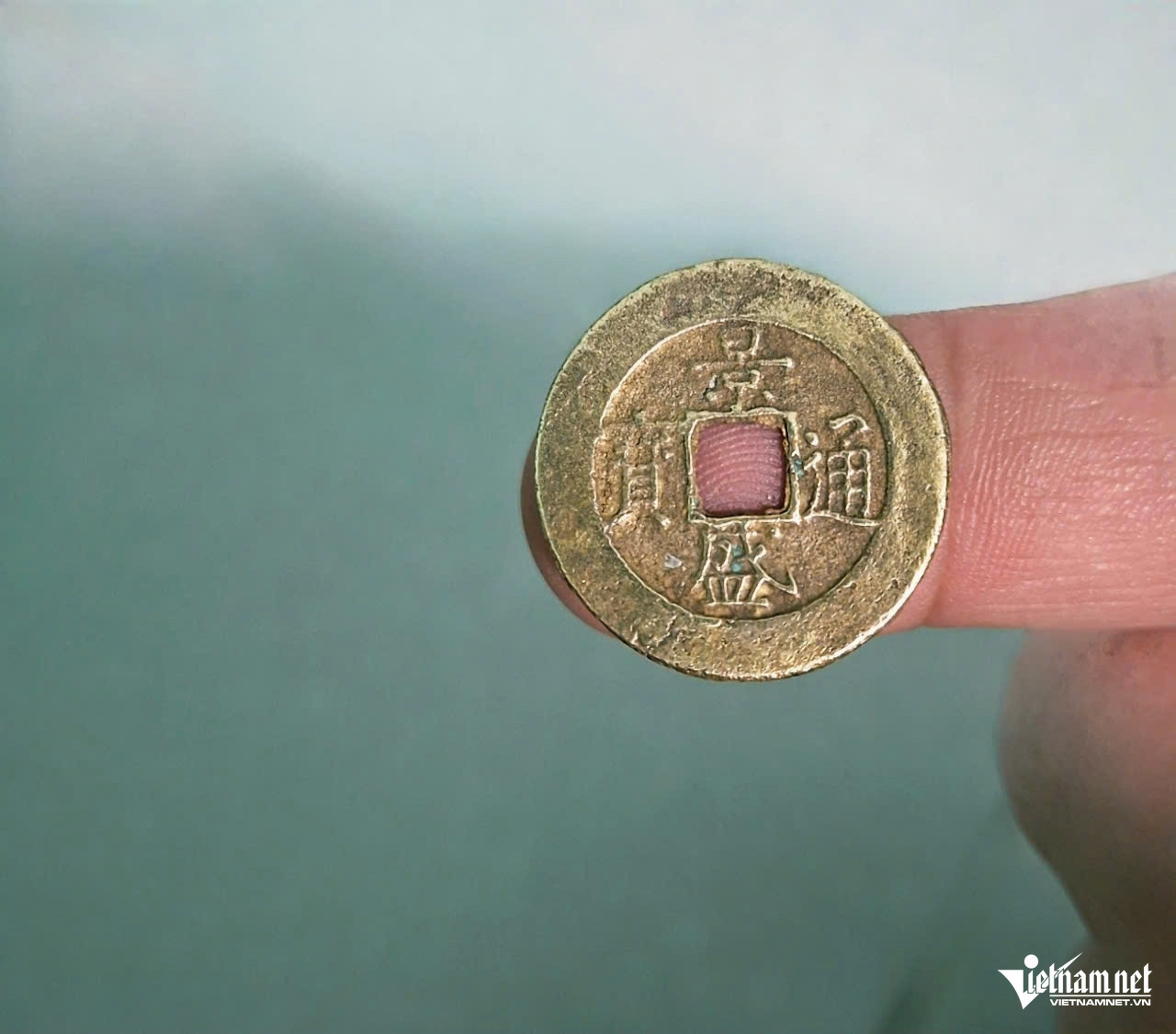
Tam believes the coins were hidden by high-ranking ancestors. Photo: Ha Nguyen

Ha Nguyen
.svg)
