 Vietnamnet.vn

 Podcast



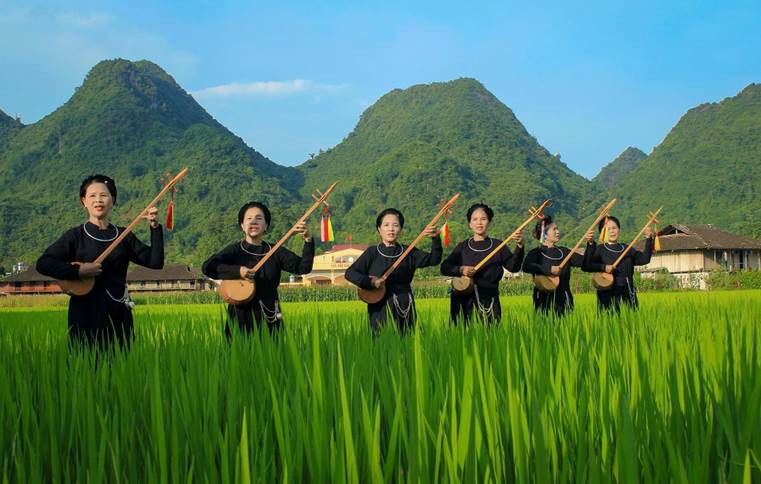
As natural resources become increasingly limited, local identity and indigenous knowledge are turning into sustainable advantages that create livelihoods and support long-term development.
Quynh Son community tourism village in Bac Son Commune, Lang Son, has been recognized by UN Tourism as one of the “Best Tourism Villages 2025.”
Located in the Bac Son Valley at an altitude of more than 600m, Quynh Son is surrounded by towering limestone mountain ranges. Every rice harvest season in July or October, when the valley turns golden, the village becomes a must-visit destination for travelers.
There are more than 400 traditional stilt houses, with many of them hundreds of years old and preserved through three to four generations.
Since 2010, Quynh Son has been transformed into a community tourism village. Residents no longer focus solely on farming as they once did, but have become more conscious of preserving landscapes and protecting the environment while developing services such as homestays and accommodation for tourists.
Tourism is not separated from daily life, but instead follows everyday rhythms such as rice cultivation, cake making, yin-yang roof tile production, Then singing, and Tinh lute performances.
The appeal of this village, located within the UNESCO Global Geopark area of Lang Son, does not come only from awards or recognition. Its attraction lies in its unique characteristics and in the experiences visitors gain from traditional culture and the pristine, majestic natural scenery.
To date, Vietnam has had five villages recognized as “Best Tourism Villages” in the world, with four of them located in ethnic minority and mountainous areas. According to the Vietnam National Authority of Tourism, the country currently has around 300 villages and hamlets engaged in community tourism, with more than 5,000 homestays.
The rapid increase of community tourism villages shows a clear movement: ethnic villages are no longer standing outside the tourism flow but are actively participating and positioning themselves. From being lesser-known cultural spaces, many places have become branded destinations, gradually making their names on the national and international tourism maps.
Beyond tourism, culture participates in the economy through local specialty products. The OCOP (One Commune One Product) program is a clear testament to this approach.
According to Hoang Thi Vinh, a household owner growing Bat Tien tea in Pieng Lao village, Muong Hum commune, Lao Cai province, households used to grow tea on a small scale, selling only raw materials or self-roasting tea to sell at periodic markets, resulting in low income. Since joining the OCOP program, they have been guided in the techniques to produce “Muong Hum Bat Tien Tea,” linked to consumption channels, leading to a significant increase in product value and much more stable output.
This story is not unique. From Muong Khuong chili sauce and Sa Pa artichokes to cinnamon buds, sticky rice, and ancient tea, many products in Lao Cai and other localities have entered the market, even reaching out internationally.
After 8 years of implementing the OCOP program, the whole country has more than 20,000 products rated 3 stars or higher, including 126 products rated 5 stars. Accompanying these are 10,615 OCOP subjects, of which 32.3 percent are cooperatives, 25.4 percent are small enterprises, 39.5 percent are production establishments/business households, and the rest are collaborative groups.
Notably, these products are not “new inventions” but values that have long existed in daily life. The change lies in the perspective - from self-consumption products to high-value commodities, and from living culture to economic culture.
From reality, a clear trend can be seen: the culture of ethnic minorities is stepping out of static conservation spaces to actively participate in economic life.
Ultimately, the green economy is not just a story of renewable energy or emission reduction, but a development model based on balance between people, the environment, and livelihoods. In that model, culture, which was once placed in a “conservation frame”, is gradually emerging as a real resource.
The most notable aspect of this process is not simply the linking of culture with the economy, but the shift in people’s thinking itself.
Instead of viewing preservation as keeping everything unchanged, many communities have proactively sought ways to “renew” culture in line with modern life: building homestay models, standardizing OCOP products, and telling stories about identity through images, videos, and social media. Many households have learned to use digital platforms to promote and sell products and connect directly with tourists and markets rather than relying entirely on intermediaries.
Sy Hao
.svg)
