 Vietnamnet.vn

 Podcast



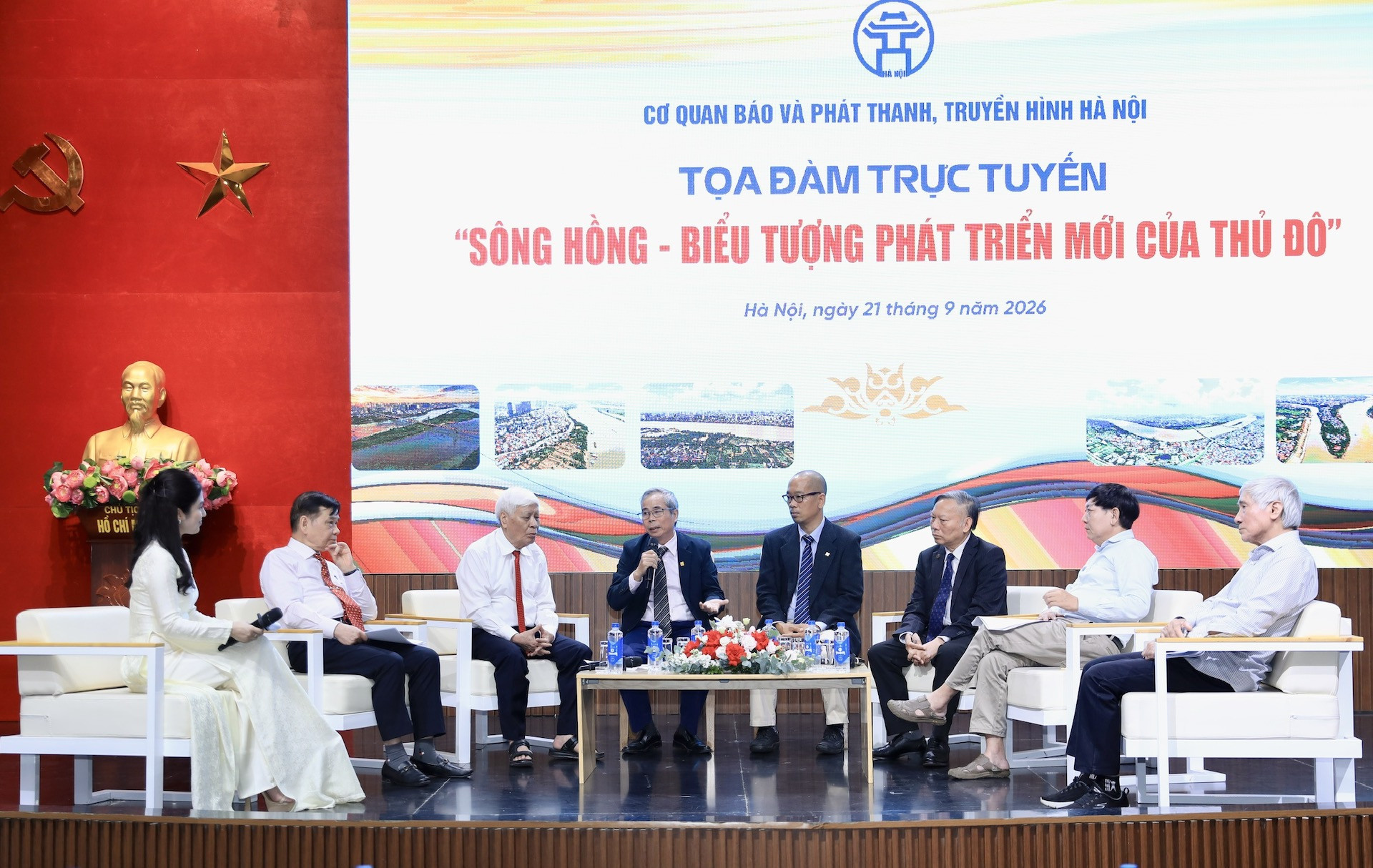
The Hanoi Newspaper and Radio – Television Agency on September 21 organized the seminar "Red River - New Development Symbol of the Capital," with the participation of seven experts, scientists, and architects.
A core topic of discussion focused on reorganizing the spatial layout of both Red River banks as Hanoi transitions from a "turning its back to the river" to "facing the river" mindset.
Nguyen Minh Duc, Deputy Director of the agency, said that throughout the formation and development history of Thang Long - Hanoi, the Red River has built up numerous land areas, villages, wharves, and commercial spaces. The river also preserves special cultural sediment layers of the capital.
Duc said Hanoi’s study of an overall adjustment to the 1/5,000-scale Red River urban zoning plan is not simply a revision of a planning scheme. It also reflects a change in how the river’s position within Hanoi’s development structure is perceived.
Under this approach, the Red River will no longer be viewed primarily as a natural boundary but as a central spatial axis. Areas along both banks will be organized into integrated spaces combining urban development, ecology, culture, history and community life.
Lessons from natural water storage spaces
People's Teacher Prof. Dr. Nguyen Quang Ngoc, Vice President of the Vietnam Association of Historical Sciences, recalled experiences from the time he directly participated in fighting the historic 1971 flood.
According to Ngoc, in the past, urban areas "turning their backs to the river" was a natural response to adapt to natural disasters. However, under current conditions, Hanoi's orientation toward "facing the river" represents a correct approach.
Previously, West Lake, natural mudflats, and the Da Trach field acted as water reservoirs, helping regulate and reduce flow pressure. Unobstructed tributaries alongside undamaged headwater forest areas enabled the Red River to self-regulate during major floods.
From this experience, Ngoc argued that modern planning must learn ancestral lessons while applying scientific and technological achievements to solve river management problems that were previously unmanageable.
This also imposes a requirement that the urban development process must be calculated cautiously regarding riverbanks, water storage spaces, and natural flow systems. Expanding riverside urban space must go hand in hand with ensuring water regulation capacity and disaster adaptation.
Looking back at history, Ngoc noted that from the capitals of Van Lang and Co Loa to Thang Long, residents centered many activities around the Red River. People adapted to the river while creating cultural values and leaving behind a special heritage system in this region.
"The Red River has always been the center and crystallization of many cultural and historical values of Hanoi. Turning the Red River into a development driver for Hanoi's urban area is correct and well-founded, and I believe we can achieve it," Ngoc said.
Traditional cultural values
Beside ensuring safety against natural disasters, experts argued that it is necessary to avoid eroding cultural values formed over generations.
Dr. Nguyen Viet Chuc, Vice Chair of the Advisory Council on Culture and Social Affairs under the Central Committee of the Vietnam Fatherland Front, contended that any intervention in the Red River must preserve its gentleness and ensure cultural integrity. Harsh interventions could trigger adverse impacts on the river. However, conservation does not mean keeping everything unchanged and refusing development.
"Preserving and developing culture requires us to respect and conserve, but at the same time, we must know how to promote values under new conditions," Chuc said.
With this approach, cultural identity is not merely an element requiring protection, but must become a resource for the new urban space. Historical and cultural values tied to the Red River need to be identified, promoted, and brought into contemporary life, rather than existing solely as vestiges of the past.
According to Chuc, the ultimate benchmark of planning lies not in the scale of construction projects or the appearance of riverside spaces, but in the quality of life of the residents.
The highest objective of cultural development and river planning must be serving the people. The "Red River Miracle" will only be established when it brings prosperity and happiness, allowing residents on both banks to directly benefit from the values created by the development process.
Thanh Hue
.svg)
