 Vietnamnet.vn

 Podcast



A 33-year-old woman visited the hospital for pain in her lower left back and painful urination. Upon examination, doctors discovered a medical device that had been left inside her body for 15 years.
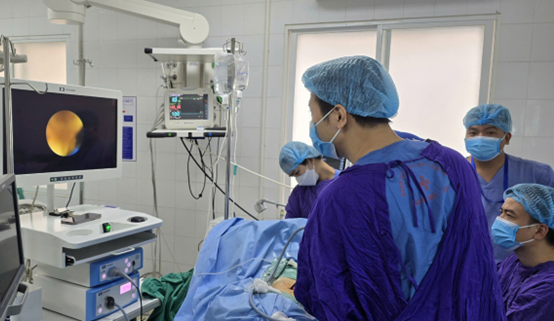
Doctors perform surgery to remove the 15-year-old JJ stent from the female patient. Photo: 19-8 Hospital.
On October 6, the 19-8 Hospital under the Ministry of Public Security reported that its Urology Department had successfully treated a rare and complex case, requiring extreme precision and caution from the surgical team.
The female patient, aged 33, came to the Urology–Andrology Clinic with pain in the left lumbar region and discomfort while urinating. Clinical and imaging assessments revealed left kidney stones and ureteral stones in the lower third of the left ureter. More notably, doctors found a JJ stent - a medical device - still inside her body, placed 15 years earlier and never removed.
In 2010, the patient had undergone surgery to remove ureteral stones and had a JJ stent inserted. However, due to her busy schedule, she forgot her follow-up appointment and neglected to have the stent removed as recommended.
A forgotten stent turns into a complex surgical challenge
Because the JJ stent had remained inside the body for 15 years, large stones had formed in several locations, attaching themselves to the stent and migrating abnormally. This made treatment extremely complicated and carried many risks.
After detailed consultation and thorough preoperative assessment, the surgical team coordinated with multiple departments to perform the procedure. Surgeons used laser ureteroscopy to break down and remove the stones, extracted the 15-year-old JJ stent, inserted a new one, and performed percutaneous nephrolithotomy on the left kidney to clear remaining stones.
The surgery was successful. The patient was free of stones, recovered well, and was discharged just three days later.
Doctors warn about the dangers of forgotten JJ stents
According to doctors at the Urology Department, a JJ stent (Double J stent) is a common urinary drainage tube placed in the ureter after urological surgery. Its purpose is to allow urine to flow from the kidney to the bladder, prevent fluid buildup, reduce swelling, and support ureteral healing after surgical intervention.
In clinical practice, a JJ stent should only remain in place for 2–8 weeks, depending on the patient’s condition. Failure to remove it on schedule can lead to serious complications, such as recurrent urinary tract infections, persistent pain, urinary disorders, stent migration, calcium buildup, and stone formation around the stent.
In severe cases, these complications may cause kidney damage or even complete loss of kidney function. Through this exceptional case, doctors emphasize that patients with JJ stents must strictly follow follow-up appointments and removal schedules. Neglecting them could result in life-threatening complications and long-term health damage.
Anyone experiencing symptoms such as back pain, painful urination, or blood in the urine should seek immediate medical evaluation at a specialized healthcare facility.
Phuong Thuy
.svg)
