 Vietnamnet.vn

 Podcast



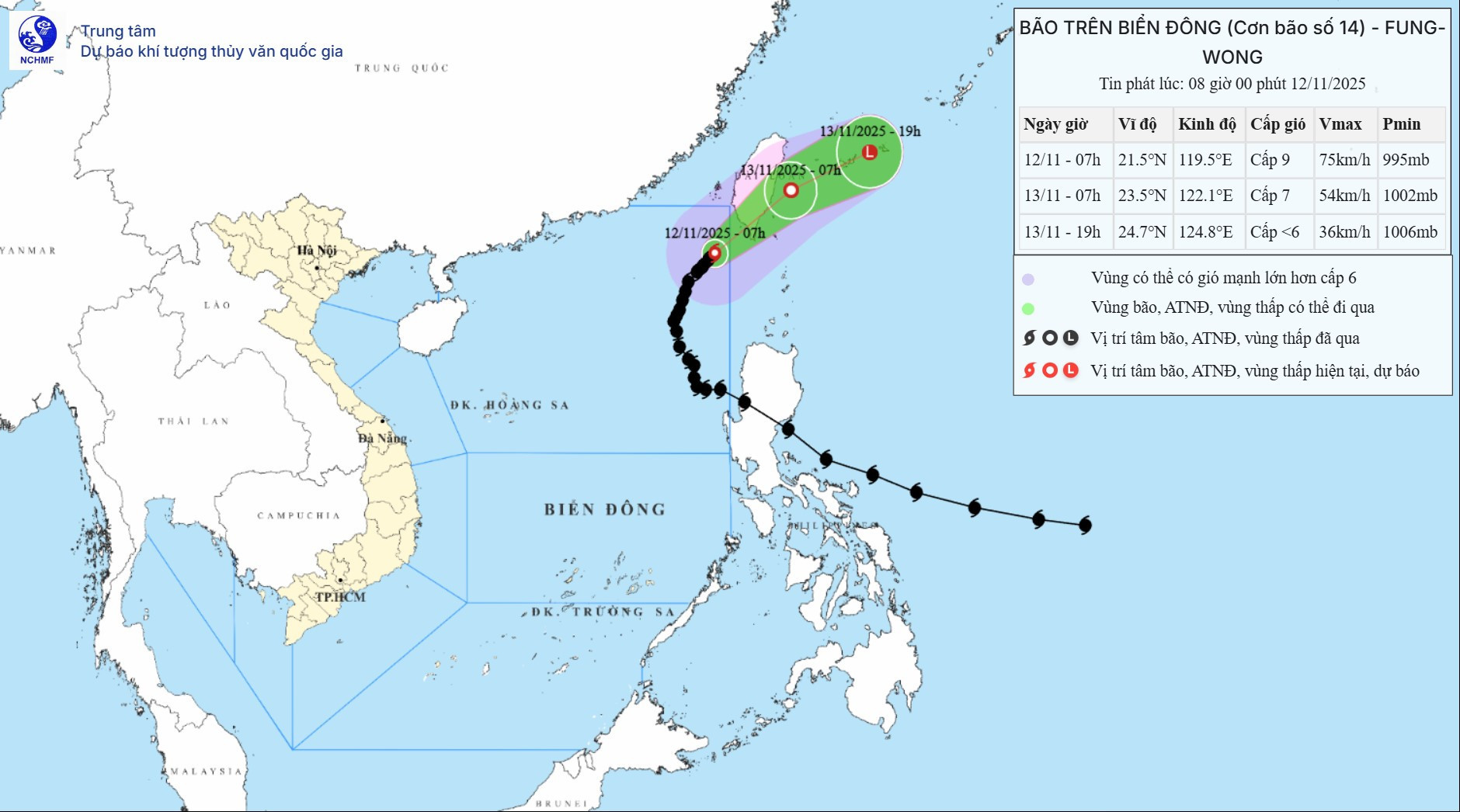
According to the National Center for Hydro-Meteorological Forecasting, as of 7:00 AM on November 12, Typhoon Fung-Wong (Storm No. 14) was located in the northeastern waters of the northern East Sea.
The maximum wind speeds near the storm’s center ranged from 62 to 88 km/h (category 8-9), with gusts reaching level 11. This marked a 2-3 category decrease from the previous day, caused by interaction with cold air.
The storm is forecast to continue moving northeast throughout today and tonight, gradually accelerating at 10-15 km/h as it exits the East Sea and weakens into a tropical depression.
By 7:00 AM tomorrow, November 13, the tropical depression will be located in the eastern waters of Taiwan (China), with winds of category 7 and gusts of category 9.
In the next 12 hours, it is expected to maintain its trajectory, increasing speed to 25-30 km/h. By 7:00 PM on the same day, it will have weakened into a low-pressure area over the northeastern waters off Taiwan.
As such, Typhoon Fung-Wong is unlikely to have any direct impact on Vietnam’s mainland.
However, due to its influence, strong winds of category 6-7 are still expected today in the northeastern waters of the northern East Sea. Near the storm center, winds will reach category 8-9 with gusts up to level 11. Waves in the area are expected to reach 3-5 meters, and 5-7 meters near the storm center.
All vessels operating in these hazardous zones are at risk of being affected by thunderstorms, squalls, strong winds, and high waves.
Since the beginning of 2025, the East Sea has seen 19 tropical cyclones (14 typhoons and 5 tropical depressions), making it the second most active year in the past 30 years, following 2017, which recorded 20 cyclones (16 typhoons and 4 tropical depressions).
Most recently, on November 6, Typhoon Kalmaegi made landfall between Quang Ngai and Gia Lai provinces with wind speeds of category 12-13 and gusts up to level 15. It resulted in six deaths, 26 injuries, and an estimated economic loss of around 318 million USD.
Prior to that, typhoons such as Wutip, Wipha, Kajiki, Nongfa, Ragasa, Bualoi, Matmo, and Fengshen caused major flooding in northern and central Vietnam.
Meteorological agencies forecast that in the coming month, 1-2 additional typhoons or tropical depressions may form in the East Sea, with potential impact on Vietnam's mainland.
Bao Anh
.svg)
